
11 July 2004
Who am I? Personality Test.
LvSA A Personality Test
And here's what the test says of me:
Wackiness: 32/100
Rationality: 74/100
Constructiveness: 44/100
Leadership: 44/100
You are an SRDF--Sober Rational Destructive Follower. This makes you a font of knowledge. You are cool, analytical, intelligent and completely unfunny. Sometimes you slice through conversation with a cutting observation that causes silence and sidelong glances. You make a strong and lasting impression on everyone you meet, the quality of which depends more on their personality than yours.
You may feel persecuted, as you can become a target for fun. Still, you are focused enough on your work and secure enough in your abilities not to worry overly.
You are productive and invaluable to those you work for. You are loyal, steadfast, and conscientious. Your grooming is impeccable. You are in good shape.
You are kind of a tool, but you get things done. You are probably a week away from snapping.
Hmmm . . . Close enough, I guess.
10 July 2004
Around the Web
Trumpeting the rise of Justice Stevens. Personally, my "block of three" - whom I think of as the three to listen to when it comes to criminal matters - are Scalia, Stevens, and Thomas. The worst of the lot are usually O'Connor, Rhenquist, and Kennedy. SS&T usually have a reliance upon reasoned application of the law, an eye toward simpler, easier to follow bright-line tests and have the ability to tell either side it is wrong. The ORK? Not so much. In particular, the ORK really has neither the inclination nor the stomach to tell law-enforcement that it is wrong. Whenever I see SS&T on one side and the ORK on the other I feel it in my bones that SS&T's side is right (see Apprendi, Blakely, etc.. Actually, sometimes I prefer it when a member or two of SS&T are in the minority because they write the most interesting dissents (this is particularly true when Stevens and Scalia are sniping at each other).
The judge in the Peterson trial let the prosecutors use pictures of a pregnant woman in Peterson's toolbox and boat to demonstrate their speculation as to how he transported his dead wife. I would be bouncing off the walls. The emotional prejudice which that is meant to cause can in no way be overbalanced by the evidentiary weight of the demonstration of a guess. Apparently, the prosecution has shifted from trying to build its case on a foundation of Peterson's contradictory statements and actions to using highly prejudicial, emotional materials to try and overwhelm the jury; I'm not sure why.
Aw c'mon, let the poor Senator have his cut. After all, the guy higher up the food chain always gets his cut. Don't you watch Mafia movies?
$2 million in bad checks and stolen cars (and still uncaught). This guy's good.
You know, I don't really want to go to jail but if I get a free concert out of it . . .
A Taste of Things to Come? Prove 1,300 Unindicted Overt Acts.
In United States v. Janati the 4th Circuit finds that when a conspiracy is alleged the government must be allowed to show evidence of all the alleged overt acts, even if there are 1,300 and they were not specifically alleged in the indictment.
It's not Blakely specific but it could be a shadow of things to come.
There are obvious differences, of course. The government isn't asking for a jury finding on all 1,300 overt acts, just the 61 it actually charges and the conspiracy. The Court also makes a great deal of the fact that this evidential piling on is necessary because the prosecution is trying to prove implied intent (because, I guess they think most thieves run around broadcasting their intent to the world).
Still, it doesn't seem all that difficult to take that next step and order judges to allow all sorts of "overt act" evidence in to be approved by the jury.
Virginia and Blakely
An e-mail from JH asks:
2) Why? I think because in most cases this works well. Judges are able to fashion just sentences when factors other than those considered under the guidelines should be considered. In some cases it fails when the judge goes back in and decides that a factor already considered by the guidelines should lead to a departure. I see more downward departures and they tend to be smaller departures of 12 months or less (usually less). Upward departures though more seldom seen are usually more massive; once a judge decides to depart upward he is usually thinking logarithmically. Still, all-in-all the guidelines work because they are followed 80% of the time.
How? You must remember that judges in Virginia are creatures of the Legislature. Effectively, this means they are probably among the least protected judges in the nation. Federal judges sit for life and many State judges are elected so that once they are seated they really don't face the wrath of the Legislature or the Executive. In Virginia all judges go back in front of the Legislature every so often to get voted back in at the whim of the legislators. Therefore, a judge in Virginia who flaunted the guidelines would have to face a Legislature not happy with the open defiance.
[comment] The obvious flaw in this system is that a law-and-order Legislature will not likely punish massive upward departures but might punish downward departures by removing a judge. In the last legislative term this appears to have happened to a judge who ran afoul MADD et al. by trying not to destroy people's lives with the increasingly draconian DUI laws. Of course, it didn't help that it was the same year that a legislator lining himself up to run for higher office was pushing even more draconian DUI statutes. Judges notice these things.
1.) Virginia Circuit Court Judges use the Sentencing Guidelines as a tool to assist the Judge in fixing an appropriate punishment and are not bound by them, I am assuming that Blakely decision does not apply in Virginia?1) You are correct: Blakely will not apply to Virginia's guidelines. In making the guidelines discretionary our Legislature did not set a mandatory maximum penalty per the guidelines and as long as the judge does not exceed the actual maximum punishment set out by the statute the length of the sentence is unreviewable.
2.) The "Sentence Reform Act" was inacted to prevent disaparity in sentencing. Why does and how can Virginia Courts only use the Sentence Guidelines voluntarily and not mandatory?
2) Why? I think because in most cases this works well. Judges are able to fashion just sentences when factors other than those considered under the guidelines should be considered. In some cases it fails when the judge goes back in and decides that a factor already considered by the guidelines should lead to a departure. I see more downward departures and they tend to be smaller departures of 12 months or less (usually less). Upward departures though more seldom seen are usually more massive; once a judge decides to depart upward he is usually thinking logarithmically. Still, all-in-all the guidelines work because they are followed 80% of the time.
How? You must remember that judges in Virginia are creatures of the Legislature. Effectively, this means they are probably among the least protected judges in the nation. Federal judges sit for life and many State judges are elected so that once they are seated they really don't face the wrath of the Legislature or the Executive. In Virginia all judges go back in front of the Legislature every so often to get voted back in at the whim of the legislators. Therefore, a judge in Virginia who flaunted the guidelines would have to face a Legislature not happy with the open defiance.
[comment] The obvious flaw in this system is that a law-and-order Legislature will not likely punish massive upward departures but might punish downward departures by removing a judge. In the last legislative term this appears to have happened to a judge who ran afoul MADD et al. by trying not to destroy people's lives with the increasingly draconian DUI laws. Of course, it didn't help that it was the same year that a legislator lining himself up to run for higher office was pushing even more draconian DUI statutes. Judges notice these things.
09 July 2004
All Deliberate Speed
One of my favorite blawgs is back up: All Deliberate Speed.
And no, I'm pretty sure Blonde Justice doesn't look like Tripp - after all, she does have a picture up on the blawg.
FOIA and "Meetings"
Guess what? Our Legislature is capable of making more than one error per session. Not only did they screw up the blue laws they also screwed up in the FOIA area.
The author sends me this new, improved article.
08 July 2004
New DOJ Memo
SL&P has the new version of the DOJ memo concerning Blakely.
I'm telling you folks, that blog must have a direct link to Ashcroft himself.
The Perfect Sexual Assault Defense
All you have to do is tell the judge you only did it when you were in a bad mood.
07 July 2004
Guidelines out in Texas
Blakely Blog is reporting that in the Western District of Texas the chief judge has declared the guidelines unconstitutional.
The intriguing statement reported is that "[h]is holding was that to uphold the Guidelines as would be allowable under Blakely would 'allow the Government to select the charges and the punishment for the offense in question,' violating the Separation of Powers provision of the US Constitution."
I'm not sure how that's any different from pre-Blakely. The prosecutor was able to decide what to charge and through that the potential penalties. I'd like to see the judge's reasoning. As BB said: "We eagerly await an opinion."
[addendum] SL&P has reported (via a comment) that the Northern District of Oklahoma has declared the guidelines unconstitutional.
Around the Web
The DOJ is refusing to give information out because to do so would break its computers.
Go and download and watch "Why I Quit Being a Court Reporter." This is hilarious. Lv head case.
If your first attempt to rob a bank fails you probably shouldn't go right back.
Gluing your electronic anklet to the cat probably isn't going to fool the authorities for too long. Lv Fark. And no, I don't go to Fark just so I can go on to look at the SbB girls. At least you can't prove that I do.
DOJ Blakely Memo
Nihil quod est contra rationem est licitum.
The DOJ memo was noted here at Sentencing Law and Policy and C&F is unimpressed. SCOTUS blog offers this comment. Here's my take:
The memo starts out in Section I by admitting that the Supreme Court has pegged the government to a position in footnote 9 of Blakely which stated it believed there was little or no difference between the federal sentencing requirements and Washington's guidelines. It goes on to point out that the Supreme Court stated it expressed no opinion on the guidelines.
Having gotten that out of the way the memo moves on to Section II. In this section the government walks away from its Blakely position and orders AUSA's to argue that the federal guidelines are constitutional and that District Court judges don't have the right to interpret the constitutionality of the guidelines:
Section III: Here the government lays out its position "if" Blakely applies to the federal guidelines
This strikes me as a poorly thought out position based solely on what favors the prosecution rather than a constitutional principle. The difference between this and the Utah Decision is that the judge in Utah decided to go with indeterminate sentencing across the board and use the guidelines as guidance. I believe this will be the minority position but at least it is consistent as opposed to the back and forth which this memo calls for.
Section IV: Tactics
(1 & 2) Make indictments contain as many sentencing factors as possible.
[comment] No big shock here. It's an obvious step. The question that arises is whether Defendants will be able to get sentencing factors which are not factors needed to prove the alleged offense struck as surplusage.
(3 & 4) Explain to the judge why you are cramming all that stuff into the indictment and try to get the judge to take a position on Blakely pretrial.
Try to get Defendants to waive any rights they may have pursuant to Blakely.
[comment] I don't think the Defendant can waive the burden of proof since it's not really a right but a burden on the prosecutor. It strikes me that the Defense cannot relieve the prosecutor of a burden he cannot place on that prosecutor. This is different from requiring a trial or discovery under Brady because both of those require the defense to take a step to put the burden on the prosecution (pleading not guilty or making a discovery request). The burden of proof is pre- existent, requiring no action on the part of the Defendant. Surely a Defendant can stipulate that the evidence fulfills that burden but I don't think he can make it go away.
(5) Urge the courts to continue having presentence reports done by the probation officers.
(6) Try to get the judges to issue multiple, contingent sentences.
[comment] Are trial courts authorized to do such a thing? It would seem to me that in so doing courts would not be ruling on the case at hand and the law as the court understands it. The court would be ruling on hypotheticals. If the law doesn't mean what I say it means then . . .
It's not really much of an issue and as a practical matter courts who did this could potentially save a lot of time and trouble. Still, I have this nightmare image of paperwork getting screwed up and some guy serving 5 years rather than the 2 he should have because someone in the prison system put the contingent number in the computer rather than the real sentence.
(7) Keep track of the actual sentences and the potential sentences under the guidelines.
[comment] Because how else are we going to gather statistics to fight this in courts or use in Congress?
Lies, damn lies, and . . .
The DOJ memo was noted here at Sentencing Law and Policy and C&F is unimpressed. SCOTUS blog offers this comment. Here's my take:
The memo starts out in Section I by admitting that the Supreme Court has pegged the government to a position in footnote 9 of Blakely which stated it believed there was little or no difference between the federal sentencing requirements and Washington's guidelines. It goes on to point out that the Supreme Court stated it expressed no opinion on the guidelines.
Having gotten that out of the way the memo moves on to Section II. In this section the government walks away from its Blakely position and orders AUSA's to argue that the federal guidelines are constitutional and that District Court judges don't have the right to interpret the constitutionality of the guidelines:
The government's legal argument, which will be developed more fully in a model brief that the Criminal Division will distribute, is that the lower federal courts are not free to invalidate the Guidelines given the prior Supreme Court decisions upholding their constitutionality, and that, on the merits, the Guidelines are distinguishable from the system invalidated in Blakely.[comment] I don't think that the bigwigs at DOJ actually expect to win this argument. They seem to want to preserve the appeal just in case there is an appellate court out there which cannot read or distinguishes the Washington guidelines because they were passed into law on a different date than the federal guidelines.
Section III: Here the government lays out its position "if" Blakely applies to the federal guidelines
First, the Guidelines remain constitutional and applicable if the Guidelines sentence can be calculated without the resolution of factual issues beyond the admitted facts or the jury verdict on the elements of the offense of conviction. Thus, in cases where a court, applying the Guidelines as they were intended, finds that there are no applicable upward adjustments under the Guidelines beyond the admitted facts or the jury verdict on the elements of the offense, the Guidelines are constitutional and should be applied.[comment] Can you say schizophrenia? If they're unconstitutional we will push for them to be applied when the situation favors us but when it doesn't we will push for them to be totally disregarded so that we can push for them to be applied. I feel sorry for the AUSA's who have now been ordered to stand in front of the same judge and argue inconsistent positions. On Monday the judge will hear himself told that he should follow the guidelines and on Tuesday he will be told that he should use indeterminate sentencing. That doesn't really build your credibility with the courts.
Second, in a case in which the defendant agrees to waive his right to resolution of contested factual issues under the Blakely procedural requirements, the Guidelines should be applied. Thus, waivers of "Blakely rights" in connection with plea agreements and guilty pleas may be sought.
Third, in a case in which there are applicable upward adjustments under the Guidelines, and the defendant desires to contest the underlying facts under the Blakely procedures, the Guidelines system as a whole cannot be constitutionally applied. In that event, the government should urge the court to impose sentence, exercising traditional judicial discretion, within the applicable statutory sentencing range. The government's sentencing recommendation in all such cases should be that the court exercise its discretion to impose a sentence that conforms to a sentence under the Guidelines (including justifiable upward departures), as determined without regard to Blakely.
This strikes me as a poorly thought out position based solely on what favors the prosecution rather than a constitutional principle. The difference between this and the Utah Decision is that the judge in Utah decided to go with indeterminate sentencing across the board and use the guidelines as guidance. I believe this will be the minority position but at least it is consistent as opposed to the back and forth which this memo calls for.
Section IV: Tactics
(1 & 2) Make indictments contain as many sentencing factors as possible.
[comment] No big shock here. It's an obvious step. The question that arises is whether Defendants will be able to get sentencing factors which are not factors needed to prove the alleged offense struck as surplusage.
(3 & 4) Explain to the judge why you are cramming all that stuff into the indictment and try to get the judge to take a position on Blakely pretrial.
Try to get Defendants to waive any rights they may have pursuant to Blakely.
[comment] I don't think the Defendant can waive the burden of proof since it's not really a right but a burden on the prosecutor. It strikes me that the Defense cannot relieve the prosecutor of a burden he cannot place on that prosecutor. This is different from requiring a trial or discovery under Brady because both of those require the defense to take a step to put the burden on the prosecution (pleading not guilty or making a discovery request). The burden of proof is pre- existent, requiring no action on the part of the Defendant. Surely a Defendant can stipulate that the evidence fulfills that burden but I don't think he can make it go away.
(5) Urge the courts to continue having presentence reports done by the probation officers.
(6) Try to get the judges to issue multiple, contingent sentences.
[comment] Are trial courts authorized to do such a thing? It would seem to me that in so doing courts would not be ruling on the case at hand and the law as the court understands it. The court would be ruling on hypotheticals. If the law doesn't mean what I say it means then . . .
It's not really much of an issue and as a practical matter courts who did this could potentially save a lot of time and trouble. Still, I have this nightmare image of paperwork getting screwed up and some guy serving 5 years rather than the 2 he should have because someone in the prison system put the contingent number in the computer rather than the real sentence.
(7) Keep track of the actual sentences and the potential sentences under the guidelines.
[comment] Because how else are we going to gather statistics to fight this in courts or use in Congress?
Lies, damn lies, and . . .
06 July 2004
A Week in the Life of a Criminal Defense Attorney
Monday: In the morning I go to court for a guy charged with driving with a suspended license and falsely identifying himself to the officer. When pulled over he gave his father's name and date of birth in an attempt to avoid getting the driving suspended charge. As the officer told me, "He was about 25 years too young." Client stuck with the story until the officer found his real name through fingerprinting. Anyway, my client has been stuck in jail for a little over two months waiting for trial (the equivalent of four months because for misdemeanors convicts serve 50%). With an abundance of caution, I work out a deal with the prosecutor which will sentence my client to one month on each charge. When we go up to present the deal, the judge takes one look at Client's driving record (several prior driving suspended convictions) and refuses the plea agreement because it is too low. After a couple seconds of confusion both I and the prosecutor submit the case to the judge. He sentences Client to one month on the false identification and three months on the driving suspended. Client has already served time sufficient for that so everything ended well.
Tuesday: In the morning I have two cases at the local general district courthouse. The first is strictly damage control. Client has been caught, on two separate occasions, driving with a suspended license. The first time he didn't come to court so they issued a warrant for failing to appear. The second time he was also charged with driving reckless (20 mph over posted limit is reckless). The best I've been able to do is get all of this guy's charges moved to the same day so it will be one hit and hopefully a little less time. In the end Client gets 30 days on one driving suspended, 60 days on another driving suspended, and fines for the other charges. He also gets work release and delayed reporting so he can get that set up.
Finishing that, I turn my attention to the other matter. Client is charged with driving on a suspended license but has paperwork showing he had a restricted license at the time. So I go to talk with the trooper involved. He is sitting right next to the door which the judge will come out of and a deputy has just announced that the judge will be right out. I ask the trooper to come out in the hall to discuss the case and he looks at me kinda weird. Then I say, "I really don't want to be standing in front of the door when the judge comes out but if you don't want to come out we can wait until after the judge is on the bench." Trooper (looking at me like I'm stoned): "We'll wait."1 Okay, fine. I stand around for 5 minutes - no judge, 10 minutes - no judge. Finally, I go over to the Trooper and start talking to him about the case. You guessed it - the judge walks in; he even pats me on the shoulder and says "good morning" as he walks past. Uurrgggg. So I talk to the trooper a little more but there's not much helpful there; I think he must have been coming off shift because he seemed half asleep (they make these poor guys work all night and then spend half the next day in court). Finally, I ask for my client's record which is not much help because it shows multiple court dates and dispositions which are ambiguous. The next step is a trip to the clerk's office where a helpful clerk helps me get copies of my client's prior convictions. Of course these have cryptic notes on them as well. When I finally sort through everything it seems a 50/50 proposition as to whether my client had the right to drive. I take it to the prosecutor and try to explain it as best I can and eventually the prosecutor interjects: "You're confused. I'm confused. I'm not going to confuse the judge. I'll just drop that charge." And that's what happened. Of course, Client still had to pay fines on a bad registration and not having three kids in their seatbelts but he was happy with that.
1 Strangely, later when the hot Latina lawyer walked up and asked him if he'd go outside to talk with her he got immediately up and followed her right out.
Then I scoot over to Juvenile Domestic Relations court. A client is supposed to return with proof he did his community service so that his fighting charge will go away. I'm running late but when I get to the lobby I see that the court's state of the art video docket (picture the big monitors you see in airports) shows the case as not being called. I hurry over to the courtroom and see the prosecutor outside the door. He informs me that they called the case, my client wasn't there, and they dismissed it because the record indicated that the community service had been done. As I leave I look up at the docket again and realize that it isn't showing any cases as having been called (this is at 11:15 - 2 1/2 hours after court started). Will the wonders of technology never cease?
In the afternoon I have clients with more serious charges. The first is a B&E and assault. This is the second time this case has been called and the witness had not come to court the first time. This time she doesn't show either so the prosecutor moves to drop the charges and informs the judge she will issue a show cause on the witness. The second case is a malicious wounding case. My client got in a fight with some kids he worked with at Wal-Mart, walked home, got a knife, came back, and struck one of the kids in the back with the knife. It's a bad fact pattern. We go up to do the preliminary hearing and the prosecutor asks her witness the all important question: "Did the knife break your skin?" Witness: "I don't know. It was on my back so I couldn't see; if it did it was just a prick." This is important because the skin must be broken for a malicious wounding. When the witness is passed I try to make sure this fact is firm.
I leave court at about 3:15 and head back to my office. At around 4:40 my answering service forwards a message to my e-mail that a clerk tried to contact me at 3:30 to get me back to court for another case. At about 4:10 the clerk had called to say the case had been rescheduled for Wednesday. My answering service has standing orders to immediately call me if a clerk calls them but I guess that's too complicated.
Wednesday: Because I am scheduled to be at a jail 2+ hours away at 1 p.m. to meet with my client and the federal probation officer I run to court on the prayer that "rescheduled for Wednesday" meant in the morning. Nope. So then I go talk to a deputy in the holding area to see if my client got brought over this morning (on the hope I could bump it up). Nope. Well, I call the probation officer and, as is almost always the case with probation officers, get her voicemail. I explain what has happened and tell her I must reschedule; I pray she gets the message in time. She does and later in the morning I call and actually get ahold of her. I apologize but she laughs it off: "Oh, I understand. A little court comes into everyone's life." We reschedule for Friday morning.
In the afternoon I represent a client who has a driving suspended charge and two contempt charges for not coming to court. I point out to the judge that Client was in jail one of the times he did not come to court and in rehab the second time. I also point out that there is a possible argument to keep him from getting him punished on the driving suspended charge but that Client has decided to take responsibility for his actions. The judge gives Client 20 days on the driving charge, dismisses the first contempt, and gives ten days on the second contempt.
Thursday: In the morning I am in court for the final dismissal of the unconstitutional search case. Prior to the case being called my client informs me that the street drugs unit stopped her again and searched her vehicle for drugs. They found nothing and when I started to get a little peeved she said, "Oh, it's all right. I told 'em they got a free pass this time and let 'em search." The prosecutor then calls the case and moves to drop the charges. Motion granted.
In the afternoon my client is charged with not returning a rental car. All anybody really cares about is the rental fee because the car was recovered. I try to get the prosecutor to drop it to a misdemeanor and give my client 90 days to pay restitution. Despite the fact that my client has no record the prosecutor will not agree to that unless my client is willing to spend a month in jail. So we end up certifying the case to the grand jury so that my client can try to get all the restitution paid off before her court date and perhaps get a better resolution.
Friday: In the morning I get up and drive to the jail 2+ hours away. I take country roads to avoid having to go through Richmond's early morning traffic. Twice, even though I kept driving straight, I ended up on the wrong road. Still, I got there at 15 minutes before the probation officer. The interview was pretty standard except that my client is a terrible mumbler. This probably lengthened it by at least 15-20 minutes as the officer kept reasking questions. But finally we finish and I drive the two hours back.
And thus ends another week.
Tuesday: In the morning I have two cases at the local general district courthouse. The first is strictly damage control. Client has been caught, on two separate occasions, driving with a suspended license. The first time he didn't come to court so they issued a warrant for failing to appear. The second time he was also charged with driving reckless (20 mph over posted limit is reckless). The best I've been able to do is get all of this guy's charges moved to the same day so it will be one hit and hopefully a little less time. In the end Client gets 30 days on one driving suspended, 60 days on another driving suspended, and fines for the other charges. He also gets work release and delayed reporting so he can get that set up.
Finishing that, I turn my attention to the other matter. Client is charged with driving on a suspended license but has paperwork showing he had a restricted license at the time. So I go to talk with the trooper involved. He is sitting right next to the door which the judge will come out of and a deputy has just announced that the judge will be right out. I ask the trooper to come out in the hall to discuss the case and he looks at me kinda weird. Then I say, "I really don't want to be standing in front of the door when the judge comes out but if you don't want to come out we can wait until after the judge is on the bench." Trooper (looking at me like I'm stoned): "We'll wait."1 Okay, fine. I stand around for 5 minutes - no judge, 10 minutes - no judge. Finally, I go over to the Trooper and start talking to him about the case. You guessed it - the judge walks in; he even pats me on the shoulder and says "good morning" as he walks past. Uurrgggg. So I talk to the trooper a little more but there's not much helpful there; I think he must have been coming off shift because he seemed half asleep (they make these poor guys work all night and then spend half the next day in court). Finally, I ask for my client's record which is not much help because it shows multiple court dates and dispositions which are ambiguous. The next step is a trip to the clerk's office where a helpful clerk helps me get copies of my client's prior convictions. Of course these have cryptic notes on them as well. When I finally sort through everything it seems a 50/50 proposition as to whether my client had the right to drive. I take it to the prosecutor and try to explain it as best I can and eventually the prosecutor interjects: "You're confused. I'm confused. I'm not going to confuse the judge. I'll just drop that charge." And that's what happened. Of course, Client still had to pay fines on a bad registration and not having three kids in their seatbelts but he was happy with that.
----------
1 Strangely, later when the hot Latina lawyer walked up and asked him if he'd go outside to talk with her he got immediately up and followed her right out.
----------
Then I scoot over to Juvenile Domestic Relations court. A client is supposed to return with proof he did his community service so that his fighting charge will go away. I'm running late but when I get to the lobby I see that the court's state of the art video docket (picture the big monitors you see in airports) shows the case as not being called. I hurry over to the courtroom and see the prosecutor outside the door. He informs me that they called the case, my client wasn't there, and they dismissed it because the record indicated that the community service had been done. As I leave I look up at the docket again and realize that it isn't showing any cases as having been called (this is at 11:15 - 2 1/2 hours after court started). Will the wonders of technology never cease?
In the afternoon I have clients with more serious charges. The first is a B&E and assault. This is the second time this case has been called and the witness had not come to court the first time. This time she doesn't show either so the prosecutor moves to drop the charges and informs the judge she will issue a show cause on the witness. The second case is a malicious wounding case. My client got in a fight with some kids he worked with at Wal-Mart, walked home, got a knife, came back, and struck one of the kids in the back with the knife. It's a bad fact pattern. We go up to do the preliminary hearing and the prosecutor asks her witness the all important question: "Did the knife break your skin?" Witness: "I don't know. It was on my back so I couldn't see; if it did it was just a prick." This is important because the skin must be broken for a malicious wounding. When the witness is passed I try to make sure this fact is firm.
"There was no blood?" W: "No."At this point the prosecutor jumps in: "Your honor, at this time we'd like to drop all charges." Both I and the judge are a little startled by this because there is clearly enough for a battery conviction and the facts would probably get my client a stiff sentence. Still, the judge grants it and the prosecutor tells me as I leave that she is going to direct indict my client for attempted malicious wounding.
"Was your shirt cut or punctured?" W: "No."
"You saw the knife afterward? W: "Yes."
"Any blood on it?" W: "No."
I leave court at about 3:15 and head back to my office. At around 4:40 my answering service forwards a message to my e-mail that a clerk tried to contact me at 3:30 to get me back to court for another case. At about 4:10 the clerk had called to say the case had been rescheduled for Wednesday. My answering service has standing orders to immediately call me if a clerk calls them but I guess that's too complicated.
Wednesday: Because I am scheduled to be at a jail 2+ hours away at 1 p.m. to meet with my client and the federal probation officer I run to court on the prayer that "rescheduled for Wednesday" meant in the morning. Nope. So then I go talk to a deputy in the holding area to see if my client got brought over this morning (on the hope I could bump it up). Nope. Well, I call the probation officer and, as is almost always the case with probation officers, get her voicemail. I explain what has happened and tell her I must reschedule; I pray she gets the message in time. She does and later in the morning I call and actually get ahold of her. I apologize but she laughs it off: "Oh, I understand. A little court comes into everyone's life." We reschedule for Friday morning.
In the afternoon I represent a client who has a driving suspended charge and two contempt charges for not coming to court. I point out to the judge that Client was in jail one of the times he did not come to court and in rehab the second time. I also point out that there is a possible argument to keep him from getting him punished on the driving suspended charge but that Client has decided to take responsibility for his actions. The judge gives Client 20 days on the driving charge, dismisses the first contempt, and gives ten days on the second contempt.
Thursday: In the morning I am in court for the final dismissal of the unconstitutional search case. Prior to the case being called my client informs me that the street drugs unit stopped her again and searched her vehicle for drugs. They found nothing and when I started to get a little peeved she said, "Oh, it's all right. I told 'em they got a free pass this time and let 'em search." The prosecutor then calls the case and moves to drop the charges. Motion granted.
In the afternoon my client is charged with not returning a rental car. All anybody really cares about is the rental fee because the car was recovered. I try to get the prosecutor to drop it to a misdemeanor and give my client 90 days to pay restitution. Despite the fact that my client has no record the prosecutor will not agree to that unless my client is willing to spend a month in jail. So we end up certifying the case to the grand jury so that my client can try to get all the restitution paid off before her court date and perhaps get a better resolution.
Friday: In the morning I get up and drive to the jail 2+ hours away. I take country roads to avoid having to go through Richmond's early morning traffic. Twice, even though I kept driving straight, I ended up on the wrong road. Still, I got there at 15 minutes before the probation officer. The interview was pretty standard except that my client is a terrible mumbler. This probably lengthened it by at least 15-20 minutes as the officer kept reasking questions. But finally we finish and I drive the two hours back.
And thus ends another week.
05 July 2004
Yet More on Hiibel

Gleefully plagiarized from head case (not sure where he got it).
Actually, Hiibel, as I understand it only allows officers with reasonable suspicion to ask your name. It's still a bad decision. What competent officer cannot find a reasonable suspicion? Still, it has (very) theoretical limits.
Juror First Votes
Does how a juror votes on the first ballot reflect his background? Does such an effect carry thru to the final vote?
Lv Legal Theory Blog
Metaethics and the Guidelines
While I won't admit that Punishment Theory has posts that go over my head, I will say that on occasion it causes me to try and clear out some of those cobwebs in sections of my brain which haven't been used since college. After all how often do you argue metaethics in a courtroom? That said, I read this post a couple of times as it explained "where Justice Breyer goes wrong when he tries to do criminal law."
As a philosophical position I think it's dead on accurate - as long as you are talking about one judge. However, rational men can differ greatly on all sorts of factors to be considered in sentencing. The hope of the guidelines was that it would even out the sentences between "Hang-em High" Roy in the 5th Circuit and "Berkley Bob" in the 9th. All sentences would end up in a fair and balanced middle ground.
The failure of the guidelines is that it did not factor in politics. The Justice Department is a constant presence in the ears of the congressmen, telling them of all the horrors which must be taken care of by stiffening the guidelines and putting more and more judicial power in the hands of the prosecutors. The congressmen don't understand and hence things like the Feeney Amendment (if you believe Feeney understood what he did go watch the video referred to here: the congressman is clueless). As well, extra punishment is heaped on the perceived worst crime of the moment - for instance punishment for possession with intent for certain levels of crack cocaine might be made to carry disproportionate amounts of punishment if a basketball star dies from an overdose. One of the worst problems is that errors can never be fixed because that would make legislators look weak on crime. In the end, the political effect will always be to make the guidelines tougher and tougher. Therefore, there they are not a fair, balanced, middle ground; they are harsh and unusually long punishments which are not appropriate.
The difficulty for the sentencing debate is that, there at least, Breyer seems more an emotivist than a best opinion theorist. Breyer's basic difficulty is that he cannot see how discretionary sentencing could be just. And the reason he gives in his Blakely dissent is the classic canard about normative judgments: "The length of time a person spent in prison appeared to depend on what the judge ate for breakfast on the day of sentencing."As I read the post the gist is that indeterminate sentencing is more rational than determinate because the judge can consider a host of factors and balance them properly. A determinate sentencing scheme, operating as a code, only gives the previously determined values for various legislated factors; therefore, it can neither reach all pertinent facts nor arrive at a just evaluation of the fair weight which should be given to each factor in the particular case.
. . .
To Breyer, this means that a just sentencing system has to be rule-bound (the Guidelines are rules, not standards) in order to be just, fair, and equal.
. . .
There is another way in which metaethical mistakes have affected Breyer's thinking on sentencing. He insists that there is no difference between the reasons a judge might invoke to justify a discretionary sentence and the reasons a legislature or sentencing commission might invoke, in rule form, to justify determinate sentences. But there is a difference. When a "sentencing factor" is invoked by a judge, he uses it to make a sentence more fine-grained . . . He is closing the gap between informal moral judgments and formal legal judgments. When a "sentencing factor" is made part of the positive law by a legislature or sentencing commission, there is, necessarily, something entirely different going on. The same fact or consideration is being incorporated into the positive law. The result is unwieldy law, and the profound difficulties encountered by the federal sentencing guidelines.
As a philosophical position I think it's dead on accurate - as long as you are talking about one judge. However, rational men can differ greatly on all sorts of factors to be considered in sentencing. The hope of the guidelines was that it would even out the sentences between "Hang-em High" Roy in the 5th Circuit and "Berkley Bob" in the 9th. All sentences would end up in a fair and balanced middle ground.
The failure of the guidelines is that it did not factor in politics. The Justice Department is a constant presence in the ears of the congressmen, telling them of all the horrors which must be taken care of by stiffening the guidelines and putting more and more judicial power in the hands of the prosecutors. The congressmen don't understand and hence things like the Feeney Amendment (if you believe Feeney understood what he did go watch the video referred to here: the congressman is clueless). As well, extra punishment is heaped on the perceived worst crime of the moment - for instance punishment for possession with intent for certain levels of crack cocaine might be made to carry disproportionate amounts of punishment if a basketball star dies from an overdose. One of the worst problems is that errors can never be fixed because that would make legislators look weak on crime. In the end, the political effect will always be to make the guidelines tougher and tougher. Therefore, there they are not a fair, balanced, middle ground; they are harsh and unusually long punishments which are not appropriate.
04 July 2004
Around the Web
A couple of new sites have come to my attention. The first is The Prosecutor's Spot, a blog by a gentleman who is studying for the bar as you read this. It's not quite the Lexington, Kentucky prosecutor's page but it's interesting.
As well, I've been hearing rumors for a while now about Underneath Their Robes so I finally went and checked it out. It's ahhh . . . well, it's ummm . . . I think you need to go look at this one yourself. The latest post is of a judge beating Squiggy for a date on The Dating Game (downloading the video took a bit but it's worth it).
Apparently my readership is wide and varied. On the one hand, I am read by an "Everyday Saxophonist," while on the other I've recently been linked to by the Duke Law Students Blog.
On another subject, I have to say mea culpa. Every month I get a couple or three requests that I link to a new "blog" or website which is touted as informative and put out there to help people. Almost invariably these turn out to be advertisements by people who've been told that this is a way to get clients and make money. I check them out and generally pass. However, every once and a while one turns out to be for real. I goofed up on this one folks. The publisher of CCJA contacted me a while back and I don't think I mentioned it (probably because I mistook it for another ad).
Anyway the Center for Criminal Justice Advocacy has all sorts of resources which could be very useful to all (and particularly to those starting out). I link to the Bibliography page because each one of the four little blue blocks below it is worth checking.
On yet another subject I received a brand new twist on the Nigerian e-mail scam today which called upon me as a fellow muslim to help a man facing repression despite having moved from Northern Nigeria to Southern Nigeria. Innovative try but it probably would have worked better if I was muslim instead of CATHOLIC.
03 July 2004
An Important Continuance
Plagiarized from Say What?!.
(The scene is a capitol post-conviction hearing)
Mr. Ferrar: Your Honor, can we discuss scheduling?
The Court: Yes, let’s do that.
Mr. Ferrar: I note that it’s approximately 20 till six. I have no objection to continuing it. Today is my wife’s birthday.
The Court: Did you get her a gift?
Mr. Ferrar: We did a little something yesterday, so I’m not going to —
The Court: You’re not answering the question. I don’t blame you. I wouldn’t go home either without a gift. How much time do you need to go get her something?
Blakely Waiver
I'm told that what follows is the waiver which is being tried by prosecutors in the federal courts in Virginia:
I am also waiving any right I may have for a jury determination of any and all facts relevant to the application of any Sentencing Guideline factors by the United States District Judge. I agree the District Judge should make the Sentencing Guideline determination using the preponderance of the evidence standard. I understand that by signing this plea agreement I waive any right to a jury determination of sentencing factors that may exist under Blakely and Apprendi, and any case interpreting these two Supreme Court decisions.
Justice Thomas
At Ave Maria Law School's Commencement:
"I used to carry a quote around in my wallet - that is before my wife decided to put my wallet in the washer - Money Laundering . . .
You laugh, the way we are interpreting statutes . . . If some European court has said it was, it was."
Tripped over this as I was listening to C-Span's America and the Courts from last week.
Off Point - Arabic Translation for the Clerk
I'm taking the day off but wandering through the net I saw that the Curmudgeonly Clerk was asking for an Arabic translation of this passage:

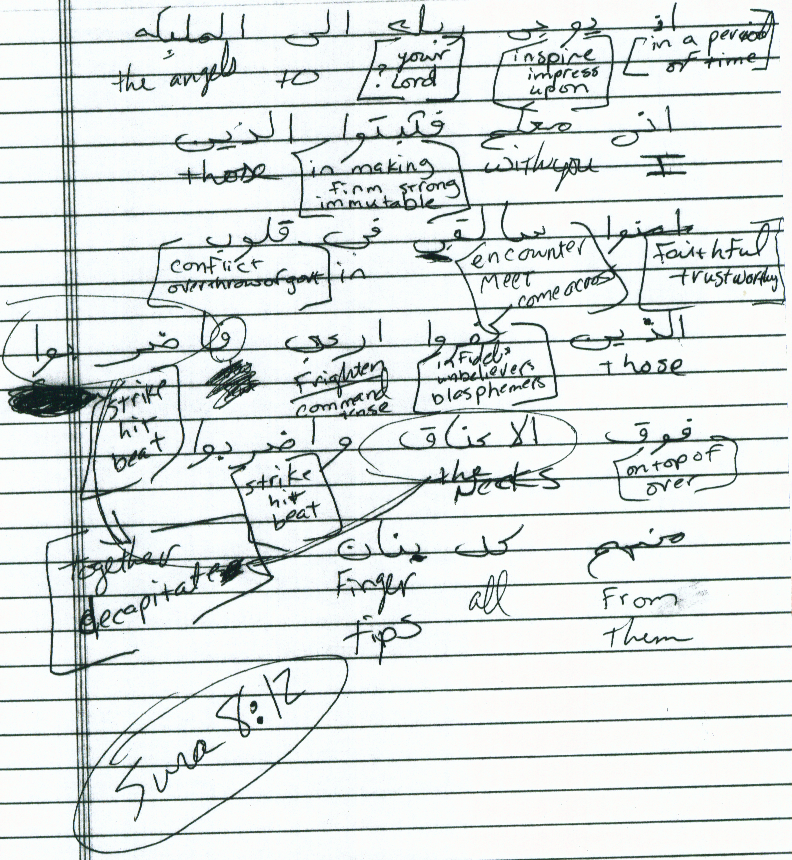
I haven't done any translation for a while so this looked like fun and I sat down for a while to hash it out. Here it is in a more accurate, and therefore rougher translation (as best as my skills are still able to accomplish):
First, this is Quranic Arabic and it does not track with modern Arabic, even modern standard Arabic. There are slightly different spellings, slightly different words, slightly different vowel markings - all of which make translation harder. There are several words in this passage which are recognizable but would not be considered the correct form if a modern Arabic newspaper editor was proofing an article.
Second, not having a common basis with English, words quite often do not translate directly. For instance the word above translated as "conflict" also has connotations of "overthrowing of the government."
Third, Arabic has no punctuation. True, many modern Arabic publications have adopted western-style periods, question marks, etc. However, the Quran was obviously written long before this. They did use a letter marker to indicate the beginning of a new sentence; basically the tacking on of an "f" before a word indicated a new sentence. The translation relied upon in the Slate article does not seem to follow this, probably because while it sacrifices accuracy it makes for a more coherent translation.
Forth, idioms cause problems. My trusty old Arabic dictionary informs me that "strike the neck" means to decapitate. However, the language in the passage does not track exactly in that it talks of striking them "over" or "on top" of the necks. As well, I am always concerned that an accepted interpretation of the Quran which is well established and permeates the society (but could have developed long after the writing) drives the idiom rather than following it. Still, considering that the immediately following passages calls for the striking fingertips off, decapitation does seem to be what is meant by the passage.
Click on the small picture below and a larger picture of the translation in work will come up. Remember, Arabic reads from top to bottom right to left. The Arabic is above and the possible translations are below. You'll see that several words have a number of possible translations which often leads to a number of different translations:
I haven't done any translation for a while so this looked like fun and I sat down for a while to hash it out. Here it is in a more accurate, and therefore rougher translation (as best as my skills are still able to accomplish):
Then your Lord impressed upon the angels: I [am] with you. In making those faithful firm I shall bring across in conflict [with] those infidels fear. Strike over the necks and strike from them all fingertips.Of course, even this is cleaned up some. There are several problems in translating Arabic.
Sura 8:12
First, this is Quranic Arabic and it does not track with modern Arabic, even modern standard Arabic. There are slightly different spellings, slightly different words, slightly different vowel markings - all of which make translation harder. There are several words in this passage which are recognizable but would not be considered the correct form if a modern Arabic newspaper editor was proofing an article.
Second, not having a common basis with English, words quite often do not translate directly. For instance the word above translated as "conflict" also has connotations of "overthrowing of the government."
Third, Arabic has no punctuation. True, many modern Arabic publications have adopted western-style periods, question marks, etc. However, the Quran was obviously written long before this. They did use a letter marker to indicate the beginning of a new sentence; basically the tacking on of an "f" before a word indicated a new sentence. The translation relied upon in the Slate article does not seem to follow this, probably because while it sacrifices accuracy it makes for a more coherent translation.
Forth, idioms cause problems. My trusty old Arabic dictionary informs me that "strike the neck" means to decapitate. However, the language in the passage does not track exactly in that it talks of striking them "over" or "on top" of the necks. As well, I am always concerned that an accepted interpretation of the Quran which is well established and permeates the society (but could have developed long after the writing) drives the idiom rather than following it. Still, considering that the immediately following passages calls for the striking fingertips off, decapitation does seem to be what is meant by the passage.
Click on the small picture below and a larger picture of the translation in work will come up. Remember, Arabic reads from top to bottom right to left. The Arabic is above and the possible translations are below. You'll see that several words have a number of possible translations which often leads to a number of different translations:
02 July 2004
Happy 4th
I'm gone for the next couple days but here's something we should all think of over independence day:
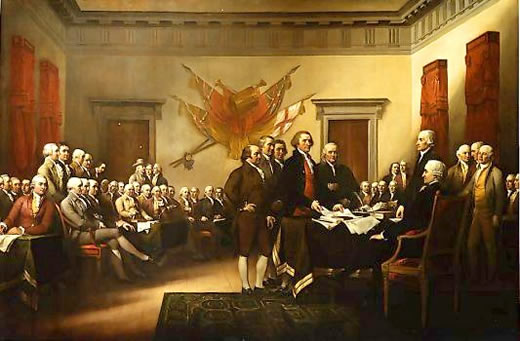
We hold these truths to be self-evident, that all men are created equal, that they are endowed by their Creator with certain unalienable Rights, that among these are Life, Liberty and the pursuit of Happiness. --That to secure these rights, Governments are instituted among Men, deriving their just powers from the consent of the governed.
Blakely Again
I expect the Blakely opinions and reactions to snowball from this point onward. I suggest everyone keep an eye on Sentencing Law and Policy, which I suspect will be able to keep better tabs on this than I will.
This doesn't mean that I won't post about Blakely happenings I find intriguing in the coming weeks. However, I think that the important positions have already been staked out. On one side will be those who believe the guidelines are still valid and will apply them with only the unconstitutional portion excised. On the other will be those who adhere to the position that the guidelines have now been rendered entirely unconstitutional. I think the first position will be the one generally followed; it appears that this trend is already taking place.
I'd like to tell you some real world things which have happened but most of what I'm hearing is rumors and speculation. The biggest is apparently true. It appears that in Virginia AUSA's are adding Blakely waivers to their plea agreements. However, if the grapevine is correct, while some judges are accepting the waivers a larger number are refusing them.
I was informed by a probation officer today that they had received no guidance as to Blakely.
And that's about all I've got at the moment. More as it comes in . . .
And Now the 5th Amendment
Donald, at Crescat Sententia, goes over the latest supreme court pontifications concerning the 5th Amendment.
01 July 2004
The Trickle Before the Torrent II
Other Blakely opinions have come forth from WV (reduction under the sentencing guidelines from 240 months to 6-12 months) and Maine:
I conclude that, without those jury findings here, I may not increase the sentence above the 63 to 78 month range to the guideline range I found earlier of 188 to 235 months.[comment] These large cuts in the maximum sentence should fade fairly quickly as prosecutors allege more facts, charge more crimes, file superceding indictments, etc.
I point to that conclusion, although perhaps surprising to those of us who have been laboring under guideline sentencing for these many years, that conclusion would not bother the Blakely court.
I quote again from the opinion, "The Framers would not have thought it too hard to demand that, before depriving a man of three more years of his liberty, the State should have to suffer the modest inconvenience of submitting its accusation to 'the unanimous suffrage of twelve of his equals and neighbours,' rather than a lone employee," that's me, the Judge "of the State."
The Trickle Before the Torrent
Post-Blakely many seemed to have paused to size up the new landscape. However a trickle of decisions has begun. Here's the first and perhaps most radical:
U.S v. Croxford
The decision begins by describing Blakely as “potentially cataclysmic” and ends with “[g]iven this bleak prediction about the future, the court hopes that it has overlooked something and that the Guidelines can be constitutionally applied.” The tone between these two points doesn’t depart much from this baseline.
At first I was impressed because this judge obviously has a very favorable view of the federal sentencing requirements but had the integrity to follow the constitutional teachings of a case contrary to his beliefs. He rules that points cannot be added for “obstruction” or for “relevant conduct” (in this case another crime neither proven nor admitted to).
But at the same time he goes a step too far: “While this court has searched diligently for a way to disagree with the warnings of the [Blakely] dissenters, the inescapable conclusion of Blakely is that the federal sentencing guidelines have been rendered unconstitutional in cases such as this one.”
The problem with that statement is that it is not an accurate statement of the holding in Blakely. In fact, it badly overstates the supreme court’s decision. Blakely stands for the proposition that the maximum sentence in a determinative sentencing scheme cannot be increased by the consideration of factors which had not been stipulated to or found by a jury. That comes nowhere near the elimination of the federal sentencing requirements; it only stops upward departures based on unproven facts.
The Remedy:
With little support for his position, the judge converts the sentencing guidelines from mandatory requirements into sentencing recommendations.
(1) The judge first dismisses the possibility of a “sentencing jury” because “the statutes do not authorize such an approach.” The judge also shows no confidence in the ability of juries to do anything more than say yea or nay: “While juries are generally adept at determining the guilt or innocence of a defendant, the list of findings contemplated by the Guidelines is extensive and nuanced, modified and interpreted regularly in numerous court opinions, creating a task much better suited to judges rather than juries.”
[comment] While the judge is probably right (I have not dug through the federal statutes to check) in stating that the federal system has no provision for “sentencing juries,” it is dismaying to see his lack of faith in the abilities of a band of twelve citizens to determine facts. The question that arises, if you subscribe to that point of view is this: if sentencing has become so complex that a highly trained professional judge can barely wade through it and regular citizens would never find all the facts necessary for all the upward departures - maybe the system of piling on after the plea is a broken system? Perhaps?
(2) The judge then decides that sentencing under the guidelines without the possibility of upward departures for facts neither stipulated nor found by a jury is not viable. “This approach would appear to solve the Sixth Amendment problem with the Guidelines [but it] would be fundamentally unfair to the United States and would distort the guidelines.” Since downward departures for such things as acceptance of responsibility and being a minor participant are not required to be proven to a jury, requiring the government to prove beyond a reasonable doubt the factors which will determine a greater punishment in open court is unfair. The sentencing guidelines are meant to operate as a whole and the court cannot slice off the upward departures leaving only those factors which “would inevitably tug downward on criminal sentences, perhaps producing sentences that do not provide just punishment or protect public safety.”
[comment] Fairness to the government . . . fairness to the government . . . Hmmmm . . . I just can’t seem to find that section of the constitution. Oh, wait, that’s right - it ain’t there. There is no such provision because there is no such thing. Our government is a aggregation of power meant to accomplish those things which we cannot accomplish alone. This aggregation of power is neither inherently good nor evil but being untrusting types, our founders looked back to the Magna Carta and set out a document which would limit this government’s exercise of its raw power (just in case the government started acting like a sovereign with its own particular set of interests). A particularly bright set of fellows, our founders; apparently they foresaw the day when someone would assert that the government/sovereign has its own set of interests separate from the citizenry and tried to keep that set of interests in check.
The judge’s second argument has more play to it. The claim that the mandatory sentencing guidelines must be read as a whole and that sections cannot be judicially removed could have legs. The argument that Blakely unbalances the system falls flat because of the obvious imbalance (pro-prosecution) which is already built into the system. Nevertheless, Congress could have intended that a significant change in this imbalance lead to an abrogation of the mandatory sentencing requirements. While it seems doubtful that the intent of Congress was to scrap the entirety of the sentencing requirements if sections were found unconstitutional, I’ve never looked at that issue before. Have sections of the sentencing requirements been sliced off by judicial holdings prior to this date? If so that would seem to undermine the judge’s argument. Although not necessarily deadly to the judge’s opinion because of the potential great effect of Blakely, it could be instructive. I don’t find the judge’s argument persuasive. On the other hand, I must admit that it is definitely colorable.
(3) (a) The judge concludes that under Blakely he must go back to indeterminate sentencing, limited only to the maximum penalty and the minimum penalty allowed by the statute. He sets forth how under this system he is allowed to consider factors which would have been allowed under the guidelines and even factors which would not have been allowed under the guidelines. (b) The judge then takes the further step of deciding that he will consider the guidelines “as providing useful instruction on the appropriate sentence.” He then sentences using the guidelines.
[comment] As far as his argument goes in (a) above the judge is on point. If he’d just stopped there and sentenced his argument would have been much tighter. When he proceeds to (b) and relies on the guidelines he wanders into dangerous waters. By relying on the guidelines after he has foresworn them he puts his argument back into the zone of Apprendi et al. These decisions look to practical effects not theoretical underpinnings. The reasoning he has engaged in looks like a smoke screen for sentencing under the guidelines while pretending not to. Sadly, while the judge should admired for his honesty he loses points for not obfuscating.
[overall comment] When I first read this I must admit to having had a knee-jerk reaction. My first thought was that this judge was trying to force a Hobson’s choice on the courts appellate so that they would either have to refute Blakely or wipe out the entire sentencing structure as it now stands. After I set the opinion aside for a while I sat back down to reread it.
Upon a second reading my interpretation of the court’s intent changed. It is actually more subtle than my first impression led me to believe. While it is obvious that the judge strongly disagrees with the results announced in Blakely, I no longer believe my first impression correct. The judge seems to accept what the Supreme Court has wrought and is trying to do his best to make the system operate as closely as possible to the way in which it operated pre-Blakely. To that effect he has decided that the road best taken is one which the academics recommend in my post below (Virginia-izing the Federal Sentencing Guidelines). As a result oriented endeavor the opinion gets him where he wants to be.
I find the opinion unconvincing. I just cannot believe that it was the intent of Congress to give the judiciary the power to scrap the entirety of the guidelines if a portion were struck down. The guidelines are still, in large part, valid. Some downward departures are allowed and upward departures are still allowed based upon prior record. While the end result really doesn’t effect the constitutionality of the sentencing requirements, what the Blakely decision did was to balance the possible ups more closely to the possible downs. The few downward possibilities are no longer heavily outbalanced by the upward possibilities; in fact, the judge may be correct that they now outweigh the increases (although this would depend on a case by case application of the Defendant’s record). The sentencing requirements are still there and must be adhered to.
Of the two recent opinions discussing this matter, I believe the precognitive Massachusetts case has the better of the possible remedies. Applying the guidelines using the facts found by a jury (or stipulated) in conjunction with the record to determine the maximum punishment is the proper way to remedy the constitutional error.
30 June 2004
Hunting the Cunning Counseloris Rex
One of the joys of being an attorney is the constant flow of jokes which are directed at you. It's so much fun being told about the professional courtesy we receive from vipers and sharks and that a hundred dead lawyers is "a good beginning."
Still, every once in a while one is cute enough to forward. I got this one from an old military buddy:
NEW REGULATIONS FOR THE HUNTING OF LAWYERS
Government Department of Fish and "WildLife" Sec. 1200
1. Any person with a valid hunting license may harvest attorneys.
2. Taking of attorneys with traps or deadfalls is permitted. The use of currency as bait is prohibited.
3. Killing of attorneys with a vehicle is prohibited. If accidentally struck, remove dead attorney to roadside and proceed to nearest car wash.
4. It is unlawful to chase, herd, or harvest attorneys from a snow machine, helicopter, or aircraft.
5. It shall be unlawful to shout "whiplash", "ambulance", or "free Perrier" for the purpose of trapping attorneys.
6. It shall be unlawful to hunt attorneys within 100 yards of BMW dealerships.
7. It shall be unlawful to hunt attorneys within 200 yards of courtrooms, law libraries, whorehouses, health spas, gay bars, ambulances, or hospitals.
8. If an attorney is elected to government office, it shall be a felony to hunt, "entrap", or possess it.
9. Stuffed or mounted attorneys must have a state health department inspection for rabies and vermin.
10. It shall be illegal for a hunter to disguise himself as a reporter, drug dealer, pimp, female legal clerk, sheep, accident victim, bookie, or tax accountant for the purpose of hunting attorneys.
BAG LIMITS
(Maximum number of catches allowed per hunting season)
1. Yellow Bellied Sidewinder...........(2)
2. Two-faced Tort Feasor...............(1)
3. Back-stabbing Divorce Litigator.....(4)
4. Small-breasted Ball Buster..........(3)
(Female only)
5. Big-mouthed Pub Gut.................(2)
6. Honest Attorney.....................(0)
(On the Endangered Species List) (Illegal to hunt)
7. Cut-throat..........................(2)
8. Back-stabbing Whiner................(2)
9. Brown-nosed Judge Kisser............(2)
10. Silver-tongued Drug Defender.......($100 BOUNTY)
29 June 2004
Virginia-izing the Federal Sentencing Guidelines
In this op-ed a couple professors suggest changing the federal system to one which mirrors Virginia's sentencing guidelines.
In Virginia guidelines are entirely optional and judges can depart from them either up or down at whim. The judge must give a reason but the reasons given are often rather weak (usually because the same reason was already accounted for in the recommendation) and a departure from the voluntary guidelines cannot be appealed.
All that said, it is amazing how many of the judges actually stick within the guidelines. Of course, judges in Virginia are creatures of the Legislature, serving at its periodic whim. If the Legislature feels they have been going too far afield the next time they come up for election they might have to find a new job. This has some good effects in that judges will tend to follow legislatively mandated guidelines. It also has some bad effects as anyone who has watched judges looking over their shoulder whenever they are asked to rule on an issue which is hot with the Legislature (e.g. DUI interpretations and sentencings).
I'm not sure what incentive would cause federal judges to follow voluntary guidelines.
Lv Sentencing Law & Policy
Virginia Supreme Court 06/10 Charge Bargaining Not Vindictive
Barret v. Commonwealth - Subject: When a prosecutor brings extra charges after the Defense has successfully exercised its constitutional right to appeal one charge is that prosecutorial vindictiveness?
The Defendant succeeded in an appeal but the charge was returned for prosecution on a lesser included charge. Prior to the second trial the prosecution threatened to bring more charges if there was a not guilty plea. Thereafter, the prosecution brought the extra charge when negotiations for a plea were unsuccessful. Defendant moved to quash the indictment as punishment for the fact that she had succeeded in her exercise of her constitutional right to appeal.
The Court finds no direct connection between the successful appeal and the bringing of the new charge. Without a direct connection, there is no presumption of prosecutorial vindictiveness. Absent a presumption the Defendant must prove vindictiveness. The fact that the subsequent charge was not brought prior to the successful appeal is not proof that the prosecution is vindictive.
Comment: As far as it goes, this opinion appears correct. While we all know that but for the successful appeal the subsequent charge would never have been brought, it was not brought to punish the appeal. It was brought to punish the Defendant for exercising her constitutional right to plead not guilty.
This is what the judge in the Massachusetts federal sentencing guidelines case called “charge bargaining.” Most of the time this is accomplished by charging more felonies (and/or misdemeanors) than the prosecution is really interested in pursuing so that charges can be dropped in exchange for a guilty plea. A bright prosecutor can make his job easier by arranging several more charges than he ever intends to prove (although all colorable) and dropping all but one or two in order to get a plea; this is the intelligent way of doing charge bargaining because the Defendant is able to see what she is getting from the bargain - the more charges dropped the better.
The way it was done in this case is more heavy-handed, showing some lack of finesse. While not unheard of, when a prosecutor threatens to raise new charges unless you plead to the one it seldom makes the negotiation easier. To begin with it makes it harder to explain to the Defendant. A Defendant is almost always extremely focused on what is currently charged. Explaining to her that she must plead guilty or potential new charges might be filed often does not pierce this concentration and decisions are mostly made solely pursuant to the perceived danger rather than the potential danger. As well, the majority of the time I have seen this threat put out there it has not been followed through on (albeit, probably because the prosecutor is satisfied with the slamming my client got in the trial of the initial charge). So it can be hard to advise the client on the probability of the prosecutor following through on the threat.
Even on those occasions when I am absolutely convinced that the prosecutor will bring extra charges trying to get the client to understand is painful. If charges are going away the client gets it; if you are keeping charges from being brought the client only sees the charge in front of her and the fact that you are not getting that charge reduced or making it go away. More than once I’ve been told at this point how worthless I am and that a “paid attorney” would have done a better job. Once, having maneuvered to keep at least four new, easily-provable felonies from coming into play, my client’s aunt proclaimed in a stage whisper as she left the courtroom, “He’s worthless. He didn’t do anything for you.” Ggggrrrrrr.
This, of course, is a discussion of the tactics of charge bargaining, not the morality. While properly done charge bargaining makes life easier for everyone in the courtroom - the prosecutor, the Defense counsel, and probably even the Defendant - at its core it is an immoral practice. It denies the system the ability to function in the manner it is supposed to operate. The prosecutor should bring the charge(s) he believes appropriate from the beginning. Bringing charges without the intent to prosecute or threatening new charges that the prosecution had not initially intended to file is done with the sole purpose of pressuring the Defendant so that he will not exercise his right to put the prosecution to its proof. It’s wrong but courts allow it and even if they tried to intervene it would be extremely hard for a court to enforce a ban on charge bargaining. After all, how will the court know if a prosecutor is dropping a charge because he no longer believes it viable or because the Defendant will plead to one if the other is dropped? The judge may have a strong suspicion but unless the court is willing to engage in presumptions following certain activity (as this case illustrates it is not) there is no practical way of knowing. And, again, nobody really wants it to go away because well done charge bargaining makes the system run smoother.
Subscribe to:
Posts (Atom)