03 July 2004

Off Point - Arabic Translation for the Clerk

I'm taking the day off but wandering through the net I saw that the Curmudgeonly Clerk was asking for an Arabic translation of this passage:

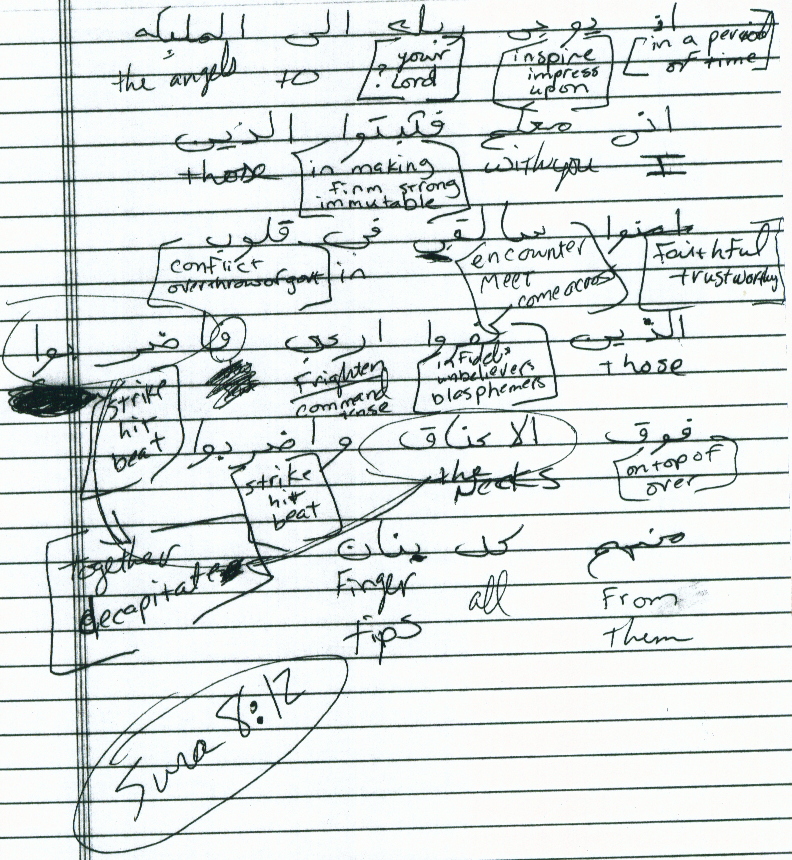
I haven't done any translation for a while so this looked like fun and I sat down for a while to hash it out. Here it is in a more accurate, and therefore rougher translation (as best as my skills are still able to accomplish):
Then your Lord impressed upon the angels: I [am] with you. In making those faithful firm I shall bring across in conflict [with] those infidels fear. Strike over the necks and strike from them all fingertips.
Sura 8:12
Of course, even this is cleaned up some. There are several problems in translating Arabic.

First, this is Quranic Arabic and it does not track with modern Arabic, even modern standard Arabic. There are slightly different spellings, slightly different words, slightly different vowel markings - all of which make translation harder. There are several words in this passage which are recognizable but would not be considered the correct form if a modern Arabic newspaper editor was proofing an article.

Second, not having a common basis with English, words quite often do not translate directly. For instance the word above translated as "conflict" also has connotations of "overthrowing of the government."

Third, Arabic has no punctuation. True, many modern Arabic publications have adopted western-style periods, question marks, etc. However, the Quran was obviously written long before this. They did use a letter marker to indicate the beginning of a new sentence; basically the tacking on of an "f" before a word indicated a new sentence. The translation relied upon in the Slate article does not seem to follow this, probably because while it sacrifices accuracy it makes for a more coherent translation.

Forth, idioms cause problems. My trusty old Arabic dictionary informs me that "strike the neck" means to decapitate. However, the language in the passage does not track exactly in that it talks of striking them "over" or "on top" of the necks. As well, I am always concerned that an accepted interpretation of the Quran which is well established and permeates the society (but could have developed long after the writing) drives the idiom rather than following it. Still, considering that the immediately following passages calls for the striking fingertips off, decapitation does seem to be what is meant by the passage.

Click on the small picture below and a larger picture of the translation in work will come up. Remember, Arabic reads from top to bottom right to left. The Arabic is above and the possible translations are below. You'll see that several words have a number of possible translations which often leads to a number of different translations:

02 July 2004

Happy 4th

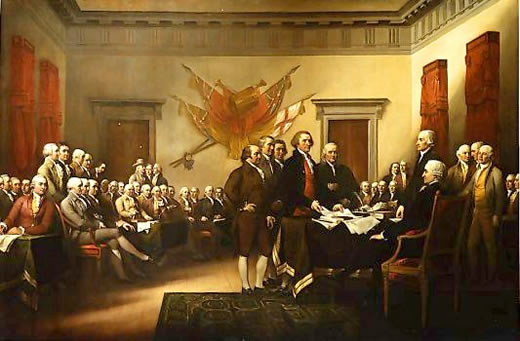
I'm gone for the next couple days but here's something we should all think of over independence day:
We hold these truths to be self-evident, that all men are created equal, that they are endowed by their Creator with certain unalienable Rights, that among these are Life, Liberty and the pursuit of Happiness. --That to secure these rights, Governments are instituted among Men, deriving their just powers from the consent of the governed.

Blakely Again

I expect the Blakely opinions and reactions to snowball from this point onward. I suggest everyone keep an eye on Sentencing Law and Policy, which I suspect will be able to keep better tabs on this than I will.

This doesn't mean that I won't post about Blakely happenings I find intriguing in the coming weeks. However, I think that the important positions have already been staked out. On one side will be those who believe the guidelines are still valid and will apply them with only the unconstitutional portion excised. On the other will be those who adhere to the position that the guidelines have now been rendered entirely unconstitutional. I think the first position will be the one generally followed; it appears that this trend is already taking place.

I'd like to tell you some real world things which have happened but most of what I'm hearing is rumors and speculation. The biggest is apparently true. It appears that in Virginia AUSA's are adding Blakely waivers to their plea agreements. However, if the grapevine is correct, while some judges are accepting the waivers a larger number are refusing them.

I was informed by a probation officer today that they had received no guidance as to Blakely.

And that's about all I've got at the moment. More as it comes in . . .

And Now the 5th Amendment

Donald, at Crescat Sententia, goes over the latest supreme court pontifications concerning the 5th Amendment.

01 July 2004

The Trickle Before the Torrent II

Other Blakely opinions have come forth from WV (reduction under the sentencing guidelines from 240 months to 6-12 months) and Maine:
I conclude that, without those jury findings here, I may not increase the sentence above the 63 to 78 month range to the guideline range I found earlier of 188 to 235 months.

I point to that conclusion, although perhaps surprising to those of us who have been laboring under guideline sentencing for these many years, that conclusion would not bother the Blakely court.

I quote again from the opinion, "The Framers would not have thought it too hard to demand that, before depriving a man of three more years of his liberty, the State should have to suffer the modest inconvenience of submitting its accusation to 'the unanimous suffrage of twelve of his equals and neighbours,' rather than a lone employee," that's me, the Judge "of the State."
[comment] These large cuts in the maximum sentence should fade fairly quickly as prosecutors allege more facts, charge more crimes, file superceding indictments, etc.

The Trickle Before the Torrent

Post-Blakely many seemed to have paused to size up the new landscape. However a trickle of decisions has begun. Here's the first and perhaps most radical:

U.S v. Croxford

The decision begins by describing Blakely as “potentially cataclysmic” and ends with “[g]iven this bleak prediction about the future, the court hopes that it has overlooked something and that the Guidelines can be constitutionally applied.” The tone between these two points doesn’t depart much from this baseline.

At first I was impressed because this judge obviously has a very favorable view of the federal sentencing requirements but had the integrity to follow the constitutional teachings of a case contrary to his beliefs. He rules that points cannot be added for “obstruction” or for “relevant conduct” (in this case another crime neither proven nor admitted to).

But at the same time he goes a step too far: “While this court has searched diligently for a way to disagree with the warnings of the [Blakely] dissenters, the inescapable conclusion of Blakely is that the federal sentencing guidelines have been rendered unconstitutional in cases such as this one.”

The problem with that statement is that it is not an accurate statement of the holding in Blakely. In fact, it badly overstates the supreme court’s decision. Blakely stands for the proposition that the maximum sentence in a determinative sentencing scheme cannot be increased by the consideration of factors which had not been stipulated to or found by a jury. That comes nowhere near the elimination of the federal sentencing requirements; it only stops upward departures based on unproven facts.

The Remedy:

With little support for his position, the judge converts the sentencing guidelines from mandatory requirements into sentencing recommendations.

(1) The judge first dismisses the possibility of a “sentencing jury” because “the statutes do not authorize such an approach.” The judge also shows no confidence in the ability of juries to do anything more than say yea or nay: “While juries are generally adept at determining the guilt or innocence of a defendant, the list of findings contemplated by the Guidelines is extensive and nuanced, modified and interpreted regularly in numerous court opinions, creating a task much better suited to judges rather than juries.”

[comment] While the judge is probably right (I have not dug through the federal statutes to check) in stating that the federal system has no provision for “sentencing juries,” it is dismaying to see his lack of faith in the abilities of a band of twelve citizens to determine facts. The question that arises, if you subscribe to that point of view is this: if sentencing has become so complex that a highly trained professional judge can barely wade through it and regular citizens would never find all the facts necessary for all the upward departures - maybe the system of piling on after the plea is a broken system? Perhaps?

(2) The judge then decides that sentencing under the guidelines without the possibility of upward departures for facts neither stipulated nor found by a jury is not viable. “This approach would appear to solve the Sixth Amendment problem with the Guidelines [but it] would be fundamentally unfair to the United States and would distort the guidelines.” Since downward departures for such things as acceptance of responsibility and being a minor participant are not required to be proven to a jury, requiring the government to prove beyond a reasonable doubt the factors which will determine a greater punishment in open court is unfair. The sentencing guidelines are meant to operate as a whole and the court cannot slice off the upward departures leaving only those factors which “would inevitably tug downward on criminal sentences, perhaps producing sentences that do not provide just punishment or protect public safety.”

[comment] Fairness to the government . . . fairness to the government . . . Hmmmm . . . I just can’t seem to find that section of the constitution. Oh, wait, that’s right - it ain’t there. There is no such provision because there is no such thing. Our government is a aggregation of power meant to accomplish those things which we cannot accomplish alone. This aggregation of power is neither inherently good nor evil but being untrusting types, our founders looked back to the Magna Carta and set out a document which would limit this government’s exercise of its raw power (just in case the government started acting like a sovereign with its own particular set of interests). A particularly bright set of fellows, our founders; apparently they foresaw the day when someone would assert that the government/sovereign has its own set of interests separate from the citizenry and tried to keep that set of interests in check.

The judge’s second argument has more play to it. The claim that the mandatory sentencing guidelines must be read as a whole and that sections cannot be judicially removed could have legs. The argument that Blakely unbalances the system falls flat because of the obvious imbalance (pro-prosecution) which is already built into the system. Nevertheless, Congress could have intended that a significant change in this imbalance lead to an abrogation of the mandatory sentencing requirements. While it seems doubtful that the intent of Congress was to scrap the entirety of the sentencing requirements if sections were found unconstitutional, I’ve never looked at that issue before. Have sections of the sentencing requirements been sliced off by judicial holdings prior to this date? If so that would seem to undermine the judge’s argument. Although not necessarily deadly to the judge’s opinion because of the potential great effect of Blakely, it could be instructive. I don’t find the judge’s argument persuasive. On the other hand, I must admit that it is definitely colorable.

(3) (a) The judge concludes that under Blakely he must go back to indeterminate sentencing, limited only to the maximum penalty and the minimum penalty allowed by the statute. He sets forth how under this system he is allowed to consider factors which would have been allowed under the guidelines and even factors which would not have been allowed under the guidelines. (b) The judge then takes the further step of deciding that he will consider the guidelines “as providing useful instruction on the appropriate sentence.” He then sentences using the guidelines.

[comment] As far as his argument goes in (a) above the judge is on point. If he’d just stopped there and sentenced his argument would have been much tighter. When he proceeds to (b) and relies on the guidelines he wanders into dangerous waters. By relying on the guidelines after he has foresworn them he puts his argument back into the zone of Apprendi et al. These decisions look to practical effects not theoretical underpinnings. The reasoning he has engaged in looks like a smoke screen for sentencing under the guidelines while pretending not to. Sadly, while the judge should admired for his honesty he loses points for not obfuscating.


[overall comment] When I first read this I must admit to having had a knee-jerk reaction. My first thought was that this judge was trying to force a Hobson’s choice on the courts appellate so that they would either have to refute Blakely or wipe out the entire sentencing structure as it now stands. After I set the opinion aside for a while I sat back down to reread it.

Upon a second reading my interpretation of the court’s intent changed. It is actually more subtle than my first impression led me to believe. While it is obvious that the judge strongly disagrees with the results announced in Blakely, I no longer believe my first impression correct. The judge seems to accept what the Supreme Court has wrought and is trying to do his best to make the system operate as closely as possible to the way in which it operated pre-Blakely. To that effect he has decided that the road best taken is one which the academics recommend in my post below (Virginia-izing the Federal Sentencing Guidelines). As a result oriented endeavor the opinion gets him where he wants to be.

I find the opinion unconvincing. I just cannot believe that it was the intent of Congress to give the judiciary the power to scrap the entirety of the guidelines if a portion were struck down. The guidelines are still, in large part, valid. Some downward departures are allowed and upward departures are still allowed based upon prior record. While the end result really doesn’t effect the constitutionality of the sentencing requirements, what the Blakely decision did was to balance the possible ups more closely to the possible downs. The few downward possibilities are no longer heavily outbalanced by the upward possibilities; in fact, the judge may be correct that they now outweigh the increases (although this would depend on a case by case application of the Defendant’s record). The sentencing requirements are still there and must be adhered to.

Of the two recent opinions discussing this matter, I believe the precognitive Massachusetts case has the better of the possible remedies. Applying the guidelines using the facts found by a jury (or stipulated) in conjunction with the record to determine the maximum punishment is the proper way to remedy the constitutional error.

30 June 2004

Hunting the Cunning Counseloris Rex

One of the joys of being an attorney is the constant flow of jokes which are directed at you. It's so much fun being told about the professional courtesy we receive from vipers and sharks and that a hundred dead lawyers is "a good beginning."

Still, every once in a while one is cute enough to forward. I got this one from an old military buddy:

NEW REGULATIONS FOR THE HUNTING OF LAWYERS
Government Department of Fish and "WildLife" Sec. 1200

1. Any person with a valid hunting license may harvest attorneys.

2. Taking of attorneys with traps or deadfalls is permitted. The use of currency as bait is prohibited.

3. Killing of attorneys with a vehicle is prohibited. If accidentally struck, remove dead attorney to roadside and proceed to nearest car wash.

4. It is unlawful to chase, herd, or harvest attorneys from a snow machine, helicopter, or aircraft.

5. It shall be unlawful to shout "whiplash", "ambulance", or "free Perrier" for the purpose of trapping attorneys.

6. It shall be unlawful to hunt attorneys within 100 yards of BMW dealerships.

7. It shall be unlawful to hunt attorneys within 200 yards of courtrooms, law libraries, whorehouses, health spas, gay bars, ambulances, or hospitals.

8. If an attorney is elected to government office, it shall be a felony to hunt, "entrap", or possess it.

9. Stuffed or mounted attorneys must have a state health department inspection for rabies and vermin.

10. It shall be illegal for a hunter to disguise himself as a reporter, drug dealer, pimp, female legal clerk, sheep, accident victim, bookie, or tax accountant for the purpose of hunting attorneys.

BAG LIMITS
(Maximum number of catches allowed per hunting season)

1. Yellow Bellied Sidewinder...........(2)
2. Two-faced Tort Feasor...............(1)
3. Back-stabbing Divorce Litigator.....(4)
4. Small-breasted Ball Buster..........(3)
(Female only)
5. Big-mouthed Pub Gut.................(2)
6. Honest Attorney.....................(0)
(On the Endangered Species List) (Illegal to hunt)
7. Cut-throat..........................(2)
8. Back-stabbing Whiner................(2)
9. Brown-nosed Judge Kisser............(2)
10. Silver-tongued Drug Defender.......($100 BOUNTY)

29 June 2004

Virginia-izing the Federal Sentencing Guidelines

In this op-ed a couple professors suggest changing the federal system to one which mirrors Virginia's sentencing guidelines.

In Virginia guidelines are entirely optional and judges can depart from them either up or down at whim. The judge must give a reason but the reasons given are often rather weak (usually because the same reason was already accounted for in the recommendation) and a departure from the voluntary guidelines cannot be appealed.

All that said, it is amazing how many of the judges actually stick within the guidelines. Of course, judges in Virginia are creatures of the Legislature, serving at its periodic whim. If the Legislature feels they have been going too far afield the next time they come up for election they might have to find a new job. This has some good effects in that judges will tend to follow legislatively mandated guidelines. It also has some bad effects as anyone who has watched judges looking over their shoulder whenever they are asked to rule on an issue which is hot with the Legislature (e.g. DUI interpretations and sentencings).

I'm not sure what incentive would cause federal judges to follow voluntary guidelines.

Lv Sentencing Law & Policy

Virginia Supreme Court 06/10 Charge Bargaining Not Vindictive

Barret v. Commonwealth - Subject: When a prosecutor brings extra charges after the Defense has successfully exercised its constitutional right to appeal one charge is that prosecutorial vindictiveness?

The Defendant succeeded in an appeal but the charge was returned for prosecution on a lesser included charge. Prior to the second trial the prosecution threatened to bring more charges if there was a not guilty plea. Thereafter, the prosecution brought the extra charge when negotiations for a plea were unsuccessful. Defendant moved to quash the indictment as punishment for the fact that she had succeeded in her exercise of her constitutional right to appeal.

The Court finds no direct connection between the successful appeal and the bringing of the new charge. Without a direct connection, there is no presumption of prosecutorial vindictiveness. Absent a presumption the Defendant must prove vindictiveness. The fact that the subsequent charge was not brought prior to the successful appeal is not proof that the prosecution is vindictive.

Comment: As far as it goes, this opinion appears correct. While we all know that but for the successful appeal the subsequent charge would never have been brought, it was not brought to punish the appeal. It was brought to punish the Defendant for exercising her constitutional right to plead not guilty.

This is what the judge in the Massachusetts federal sentencing guidelines case called “charge bargaining.” Most of the time this is accomplished by charging more felonies (and/or misdemeanors) than the prosecution is really interested in pursuing so that charges can be dropped in exchange for a guilty plea. A bright prosecutor can make his job easier by arranging several more charges than he ever intends to prove (although all colorable) and dropping all but one or two in order to get a plea; this is the intelligent way of doing charge bargaining because the Defendant is able to see what she is getting from the bargain - the more charges dropped the better.

The way it was done in this case is more heavy-handed, showing some lack of finesse. While not unheard of, when a prosecutor threatens to raise new charges unless you plead to the one it seldom makes the negotiation easier. To begin with it makes it harder to explain to the Defendant. A Defendant is almost always extremely focused on what is currently charged. Explaining to her that she must plead guilty or potential new charges might be filed often does not pierce this concentration and decisions are mostly made solely pursuant to the perceived danger rather than the potential danger. As well, the majority of the time I have seen this threat put out there it has not been followed through on (albeit, probably because the prosecutor is satisfied with the slamming my client got in the trial of the initial charge). So it can be hard to advise the client on the probability of the prosecutor following through on the threat.

Even on those occasions when I am absolutely convinced that the prosecutor will bring extra charges trying to get the client to understand is painful. If charges are going away the client gets it; if you are keeping charges from being brought the client only sees the charge in front of her and the fact that you are not getting that charge reduced or making it go away. More than once I’ve been told at this point how worthless I am and that a “paid attorney” would have done a better job. Once, having maneuvered to keep at least four new, easily-provable felonies from coming into play, my client’s aunt proclaimed in a stage whisper as she left the courtroom, “He’s worthless. He didn’t do anything for you.” Ggggrrrrrr.

This, of course, is a discussion of the tactics of charge bargaining, not the morality. While properly done charge bargaining makes life easier for everyone in the courtroom - the prosecutor, the Defense counsel, and probably even the Defendant - at its core it is an immoral practice. It denies the system the ability to function in the manner it is supposed to operate. The prosecutor should bring the charge(s) he believes appropriate from the beginning. Bringing charges without the intent to prosecute or threatening new charges that the prosecution had not initially intended to file is done with the sole purpose of pressuring the Defendant so that he will not exercise his right to put the prosecution to its proof. It’s wrong but courts allow it and even if they tried to intervene it would be extremely hard for a court to enforce a ban on charge bargaining. After all, how will the court know if a prosecutor is dropping a charge because he no longer believes it viable or because the Defendant will plead to one if the other is dropped? The judge may have a strong suspicion but unless the court is willing to engage in presumptions following certain activity (as this case illustrates it is not) there is no practical way of knowing. And, again, nobody really wants it to go away because well done charge bargaining makes the system run smoother.

28 June 2004

Why Chesterfield is Arrestafield

The county where I live and have my office is often called "Arrestafield." This article is an example of why: Chesterfield by itself almost has more DUI arrests than all the surrounding counties and cities combined (Hanover being the only one in the list which is not bordering Chesterfield).

27 June 2004

Va. Court of Appeals 06/25

English v. Commonwealth - Subject: Bounty hunters and the impersonation of police.

A bounty hunter may have the power to stop a car, ask about weapons, and identify the occupants. However, he cannot identify himself as an officer thru his words or a misleading badge and he cannot ask the driver to exit the car and inquire whether she has been drinking.

Smith v. Virginia - Subject: What must be done in order to preserve a trial judge's decision to allow the prosecutor to allow rebuttal testimony as to character.

The trial judge ruled that he would allow the prosecution to introduce rebuttal evidence if the Defense introduced evidence as to truthfulness and honesty. Because of this the Defense did not introduce the character evidence. Because the Defense did not introduce the character evidence the prosecution did not introduce the anti-character evidence. Without the prosecution's introduction of the evidence at trial there is nothing to appeal.

Comment: It makes a nice little circle doesn't it?

In all fairness, the prosecution probably should be allowed to enter evidence in rebuttal of any point which the Defense offers evidence. What is frustrating here is that the Curt of Appeals could have easily said that (in an even shorter opinion). Instead it ducks the question by not deciding whether the judge's decision was an error and placing an evidentiary introduction burden on the Defense if it wants to argue the judge's potential legal error.

New Links

You'll notice that I have added a number of new blogs to the right. In particular I want to recommend to you Sentencing Law and Policy and Tutissima Cassis.

Scalia's Ire Toward Breyer

From Blakely:

"The implausibility of JUSTICE BREYER’s contention that Apprendi is unfair to criminal defendants is exposed by the lineup of amici in this case. It is hard to believe that the National Association of Criminal Defense Lawyers was somehow duped into arguing for the wrong side. JUSTICE BREYER’s only authority asking that defendants be protected from Apprendi is an article written not by a criminal defense lawyer but by a law professor and former prosecutor. See post, at 4–5 (citing Bibas, supra); Association of American Law Schools Directory of Law Teachers 2003–2004, p. 319."


As always there were plenty of quotable moments from Scalia but this is the one which tickled me.

26 June 2004

Blakely and Federal Sentencing Feeneyizing the Upward Departures

OMG . . . OMG . . . OMG . . . No More Upward Departures

When I screw up an analysis I really screw it up. In the immediate post below I stated that I didn't think that Blakely had much to do with the Massachusetts opinion and proceeded to analyze the opinion as either being correct or incorrect based up whether it could be characterized as changing a maximum allowable sentence or merely changing the minimum allowable sentence. I was wrong; Blakely is determinative.

How could I be wrong, you ask? Well, gentle readers, my only excuse is that I read the opinion at about 11 p.m. after several mind-numbing hours of traveling back and forth to some jail in the middle of nowhere in order to visit a federal client. I was tired and I read it fast. But today I was taking a break for lunch and I started to reread it with my brain half-engaged and OMG!!!


So here's my analysis of Blakely:

Legal Situation: Blakely pleads guilty to a charge for which the Washington State Legislature has set a 10 year maximum punishment. However, the Legislature has also enacted sentencing guidelines which set forth a range of punishment. The judge departs upward from these guidelines by finding an aggravating factor which had not been stipulated to by the Defendant and was not necessary for the conviction. A finding that the aggravating factor exists moved the sentencing guidelines upward but they were still within the ten year maximum.

Finding of the U.S. Supreme Court:


The maximum sentence is that which is set out by the guidelines not that which is stated to be the maximum under the actual statute for the crime.

Going back to Apprendi the Court stands by the principle that outside of the prior record the judge cannot find any factor which will increase a maximum sentence. Such factors can only be stipulated by the Defendant or found by the jury.
[T]he relevant "statutory maximum" is not the maximum sentence a judge may impose after finding additional facts, but the maximum he may impose without any additional findings.
Since the judge could not impose the sentence he did solely from the stipulations in the guilty plea the increased sentence is a violation of the Defendant's right to have all facts determinative of the maximum sentence decided by the jury.

The State seems to have argued along the lines of what I hypothesized while discussing the Massachusetts case below: that the fact upward departures occurred indicates that the guidelines actually only set mandatory minimums. The Court rejects this out of hand. As long as there is a range and the maximum changes due to factors neither stipulated to nor found by a jury the minimum is irrelevant.

Comment:

Despite the gnashing of teeth and wailing on one side and the exuberant jubilance on the other this is not the death knell for the federal sentencing guidelines. It is a blow against uncertainty in the maximum sentence. I foresee three possible outcomes:

First, the guidelines could be revamped so that all they establish are mandatory minimums. I'm not an expert on the Sentencing Commission but hopefully it would not be able to undertake such a massive change without Congress being required to vote on it. I am doubtful that this could be gotten through both houses of Congress (at least if it's not attached as an amendment to the "Allow Motherless Orphan Babies to Have Milk" bill).

Second, it could lead to bifurcated hearings. The problem here is how unwieldy this would be in practice; with the guidelines as they are you might have to schedule longer for the sentencing hearing than the trial. It would also mean that prosecutors would have to be much more detailed in their indictment so that each and every element of the maximum sentence was included and could be proven. This system is doubtful because of its difficulty. One advantage of it is that it would probably do away with the one guideline abuse that bothers me the most: getting extra points for obstruction when you exercise your right to testify at your trial. Prosecutors cannot indict a future possibility and thus could not prove this unalleged element of the maximum sentence.

Third, is to adopt the method which the judge in Massachusetts chose to use (if you see that judge buying a lottery ticket make sure you listen for the number - he shows signs of precognition). Judges shall only sentence in the range determined by the base number as effected by the Defendant's prior record. This is what I foresee happening.

This option is what I meant by Feeneyizing upward departures. As we all know, downward departures have become (under Feeney) almost impossible to obtain. This ruling makes upward departures impossible to obtain. It makes the guidelines far more predictable and standardized.

Probable Effect: The second and third options above are not mutually exclusive. When the US Attorney really, really wants to get someone he could jump through all the hoops and bring a complex and fully laid out indictment alleging all the facts for the maximum sentence he wishes to have imposed. He would then ask for a bifurcated trial in order to prove all the allegations. The trial could go on forever but in the end he could get the massive sentence he desires.

More likely, under the third option prosecutors will go back to bringing multiple charges and proving them in order to get all the relevant factors which will boost the sentencing range (newer prosecutors seem to tend to only bring the conspiracy charge nowadays). They will also require a Defendant who enters a plea agreement or who wishes to get the third point of downward departure to stipulate to the facts as the prosecutor wants them presented to the judge.


Well, I could probably put much more in but poker calls . . .

25 June 2004

The Massachusetts Ruling that Federal Sentencing Guidelines are Unconstitutional

Well, I read Blakely last night and don’t think it changes much in the Massachusetts opinion. It doesn’t hurt the district court judge’s decision and its affirmation that the jury is the only body which can decide facts determinative of the maximum sentence is in the same vein as the trial judge. However, it doesn’t really reach the core matter which the trial judge’s opinion hinges on.

The Massachusetts Opinion:

Holding:

This ruling does not find the entirety of the federal sentencing requirements unconstitutional. Under this finding the base number which is assigned to a crime and the considerations of prior record which effect it are still held to be constitutional. All other factors which a judge can find that would otherwise cause an increase in the maximum sentence after a finding of guilt are unconstitutional and cannot be applied. However, the opinion seems to leave those factors which mitigate a sentence in place because case law allows a judge to determine factors which determine minimum allowable sentences.

The Core of the Opinion:

At it’s core this opinion is very simple. It separates the theory of the sentencing guidelines from the reality of the sentencing requirements. The theory is that they are guidelines the judiciary can depart from them in appropriate cases as determined by the judge. The reality is that they are requirements which were set in stone until the Feeney Amendment, when they became cast in steel. It is this dichotomy upon which the entire argument rises or falls.

Apprendi, Ring, and now Blakely do not care much about theory; rather, they are concerned with effect. The sentencing requirements are fixed such that, for all practical purposes, the judge cannot determine the sentence within the statutorily set out limit but only within the allowed sentencing range on the grid. Thus, the statutory limit has been superceded by the guideline range and it determines the maximum sentence. This having occurred Apprendi and its progeny attach to the sentencing requirements and there can be no increase to the maximum punishment range by judicial evidentiary findings except those proceeding from the Defendant’s prior record.

It’s a well argued thesis based upon the realities of the modern federal courthouse.

ETC:

The judge goes on to make his disagreement with Mistretta fairly plain and seems to be of the opinion that post-Feeney, the constitutionality of the shift of power from the judiciary to the executive branch embodied in the guidelines badly needs to be reviewed by the Supreme Court with a firm eye on the reality of the criminal justice system. There is a long section discussing whether the Sentencing Commission does or should have the powers granted it by Congress (Congress cannot delegate powers not allotted to it under the constitution). Much of this could have been shorn away to make his actual argument stronger.

ETC. Relevant:

Three portions of the bric-a-brac seem relevant.

First, the judge opines that the federal sentencing requirements strongly detract from the right to a jury trial (the important underlying consideration in Apprendi analysis).

Second, the judge discusses why he raises this argument sua sponte. He is convinced that under the current system Defendants dare not raise such claims because they must cowtow to the prosecution in order to gain any crumbs the prosecutor might throw their way.

Third, he discusses options to remedy the constitutional error. The first is bifurcated jury trials wherein the sentencing factors are decided by the jury in the post conviction session. The second, which the judge adopts, is to sentence only based upon the points for the offense as modified by the Defendant’s prior record.


Comment:

Problems:

As much as I like the opinion and believe the federal sentencing guidelines to be plainly constitutionally wrong I doubt the opinion’s viability. This is a very close issue but I see two problems with the Court’s analysis.

(1) The trial court seems to assume that Feeney and the sentencing requirements set an equal barrier to departures upward and downward; one would hope for such logical consistency. Nevertheless, if Feeney set a concrete floor but left a ceiling made of straw this opinion falters because courts can decide factors which determine minimum punishments. Although I’ve not researched the matter, I’d bet good money that upward departures have survived at a much higher rate and received more favorable appellate language. This is just a reality of any appellate court handling criminal appeals. All departures may start with the same standard but when a trial judge departs upward for someone who has been convicted of three sexual torture killings the appellate court is going to have to be dragged kicking and screaming to a reversal; if it can find a reason to uphold the trial court it will. On the other hand, when someone is convicted of dealing in crack cocaine and the judge departs downward the appellate court is not going to be as inclined to defer to the trial court. This is just human nature and (lest we forget) judges are human too.

I know that upward departures occur. Within the last few months an employee of the City of Richmond received an upward departure for stealing from the city (the feds seem to charge one member or another of the Richmond government every three months or so). So I’m not sure that the maximum punishment argument will stand up to scrutiny.


(2) I’m not sure the appellate courts will recognize the trial judge’s ability to raise this issue sua sponte. As a matter of fact, I think there is a strong chance that the appellate court will use this as an excuse to punt and refuse to accept the trial judge’s opinion because it was not something argued in a case. The trial court shows a reality based belief that the system will not allow defendants to make this argument. However, appellate courts are one step away from the trail court experience and seem to most often consist of those who have had no experience at all in the criminal justice system (or at least no Defense experience). Without any real world knowledge, the view from the appellate bench does not always represent reality.

Potential:

The potential out of this opinion depends on how strong the courts believe the jury system should be. The common moving force behind the decisions in Apprendi, Ring, and Blakely is the primacy of the jury. If viewed through this lens the sentencing requirements are a disaster which foreclose a jury for all but a desperate or stubborn few. Assuming that 95% of the cases stay underneath the maximum set by the guidelines can that 5% departure upward be enough to salvage the constitutionality of the entire system? If we truly believed in jury trials it should not.

---------------


That’s my snapshot view of a 176 page decision. Much is missing and/or extremely simplified. I strongly recommend reading the section which outlines how the federal judicial system actually works and the Apprendi argument.

[Addendum] Per the helpful comment below, I quote this from an 8th Circuit dissent:
Since May of 2000, the government appealed twenty-five cases in which the district court reduced the defendant’s sentence. Of those, our court reversed the district court twenty-three times, and affirmed only twice.

When it comes to cases in which the district court increased the defendant’s sentence, one would expect to see a similar pattern of reversals, inasmuch as we have employed similar standards of review for both upward and downward adjustments and departures. Unfortunately, that is not the case. Since May of 2000, we were presented with appeals from forty-six upward departures. Of those, we reversed only two, and affirmed the other forty-four.

In other words, during the same three year period that our court was consistently reversing shorter sentences, we were consistently affirming longer ones. It is difficult for me to reconcile this contrast, and I am deeply concerned with the trend and the message it sends to district courts–that more severe sentences are far more likely to withstand appellate review.
If that's the view from the 8th I can only imagine the 4th or 5th. That would seem to confirm my worries that courts have already refused to impose the same standard to an upward departure as they have a downward.

24 June 2004

That Pesky Supreme Court

I know I promised more on the case stating that the federal sentencing requirement are unconstitutional but then the pesky Supreme Court had to go and decide Blakely. I need to read and digest it so I can see how it effects the district court's reasoning.

Assuming, without promising, that my visit with my federal client goes well and I am back home before 8 p.m. I will try to get something together to post for tomorrow morning.

My Cat's Opinion of the Decision

My cat has weighed in on what he thinks of the Massachusetts district court judge's opinion ruling the federal sentencing requirements unconstitutional.

First, he thinks it tastes great:


And he went back for seconds


So he also thinks it's less filling.

More on my opinion later.

Critiqued by High Schoolers

A while back I had a hearing while a class of high-school students watched (see Wednesday here). Afterward I stayed to talk with the class along with the prosecutor, the judge, and a couple other defense attorneys.

Yesterday I got a stack of letters in the mail from the class. Most of them were the type of generic letters you get when a teacher forces students to write a letter. However, some had comments in them which showed that the student was actually paying attention. The first was pretty innocuous:
I also like listening to you discuss your client’s responsibility to his family and his financial situation.
The next was impressed by my client control skills:
I also really liked how you nudged your client to keep him from talking while the judge was speaking.
The last really was not impressed by my client:
I think the defendant you were defending, case was interesting because I don’t understand why he did what he did. I also think he got a break because he should have been doing his job and not distributing drugs. However, you did a good job defending your defendant.
It always feels good to be appreciated.

23 June 2004

The ABA Weighs In on Justice Kennedy's Challenge

The ABA has come out in favor of getting rid of mandatory minimum sentences. It also goes on about racial disparities and the pardon power but the first part is the one to focus on.

And I will. I hope to digest the report from the ABA's page sometime this weekend and to be able to comment intelligently on it early next week (says the guy who still hasn't had time to read Hiibel).

Judge Finds Federal Sentencing Requirements Unconstitutional

A federal district court judge has found the federal sentencing requirements unconstitutional. I first saw an article about this yesterday on Southern Appeal and a few of you were kind enough to point it out to me.

I printed out the 170+ pages and read the first 50 or so last night. I started to underline passages so that I could include them here but I soon found I was underlining about half of every page. It is well written. The first section is a burning indictment of the sentencing requirements and how they place power so totally in the hands of prosecution that no one can go to trial. He even notes that those who are keeping track of the number of trials in the federal system are so desperate to make it look as though trials actually occur that they are counting pre-trial motion hearings and post trial sentencing hearings (wherein someone testifies) as "trials." Then he goes on about how the shift of judge from adjudicators to clerks for the prosecutor has effected the judges (especially post Feeney). I glanced at the first paragraph of the next section and it finds the sentencing requirements unconstitutional as they contravene Apprendi et al. It's a well thought out well put together argument (so far).

On top of all that, it is a primer for how the federal courts currently operate. Anyone who is starting to practice in federal courts should be required to read the first section because it explains in detail exactly how the system works in practical terms and straight forward language.

22 June 2004

Will Baude on Hiibel

Will Baude, from Crescat Sententia, comments on Hiibel at TNR Online. It lays out the probable future results of this decision a little more calmly than I did here.

A Week in The Life of a Criminal Defense Attorney

Monday: I go to federal court so that my client can be re-arraigned and plead guilty to possession of 50 grams of crack cocaine. It bothers me because I don’t think the prosecutor can prove 50 grams. However, I know he can prove 5 or more grams. If we go to trial my client risks life imprisonment because of his prior record but if he pleads guilty his guidelines (after points for acceptance of responsibility) will put him in prison between 21-27 years. If we go to trial and the jury convicts him of possession of 5 or more grams his guidelines would put him between 21-27 years (because he won’t get points for accepting responsibility); if he testifies at his trial it is quite possible that his sentence would be even higher. And the local prosecutor has a policy of not allowing Rule 35's for those who plead not guilty. Still, I’m worried that if the judge asks me whether I agree that the prosecutor can prove his case I will have to tell the judge “no” and hurt my client.

The hearing starts and my client pleads guilty. The magistrate judge tells him several times that he can back out of his plea at any time up to the end of the hearing and then proceeds to the questions. At the point where the judge asks me the all important question it comes out, “Mr. Lammers, do you agree that the evidence would prove your client’s guilt or that it is in your client’s best interest to plead guilty?” Hallelujah!! I’m off the hook: “It is in my client’s best interest to plead guilty, your Honor.” However, my sense of elation lasts only a few seconds. When the judge asks my client if he is guilty of what he is charged he states, “No.” Crap. The judge leaves the bench and I end up in a rather heated discussion with Client. When the judge comes back in Client tells the judge he is in fact guilty.

And justice is once again served in the federal system.

Tuesday: I don’t have any cases but I go down to the local courthouse to see if I can pick up a couple court appointments. While I’m at court I see two notable things. First, a lady walks up to me to ask which courtroom she has to be in. That’s not unusual; it happens at least twice a week. But then I look past her and see her daughters, both of whom have worn tube tops and short-shorts to court. It really wasn’t all that on the 12 year old but OMG the older daughter (17?) had all the right things in all the right places. I kinda froze for a second and then kept my eyes glued on the mother’s face as I explained when and where she was supposed to be in court. What in the world would make someone think that that was appropriate court clothing in a chilly, air-conditioned courthouse? Don’t get me wrong, if we’d been at a beach I’d have been happy to switch into dirty old man mode and leer with the rest of the guys (as it was it took some willpower to not) but how does one come to the thought, “Gee, I’m going to court today. Should I wear the red or black tube top?”

Second, while I’m sitting in court I see a lady come in with her lawyer to pitch for a bond. The lawyer is up there giving it everything he’s got. He’s talking about her strokes, her kids, her husband getting sent overseas, and everything else he can put forward to tug at the judge’s heartstrings. It looked pretty good until the prosecutor gets her shot and it comes out that the lady is wanted in another State, stands charged with $100,000 in bad checks in Virginia (prior to the current charge), and, in the charge at hand, was using her child’s baby carriage (with baby) to shoplift a couple thousand dollars worth of stuff from Sears. The judge denies bond. As they go to take her back to lockup she takes half a step, wails and collapses on the floor crying, moaning, sobbing, etc. Not in the least rattled, the judge looks over at the deputy and says with a shrug, “I’m going to step off the bench for a couple minutes so you all can deal with this,” waves off the deputy who comes up to escort him, and walks out. In the end, after at least thirty minutes of a hissy-fit worthy of any three year old, they haul her off to the hospital where she will get to spend a glorious night under observation while she is handcuffed to the bed. Nobody really believed it was anything other than hysteria but the lawyer had done such a good job of selling the fact she’d had previous strokes that no one was going to take the chance.

Wednesday: In the morning I go to court to represent a client on a marijuana charge, reckless driving (95 mph), and contempt of court. He is just in court for sentencing on the first two charges because he was convicted, in his absence, in 1992; the capias (bench warrant) was issued for contempt because he had not come to court. In the end he comes out of it with 10 days for the reckless, 6 days for the marijuana, and 4 days for the capias. The judge lets him serve the time on weekends and 20 days is actually 10 days because you only do half time on misdemeanors.

Later, another client has a bond hearing. It does not go well. Client has strong ties in Atlanta and NYC, a string of misdemeanor convictions, a prior felony distribution charge which is pending in another jurisdiction, and he’s facing a felony habitual offender charge. This carries a mandatory year for the absolute evil of driving after some authority in Virginia has told you not to drive and it is extremely easy for prosecutors to prove. Therefore, it is hard to convince judges that a client charged with this should not stay in jail and get a jump on the time he is going to serve. By law, the fact alone that he was on bond for a felony when he was picked up for the second felony means the judge is not supposed to give him a bond (yes, in Virginia we have legislatively overruled the part of that annoying federal constitution about bonds). Needless to say, the judge left my client sitting in jail.

In the afternoon I jump into my car and drive two hours northeast to a jail in Warsaw where the feds have one of my clients. For the first hour or so I am on the wrong road but I catch that before the roads veer too far apart and a 15 minute drive on a little country road gets me back on the right (slightly larger) country road. I get there just at the time I’m supposed to be there but, of course, all the professional visitation rooms are packed and we have to wait 30 minutes. Then I sit and watch 90 minutes of the federal probation officer trying to get my client to remember the exact ages of his 8 brothers and sisters and exactly where he was living 25 years ago. Client is trying hard but a lot of it just isn’t coming to him.

Finally the interview ends and I jump back into the car for the ride home. I turn the cell phone back on and I have messages. In fact two clerks from my local courthouse had called to try and find out why I wasn’t in court. Aw, crud. I missed a hearing. I start to call back and my phone cuts out. I wait a couple minutes and try again but the phone can’t even find service. By the time I am back in an area where there’s service it’s past 4:30 and the clerk’s office is closed.

Thursday: In the morning I have a client charged with an 8 month old driving suspended charge and a contempt capias for failing to appear in court. The defense? It wasn’t my client. Client lives in Warsaw and goes to work at 2 a.m. in the morning; there’s no way he could have been driving around the southern part of Chesterfield County at 10:40 on a Thursday night. And if he wasn’t the guy in the car he had no way of knowing the court date so he couldn’t be in contempt. Gotta give the officer credit, prior to court I ask him if he recognizes my client as the person from the car and he tells me that Client fits his general recollection but he cannot say 100%. Then I talk to the prosecutor who wants some further proof so I go talk to my client. Client is one of those guys who holds onto every court document he’s ever had so he pulls them out and hands them to me. All of the signatures on the other documents match; the signature on the summons for this case is starkly different from the ones on the other documents. I show this to the prosecutor and he decides he hasn’t got enough to go forward. All the charges are dropped.

I wait around until the morning docket ends and just before the judge leaves the bench I go up to do a mea culpa: “Your Honor, I’m sorry I missed court yesterday.”

Judge: “You did? I didn’t realize you had.”

Dang! The clerks covered for me and I blew it (in my defense the judge’s usual clerk was not in on Thursday so I couldn’t check with her first).

Judge: “That’s okay, Mr. Lammers, everybody makes a mistake once in a while. I don’t worry about you. You always make it to court.”

Nice of him to say. Obviously it isn’t always true, but it was nice of him to say it.

During pretrials I get assigned a client who has been picked up on a larceny of meat from a grocery store. It was convenient that he was picked up the night before because I represent him on a possession of cocaine charge this afternoon. Cynical being that I am, I go to talk to him convinced that it’s just a little too convenient. Nonetheless, it turns out that it was entirely coincidental; my client just did a bad job of stealing at the wrong time.

In the afternoon I go to represent him on the possession but it turns out that the lab report hasn’t come in yet. Therefore, the case will be continued. This has been a continuing problem and the judges aren’t too happy with it (the supreme court fusses at them for continuing too many cases) but there really isn’t anything anybody can do to change it. While waiting for Client to be brought out, I decide to tweak the prosecutor a little and suggest the court adopt the same policy my clients keep telling me is in place in Richmond and automatically dismiss any cases wherein the report hasn’t been received within 45 days. The judge looks intrigued for a couple seconds but the prosecutor quickly jumps in to point out that this would just mean that all the drug cases would end up getting direct indictments and the subject fades as my client is finally brought up and we take care of the continuance.

Friday: First thing in the morning, I run off to the local courthouse in order to handle a felony petit larceny but my client is not there. This is interesting because she didn’t have a bond and was being held at the local jail. I check the local jail list and call the regional jail to see if she’s in either: nope. So then I expand my calling radius to other nearby jails and it turns out she’s in Richmond’s jail. Our local jail had shipped her there and not bothered to tell anyone. Therefore, this case gets continued until she can be brought to court.

I jump in my car and zoom over to another county where my client is charged with 3 misdemeanor bad check charges and 1 felony bad check charges. After a little bit of negotiation the prosecutor agrees to drop all the misdemeanors and reduce the felony to a misdemeanor with 30 days suspended as long as my client pays all the checks.

Thereafter, I go back to my office for Friday afternoon open office hours and not a single client shows up.


Superbowl Streaker: I Didn't know it was illegal

Jury: Yes, you did.

21 June 2004

Required to Incriminate Yourself

Wow. Gotta read the opinion but you are now required to admit your (potentially incriminating) criminal record to the officer, admit your (potentially incriminating) traffic record to the officer, admit to any warrants pending, allow officers to monitor the locations where you have been, etc.

I always knew the officer had the right to ask but I just figured you'd be able to assert your right not to aid the officer in gathering information about you.

Some of the news articles I've seen have asked if this might be the first step toward a national ID card. What's the point? The Supreme Court has cut a huge swath through the previously viable right to remain silent. Your name gives the government access to all sorts of important information that the current officer, or a future officer, might use against you. An ID card might even curtail the abuses which are now available. The next step will be for officers to be allowed to ask background info (ss#, DOB, mother's maiden name) in order to confirm that a person is who he says he is. Then what protections will be shorn away under the pretext that they will only effect the guilty (like the 4th amendment "no it's not really a search" dog searches)? Reasonable question tests will abound and consider the entirety of the set of circumstances. Good faith exceptions will come into play at about the same time.

The 4th Amendment is lying near death because our courts have shown a lack of foresight. It looks as if the health of the 5th Amendment is starting to take a turn for the worse. Not that we need them anyway; after all, only the disfavored will actually be effected.

Required to Incriminate Yourself II

My immediate, visceral reaction to the result of the required self incrimination is above. I saw the articles after I got back from my jail visits this afternoon and haven't had time to read the case yet.

These folks have had a chance to read and comment from knowledge:

Volokh 1
- Volokh 2 - Freespace - Crime & Federalism

Virginia Court of Appeals 06/15 - An Act Ain't An Act

Jefferson v. Commonwealth - Subject: The ban on convictions in Virginia for separate charges arising from the same act.

Facts: Jefferson was found guilty of carrying a concealed weapon and claimed that the conviction barred a subsequent prosecution for felon in possession of a firearm.

The Court: Unlike the 5th Amendment double jeopardy bar to subsequent prosecutions, Va. Code sec 19.2-294 relies on the acts of the accused, not the elements of the offense. There is only one act if the subsequent conviction relies on exactly the same evidence as the prior conviction. In order to pass the "same evidence" test the time, situs, victim, and nature of the act must be exactly the same. If there are separate legal disabilities there are separate "natures" and therefore separate acts.

Comment: Umm . . . er . . . And that's not a separate element test?

Clearly, having a "separate legal disability" is not an "act." An act is defined by my old trusty Webster as "anything done; an exertion of energy or force; deed." I realize that "act" can be stretched all out of shape (including things as far out as "acts of omission"). However, the most basic aspect, normal usage, and plain meaning of an "act" is a doing of something real: an activity. It is the driving of a car, the possessing of a gun, the embezzlement of funds. It is behavior defined by its purpose and the purposeful behavior is meant to accomplish a particular goal1. This goal is almost never violation of the law.

An act is inherently defined by its purpose. To redefine a single act as more than a single act because it triggers more than one legal disability is to define the act through the components of the legal disability rather than the purpose of the act. In other words, it is to define the act as acts because it violates two criminal definitions, not because two things were actually done; there are two "acts" because crimes with differing elements were contravened by the singular activity.

That's a seperate elements test.


1 I don't quite agree with Aristotle that every act aims toward a "good." Experience teaches that many goals are purely hedonistic in nature and therefore either nuetral to the good (amoral acts) or contrary to the good (immoral acts). Although, I do seem to remember him discussing those who know the good but developed or chose to pursue bad habits (been a while since I read Aristotle).

20 June 2004

A Quote Which Must Be Passed On

"[W]hen the feds have charged you in a high profile case you are like a fish in the bottom of the boat with someone taking an oar and beating the air out of your lungs."

The Hammer

Well. I finally got my new war hammer in and put it up on the wall.

For those of you who don't know I buy one of these when I have an absolute victory in a jury trial or I get an absolute victory in appellate court - no "moral victories" or "good/great results", only total success. As you can see, they are few and far between.

The two smaller are cavalry models and the larger is an infantry weapon. The latest is from the per curiam appellate victory a while back as to the unconstitutional search of my client and her truck (it took a while to get in).

BTW: For those who don't know an old nickname of mine is Hammer. And the entire basis of it is that it rhymes with my last name. Ken "The Hammer" Lammers. If there are any other reasons no one has told me to my face. ;-)

19 June 2004

Juror and Witness Talk - A Definite No, No

And now the whole case is on thin ice. A juror who seemed sympathetic to the Peterson Defense had a few friendly words with a prosecution witness. Probably about sports from what I can gather.

Blonde Justice

In case ya'll aren't readin it, I want to again recommend this blog. It seems that it is shaping up to be really interesting.

I wonder if she actually wears that pink suit into court.