Just tried to do a larger post and got an exceeded disk space message.
Go over to CrimLex for posts until Blogger fixes it.

07 November 2004
Problems with Blogger
Well, I had planned to blog about profound and important matters today. However, Blogger had different ideas.
After I tried to fix a link on my blog it refused to publish the fix. I tried a few times but had no luck. It even stopped showing content on the first page. Then I tried to publish a couple of "test" posts - no luck.
I send off a note to Blogger asking what the heck is going on. Then I tried some more and finally found a page which told me that I had used more memory than I am alloted. So I moved some posts over to CrimLex and it's letting me post again.
Should this site go down this week switch over to CrimLex.
You know, I've not been as upset with Blogger as many others seem to have been but this is the second time I've had this particular problem. I like Blogger's choices and all since they upgraded but the slow publishing and times when it just seems to shut down are annoying. I haven't really looked around at other companies. Yet . . .
06 November 2004
Political Vandalism
Drudge points to an article about a Republican headquarters being attacked:
It's also happened in New York where a recruitment station and a Republican HQ were attacked. A letter was left at a local TV station:
A police officer reported Friday that about 100 people wearing masks and gloves were walking down a street near the headquarters.Does this qualify as a hate crime? Maybe as a violation of the anti-Klan statutes?
It's also happened in New York where a recruitment station and a Republican HQ were attacked. A letter was left at a local TV station:
"Concerned Citizens Retaliate Against GOP Agenda", claim[s] responsibility for both acts of vandalism.So the message is "I'm anti-war so I want to start a revolution." Not very inspiring.
Whoever left the letter claims they are victims of "this war brought by the Republican administration", and they "encourage more people to raise their level of resistance and attack the ones who are sending us to our deaths."
If the Judge Just Knew the Law
Freespace points to a story about an appellate court jumping all over a trial judge for not knowing the law. The question of the day: why did it take the reporter so long after the opinion was published to write the story?
What to do with Anti-Social People
In the U.K. the government can evict you for being anti-social but then the law requires it to find you (a homeless person) a residence.
Yep, that makes sense.
Yep, that makes sense.
05 November 2004
How to Get Your Blawg Going (Practitioner)
Okay, I think anyone who has had a blog that has survived a while is every so often required to write a post about how ya'll out there can Start Your Very Own Blog. I'm not sure why; maybe it's in some adhesion contract I signed with Blogger or Site Meter. I just know we must - so here's my latest: An Aid to a Practitioner Who Wants to Blawg.
1. The Purpose: The very first thing you must realize is that blogging will not make you money. It's a hobby or a way to build a little prestige or an addendum to your website which will make it a little more interesting. It's just not going to work as a marketing tool. Of course, there will be some exceptions but this is the general rule. YOU WILL NOT BE THE ONE WHO PROVES THE EXCEPTION - don't fool yourself.
2. Links: (a) I get emails from other practitioner (and others) all the time telling me how they've set up a brand new blog about [insert specialty here] and asking me to link to them. My almost unwavering response is not to respond. I might make an exception if the site has something to do with criminal law. Nevertheless, my experience is that most of these sites are dead within a week, maybe two.
(b) The best way to get linked is to build your blog, link to other sites, and then keep adding content. Use the links on your blog to go to other blogs rather than getting the info thru some sort of XML or Atom collector. Most of us have some sort of tracking program on our site and will notice you; every week I discover another site this way. If your site is being updated often and the content is something I wouldn't mind associated with my blawg you will most likely get a link.
(c) Note that this will probably not work on some of the larger blogs such as Instapundit or How Appealing which get thousands of hits each day. You may want to ask them to link to your site. But, for goodness sake, do two things. First, make a track record for yourself; wait until you have been blogging consistently for a few months so that if they check your site they will see an ongoing operation. Second, send a sample of a post, preferably that day's post (and, as a matter of common sense, you might want to make sure that it is a good day or a good week as far as your posting is concerned). Don't expect success in this endeavor. I imagine Professor Reynolds and Mr. Bashman get swamped with these kinds of requests; if they linked to everybody who has linked to them there'd be no room for content.
(d) Remember that a link from someone is a privilege. Just because you linked to a site or wrote something you think is pertinent to that particular site does not mean it is in any way obligated to link to your site (unless it addresses your post). Everyone will have their own criteria for linking and apply it to your site. For instance, there is probably a reason that I am linked by Southern Appeal and not by TalkLeft. IMHO, the fact that someone does not link to you is not even a reason to remove them from your link list. If you put them on the list it should be because they have the qualities you want in blogs to which you link.
3. Content: (a) As a practitioner you will not be able to keep up (in sheer amount of content) with law students or law professors - get over it. What most of us bring to the table is the keen eye of someone who has actually been in the trenches and the black humor developed while engaged in (semi) mortal combat with that SOB, lying, cheating, non-law-knowing attorney on the other side (Who WON. How the BLEEP did he win? He must be married to the judge's daughter or something. 'Cuz he sure as heck had the law all wrong. Didn't even know the single larceny doctrine existed - much less what it meant. AAaaarrggg!!!).
(b) There are different strategies in blogging. I try to post something every day but on some days it will be a few links to interesting news stories or a few links to interesting posts on other blogs about criminal matters. Sometimes I even go off topic and do some silly things like post pictures of my critters but I try to keep on topic at least 80% of the time. Others handle this in a different way by posting when they feel they can add quality content. However, if you want to keep people coming back and choose to blog on occasion your posts best be very good. Some can pull this off. Not sure I could.
Assuming that you're going to go the daily post route accept the fact that your entries will be uneven. On one day I might be blogging about the absolute constitutional shambles which is the Virginia jury system and the next I might post a three sentence entry making fun of some judge in South Dakota for ruling that jaywalking is a third strike. Even if you haven't any clients or court appearances it is just natural to be somewhat uneven. If you do have clients and court appearances (and perhaps even *gasp* a social life) there will be days and maybe even weeks when you just don't have the time to do a long, insightful post. Just make sure there is a little value added. Often my posts are a sentence long smart-aleck comment with the link in the sentence. I can live with that. If you are going to both practice and blog you need to be able to develop some sort of similar "quick post" strategy.
(c) For Pete's Sake, if you find content on another blog give it credit and a link in the post. I repeat - For Pete's Sake, if you find content on another site give it credit and a link in the post.
Now, if it is a story that's everywhere (OJ found not guilty) then maybe you could pass on this if the article (not the post itself) triggered something you want to post about. However, if the post found an article which is original (OJ found not guilty because space aliens did it) then you need to credit the blog which found it, even if you write about something totally different. Don't ever, ever take content from a blog without crediting that blog (you'd be surprised).
(d) You might try to do something cool on your blog. You'll remember that I did a few videoblog entries a few weeks back. I'll probably try to do one again in the future but they are too time consuming to do every day. May It Please the Court has started doing something really interesting by providing recorded blog entries along with his written entries. Be creative.
(e) If you choose a particular legal subject you can stick to it and eventually you will draw a core group of readers. Write about your knowledge and the things you know actually happen. However, don't expect a huge following if you are blogging about a very specific area of the law. And realize that a lot of lawyers who might be interested in your blog are probably not savvy enough to look for a specific blog in that area of interest (unless you do techlaw). You will probably stall at certain levels of readers for long periods of time and at a certain point you will reach a certain level which you cannot expect to rise far above.
There are easy ways to draw more readers. Start doing politics instead of the legal issues or legal practice. Go pick a fight with other mid-level blogs. Truly despicable individuals comment incessantly on other very popular blogs in attempts to get people to come to their blog. The first of these is okay. The second is okay if done in a principled manner (real discussion of an issue - not vitriol). The third is not acceptable.
(f) You will, if your readership gets big enough, anger someone. Everyone deals with this differently. I'm not big on erasing a post because someone is upset; I have - very rarely - altered what is on this page but it takes something special to get me there (or an attack of conscience, but I'm working on that). Mostly, if I don't think the attack is worth answering I don't. If I have received a reasonably articulated argument and the time I will often try to provide an answer but generally I don't spend post after post arguing back and forth. Sometimes you just have to answer with a little humor.
4. Should You Blog Anonymously? (a) This is a personal call. If you blog anonymously you are more free to state what you actually think about other attorneys, judges, politically sensitive issues, your trial tactics, etc.
(b) However, I chose and think that most serious bloggers must choose to identify themselves. If you don't you run the risk of stating what you actually think about other attorneys, judges, politically sensitive issues, your trial tactics, etc AND having someone figure out who you are. Imagine writing something like "In Whatsitsname City, Judge Smith wouldn't know the law if it hit her in the nose and prosecutor Jones is a cowboy who purposefully hides evidence" AND finding out that they read your blog and have figured out who is writing it. You are in deep trouble. When you write with your name in plain sight you will (hopefully) be a little more guarded in what you say. Instead of an angry outburst you are forced to say that you disagree with Judge Smith because A, B, C . . . (or speak in far more general terms so that it is not obvious you are talking about Judge Smith or prosecutor Jones).
People will figure out who you are.
5. Comments: (a) Comments are something which can be good or bad. I've not had a lot of problems but I'm not a big enough blogger to draw problems. Maybe someday I'll have a thousand hits a day and get some problems but as of now I like comments. With comments I can ask questions and get helpful answers. I can also get called on the carpet a little when I violate my self-imposed rule of not blogging about politics.
(b) You are going to have to police your comments. Someone will eventually start a flame war. Some will abuse them just to try to get people to come to their site. Personally, if I feel that some sort of value has been added I am generally loathe to remove a comment - even if it is a weak or barely supported argument. Of course, cursing and obscenities are a reason to get deleted here; they may not be on your blog.
6. Your Blawg's Name: Don't put "Blog" in your name. Don't put "Blog" in your name. Don't put "Blog" in your name. For goodness sake, don't put "Blog" in your name.
(a) We know it's a blog. Choose a short, memorable name which reflects your subject, your firm, you, or something else you want to catch people's attention. Make it easy to do a search on Google or Yahoo. Adding "Blog" at the end adds nothing but length to your name. There are exceptions to this rule but they have either been around for a long time or succeed despite a name which is longer than needed and redundant.
(b) Don't change your name (and url) unless forced to do so by problems (once CrimLaw froze up so I ran CrimLex for a short time until Blogger fixed it) or a major shift in subject. You will confuse people as their links no longer reach your site and their search for your old name doesn't lead to you anymore.
Hope that's been helpful. Let the new sites come forth . . .
1. The Purpose: The very first thing you must realize is that blogging will not make you money. It's a hobby or a way to build a little prestige or an addendum to your website which will make it a little more interesting. It's just not going to work as a marketing tool. Of course, there will be some exceptions but this is the general rule. YOU WILL NOT BE THE ONE WHO PROVES THE EXCEPTION - don't fool yourself.
2. Links: (a) I get emails from other practitioner (and others) all the time telling me how they've set up a brand new blog about [insert specialty here] and asking me to link to them. My almost unwavering response is not to respond. I might make an exception if the site has something to do with criminal law. Nevertheless, my experience is that most of these sites are dead within a week, maybe two.
(b) The best way to get linked is to build your blog, link to other sites, and then keep adding content. Use the links on your blog to go to other blogs rather than getting the info thru some sort of XML or Atom collector. Most of us have some sort of tracking program on our site and will notice you; every week I discover another site this way. If your site is being updated often and the content is something I wouldn't mind associated with my blawg you will most likely get a link.
(c) Note that this will probably not work on some of the larger blogs such as Instapundit or How Appealing which get thousands of hits each day. You may want to ask them to link to your site. But, for goodness sake, do two things. First, make a track record for yourself; wait until you have been blogging consistently for a few months so that if they check your site they will see an ongoing operation. Second, send a sample of a post, preferably that day's post (and, as a matter of common sense, you might want to make sure that it is a good day or a good week as far as your posting is concerned). Don't expect success in this endeavor. I imagine Professor Reynolds and Mr. Bashman get swamped with these kinds of requests; if they linked to everybody who has linked to them there'd be no room for content.
(d) Remember that a link from someone is a privilege. Just because you linked to a site or wrote something you think is pertinent to that particular site does not mean it is in any way obligated to link to your site (unless it addresses your post). Everyone will have their own criteria for linking and apply it to your site. For instance, there is probably a reason that I am linked by Southern Appeal and not by TalkLeft. IMHO, the fact that someone does not link to you is not even a reason to remove them from your link list. If you put them on the list it should be because they have the qualities you want in blogs to which you link.
3. Content: (a) As a practitioner you will not be able to keep up (in sheer amount of content) with law students or law professors - get over it. What most of us bring to the table is the keen eye of someone who has actually been in the trenches and the black humor developed while engaged in (semi) mortal combat with that SOB, lying, cheating, non-law-knowing attorney on the other side (Who WON. How the BLEEP did he win? He must be married to the judge's daughter or something. 'Cuz he sure as heck had the law all wrong. Didn't even know the single larceny doctrine existed - much less what it meant. AAaaarrggg!!!).
(b) There are different strategies in blogging. I try to post something every day but on some days it will be a few links to interesting news stories or a few links to interesting posts on other blogs about criminal matters. Sometimes I even go off topic and do some silly things like post pictures of my critters but I try to keep on topic at least 80% of the time. Others handle this in a different way by posting when they feel they can add quality content. However, if you want to keep people coming back and choose to blog on occasion your posts best be very good. Some can pull this off. Not sure I could.
Assuming that you're going to go the daily post route accept the fact that your entries will be uneven. On one day I might be blogging about the absolute constitutional shambles which is the Virginia jury system and the next I might post a three sentence entry making fun of some judge in South Dakota for ruling that jaywalking is a third strike. Even if you haven't any clients or court appearances it is just natural to be somewhat uneven. If you do have clients and court appearances (and perhaps even *gasp* a social life) there will be days and maybe even weeks when you just don't have the time to do a long, insightful post. Just make sure there is a little value added. Often my posts are a sentence long smart-aleck comment with the link in the sentence. I can live with that. If you are going to both practice and blog you need to be able to develop some sort of similar "quick post" strategy.
(c) For Pete's Sake, if you find content on another blog give it credit and a link in the post. I repeat - For Pete's Sake, if you find content on another site give it credit and a link in the post.
Now, if it is a story that's everywhere (OJ found not guilty) then maybe you could pass on this if the article (not the post itself) triggered something you want to post about. However, if the post found an article which is original (OJ found not guilty because space aliens did it) then you need to credit the blog which found it, even if you write about something totally different. Don't ever, ever take content from a blog without crediting that blog (you'd be surprised).
(d) You might try to do something cool on your blog. You'll remember that I did a few videoblog entries a few weeks back. I'll probably try to do one again in the future but they are too time consuming to do every day. May It Please the Court has started doing something really interesting by providing recorded blog entries along with his written entries. Be creative.
(e) If you choose a particular legal subject you can stick to it and eventually you will draw a core group of readers. Write about your knowledge and the things you know actually happen. However, don't expect a huge following if you are blogging about a very specific area of the law. And realize that a lot of lawyers who might be interested in your blog are probably not savvy enough to look for a specific blog in that area of interest (unless you do techlaw). You will probably stall at certain levels of readers for long periods of time and at a certain point you will reach a certain level which you cannot expect to rise far above.
There are easy ways to draw more readers. Start doing politics instead of the legal issues or legal practice. Go pick a fight with other mid-level blogs. Truly despicable individuals comment incessantly on other very popular blogs in attempts to get people to come to their blog. The first of these is okay. The second is okay if done in a principled manner (real discussion of an issue - not vitriol). The third is not acceptable.
(f) You will, if your readership gets big enough, anger someone. Everyone deals with this differently. I'm not big on erasing a post because someone is upset; I have - very rarely - altered what is on this page but it takes something special to get me there (or an attack of conscience, but I'm working on that). Mostly, if I don't think the attack is worth answering I don't. If I have received a reasonably articulated argument and the time I will often try to provide an answer but generally I don't spend post after post arguing back and forth. Sometimes you just have to answer with a little humor.
4. Should You Blog Anonymously? (a) This is a personal call. If you blog anonymously you are more free to state what you actually think about other attorneys, judges, politically sensitive issues, your trial tactics, etc.
(b) However, I chose and think that most serious bloggers must choose to identify themselves. If you don't you run the risk of stating what you actually think about other attorneys, judges, politically sensitive issues, your trial tactics, etc AND having someone figure out who you are. Imagine writing something like "In Whatsitsname City, Judge Smith wouldn't know the law if it hit her in the nose and prosecutor Jones is a cowboy who purposefully hides evidence" AND finding out that they read your blog and have figured out who is writing it. You are in deep trouble. When you write with your name in plain sight you will (hopefully) be a little more guarded in what you say. Instead of an angry outburst you are forced to say that you disagree with Judge Smith because A, B, C . . . (or speak in far more general terms so that it is not obvious you are talking about Judge Smith or prosecutor Jones).
People will figure out who you are.
5. Comments: (a) Comments are something which can be good or bad. I've not had a lot of problems but I'm not a big enough blogger to draw problems. Maybe someday I'll have a thousand hits a day and get some problems but as of now I like comments. With comments I can ask questions and get helpful answers. I can also get called on the carpet a little when I violate my self-imposed rule of not blogging about politics.
(b) You are going to have to police your comments. Someone will eventually start a flame war. Some will abuse them just to try to get people to come to their site. Personally, if I feel that some sort of value has been added I am generally loathe to remove a comment - even if it is a weak or barely supported argument. Of course, cursing and obscenities are a reason to get deleted here; they may not be on your blog.
6. Your Blawg's Name: Don't put "Blog" in your name. Don't put "Blog" in your name. Don't put "Blog" in your name. For goodness sake, don't put "Blog" in your name.
(a) We know it's a blog. Choose a short, memorable name which reflects your subject, your firm, you, or something else you want to catch people's attention. Make it easy to do a search on Google or Yahoo. Adding "Blog" at the end adds nothing but length to your name. There are exceptions to this rule but they have either been around for a long time or succeed despite a name which is longer than needed and redundant.
(b) Don't change your name (and url) unless forced to do so by problems (once CrimLaw froze up so I ran CrimLex for a short time until Blogger fixed it) or a major shift in subject. You will confuse people as their links no longer reach your site and their search for your old name doesn't lead to you anymore.
---------- ---------- --------- --------- ----------
Hope that's been helpful. Let the new sites come forth . . .
A Long Week
An easy way to know it's been a long week: Around noon, you pull up in your office's parking lot and park in your normal spot. Someone on the radio starts to talk about how Marvin Lewis is going to get the Bengals turned around this week. You turn off the car but keep listening to the radio, lean your head back against the headrest - and wake up at 1:20.
Not admitting it happened. I'm just saying it would be a good indicator.
Not admitting it happened. I'm just saying it would be a good indicator.
04 November 2004
From Spam to Suicide
1. The Virginia anti-spam trial ended with one Defendant's acquital, one Defendant's conviction with a $7,500 fine, and one Defendant getting 9 years.
2. More FBI failure in its interaction with the Mob.
3. Liquid Heroin Found in Fruit Juice Boxes.
4. Somebody decided he wasn't going to let Texas kill him. Not sure I like the solution though.
2. More FBI failure in its interaction with the Mob.
3. Liquid Heroin Found in Fruit Juice Boxes.
4. Somebody decided he wasn't going to let Texas kill him. Not sure I like the solution though.
New Blog
A new "Law Professor Blog Network" criminal law blawg is up: CrimProf Blog.
The CrimLaw blawgs are SL&P, White Collar Crime Prof Blog, and CrimProf Blog.
The class act of the Network is SL&P. Professor Berman had the good fortune (or prescience) to found his blawg just as THE major sentencing event of the last 20 years or so and has shown an amazing ability to keep up with all the Blakely happenings. As a result his blawg has been booming.
The good professor has also gone with a slightly different layout, outside links, and a color scheme which differs from the others in the Network. The red, black, yellow color scheme is much better than the washed out blue and white scheme used by every single other blog. For some reason people think blue is a good color for a website. It's not. At least not if it's the washed out blue everyone seems to use in order to look "professional" (in other words identical, unimpressive, bland, inoffensive, and boring). As well, at least in my case, washed out blue next to white bothers my eyes after a while. I'd offer suggestions but it took me a while to get mine as it now appears and I went thru some . . . (how to put this?) interesting templates before I settled on the current one.
Anyway, the Network has potential so I thought ya'll might want to check it out.
The Great Critter Massacre of 2004

My critters at 4 a.m. this morning. And yes, they are only sleeping.
03 November 2004
Report & Questions
Okay first the question: Why are people coming to my site from searches such as "all nude police officer calender" and "oriental massage 2004 san diego full service sex"?
Yeah, I know the XML is busted. I tried to fix it and seem to have broken it even worse. I think I'm going to have to look for another way to get XML out from my site.
There was a win-win yesterday at the polls. The Republicans got four more years. The Democrats get to run Hillary in 2008. Of course the Republicans could do something interesting like have Cheney retire "for medical reasons" in about a year and replace him with Rice or a Hispanic VP. It would make 2008 interesting. And that's my political commentary for this year.
In the last few hours there have visits from Duke, University of Chicago, the College of New Jersey, University of Toronto, Pepperdine, University of Michigan, University of Tennessee, and Harvard.
Governmental hits have come from California, the Navy, Virginia, Indiana, and the US courts.
The top ten blogs which have referred people here are: Sentencing Law & Policy, The Volokh Conspiracy, Blonde Justice, Southern Appeal, How Appealing, Crime and Federalism, SW Va Law Blog, Waddling Thunder, Texas Law, and Notes from the (Legal) Underground.
Top five countries: U.S., U.K., Canada, Puerto Rico, and Australia.
Average number of visitors per day (this year): 212.
And that concludes my contemplation of my own navel for today. Tomorrow I should have something better for ya'll.
02 November 2004
Vote Early - Vote Often
Remember this is the day to let your vote count:
And remember, it's never too late to write in your vote for the best man.
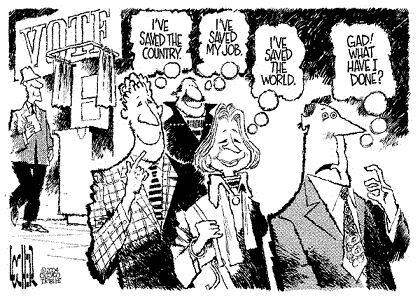
And remember, it's never too late to write in your vote for the best man.
01 November 2004
New Blawg
White Collar Crime Prof Blog.
Like anyone other than a professor would think white collar crime interesting enough to devote a whole blog to it.
;-)
Like anyone other than a professor would think white collar crime interesting enough to devote a whole blog to it.
;-)
Different Types of Client Families
I was appointed to two different clients today and they demonstrate how different client families can be.
First, you must understand that in Virginia a pretrial hearing is held to make sure the Defendant knows what he is charged with, find out what he's going to do about an attorney, and review the bond set by the magistrate. This particular county doesn't even bring the Defendants over to the court for the hearing. They use a system of cameras and TV's which allows the hearing to be done between the judge in the courtroom and the Defendant at the jail.
The system works okay except that when families come to court to support their son/brother/cousin. The family is there hoping to see there loved one and they have to settle for a picture on the TV. However, generally the judge will allow family members to come up to the bench when the pretrial hearing is going on, say a few words in the Defendant's favor, and then say something to the defendant through the microphone.
I'm sitting there waiting to see if the judge will appoint me to a case or two. The first I'm appointed to is a drug case. The client's wife is already standing up at the bench when the judge calls me up. The judge looks at Client's record, including a number of prior minor drug convictions, and is told by the pretrial officer that a couple misdemeanor offenses are pending in another jurisdiction. Pretrial's recommendation is no bond. The judge, not too happy, asks me what I think and I point out that pending misdemeanors do not trigger the presumption against bond, I think Client is entitled to some bond, and if the bond is too high I will come back in a couple days with a bond hearing. The judge then asks Wife if she has anything to say in his favor and she says "No." The judge then sets a bond of $10,000. Wife doesn't even blink. Judge lets me say a few words to my client then lets Wife speak to him: "Joe, we'll meet with a bondsman and have you out this afternoon." At this point the judge kind of backs up, looks kinda sideways at Wife, then turns to me and adds pretrial drug screens and reporting requirements to the bond. He surely did not expect that reaction from the wife of my (indigent) client. After the hearing ends I walk out of the courtroom with Wife (and a couple of other guys who were in the back). Wife barely stops long enough to take my card before she scoots out of the courthouse to go get the bondsman.
A little later I am called back to the bench. When I get there I am appointed another client. His mother and uncle are already standing at the bench. I get handed the paperwork and look down to see attempted murder. Needless to say, the judge does not grant any bond despite a heartfelt plea from Mother and what appears to be a sterling past (no record, good job, steady residency, etc.). I speak to Client for a second and then Mother is allowed to talk to him. She's sobbing a little but gets through some comfort words; then Uncle tells him to hang tight. As I'm getting ready to walk away from the bench with the family, Client (who has been pretty stoic to this point) puts his head in his hands and sobs. With that Mom starts bawling. Uncle guides her down the aisle toward the back of the court. Halfway out the rest of the family (8 people came to court) starts filing out and then Mother lets out a wail and collapses. Uncle catches her and he and another male family member carry her out of the court as she wails at the top of her lungs. We get out of the courtroom and go to a quieter corner of the hallway where Mother quiets to alternating crying/sobbing. I'm surrounded by the family and have to explain several times why Client has no bond. Eventually the family seems somewhat satisfied and go on their way.
I can't think of two families reacting much differently to the incarceration of a loved one.
31 October 2004
Scott Peterson - The Jury Instructions
The judge in the Scott Peterson case has ruled to allow a second degree murder instruction but not a voluntary manslaughter instruction. Admittedly, I have not followed this case extremely closely but my understanding is that the physical evidence of anything happening is almost nil. In such a circumstance I do not understand how the judge can decide to exclude the manslaughter charge.
Second degree murder is defined in California's penal code sec. 189 by what it is not and this seems to mean that it is not premeditated. Voluntary manslaughter is defined in California penal code sec. 192 as "the unlawful killing of a human being without malice, upon a sudden quarrel or heat of passion." Both sections can be found here.
I could spend the next two hours researching California case law to see if I can find the exact difference between those two statutes in California but I'll leave that to California lawyers. So you're going to get my very basic understanding of the difference between these two statutes: not a whole heck of a lot. But, you say "malice" - there must be malice in order to convict of second degree murder!
Sure there must. But malice in a second degree murder is begging the question. To prove malice you are pretty much going to have to prove "aforethought." Or, in more modern language, in order to prove malice you are going to have to show premeditative acts.
As an example, let's assume a set of circumstances.
So what is 2d degree murder? Technically it's malicious homicide without forethought. If you cannot prove forethought through some sort of action how do you prove malice? If you convince people that malice exists they are going to be convinced that a second of forethought exists (if nothing more than "I'm going to kill you, you son of a buck!"). With that in mind, 2d degree murder becomes an option to offer a jury (or judge) which isn't all that comfortable with convicting someone of a crime which we all know would subject him to death or life in prison.
So basically, 2d degree is homicide without real proof of actions indicating a malicious intent to commit murder. This is pretty much the same evidence which would support voluntary manslaughter. Again, how do you not give these instructions simultaneously?
Second degree murder is defined in California's penal code sec. 189 by what it is not and this seems to mean that it is not premeditated. Voluntary manslaughter is defined in California penal code sec. 192 as "the unlawful killing of a human being without malice, upon a sudden quarrel or heat of passion." Both sections can be found here.
I could spend the next two hours researching California case law to see if I can find the exact difference between those two statutes in California but I'll leave that to California lawyers. So you're going to get my very basic understanding of the difference between these two statutes: not a whole heck of a lot. But, you say "malice" - there must be malice in order to convict of second degree murder!
Sure there must. But malice in a second degree murder is begging the question. To prove malice you are pretty much going to have to prove "aforethought." Or, in more modern language, in order to prove malice you are going to have to show premeditative acts.
As an example, let's assume a set of circumstances.
Husband comes home and confronts wife while she is washing the dishes: "You whore, I know you've been sleeping with my boss!" They start screaming at each other and she takes the knife she was drying and stabs him in the heart.If she did this out of pure animal anger, with nary a thought until she is calling 911 in a panic, this is voluntary manslaughter. If she thinks to herself "I've got to do something. This can't get out." and then plunges the knife into his heart, that's first degree murder. At least it is if California follows the rule that premeditation can occur the second before the murder (which I understand to be the law in most places).
So what is 2d degree murder? Technically it's malicious homicide without forethought. If you cannot prove forethought through some sort of action how do you prove malice? If you convince people that malice exists they are going to be convinced that a second of forethought exists (if nothing more than "I'm going to kill you, you son of a buck!"). With that in mind, 2d degree murder becomes an option to offer a jury (or judge) which isn't all that comfortable with convicting someone of a crime which we all know would subject him to death or life in prison.
So basically, 2d degree is homicide without real proof of actions indicating a malicious intent to commit murder. This is pretty much the same evidence which would support voluntary manslaughter. Again, how do you not give these instructions simultaneously?
30 October 2004
Around the Web
1) In Virginia Hammoud precludes the federal prosecutor from adding extra sentencing factors in the indictment.
2) Attorney, thou shall not steal from thy clients.
3) A Texan asks a judge to let him be killed.
4) An attorney calls out a judge. Gotta say, I suspect the questions from the prosecutor must have been a little less clear than the one proffered (although it is actually two questions and therefore not proper).
5) Judicial shenanigans in California.
6) Ramadan, Muslim kids, and police in the U.K.
7) Mexican workers arrested in Virginia; must be Tuesday, or maybe Wednesday, perhaps Thursday or maybe . . .
8) No matter how tempted you are, it might not be in your best interest to shush someone during a French cartoon movie. However, it is probably an even worse idea to beat up the shusher.
9) MC Estoppel needs a job in the NY, NY area. I can't help since the nearest thing I could offer would be an eat-what-you-kill position in Virginia but I thought maybe someone out there might know more about NY than I (my main knowledge of NY City being that if I am on a cattle drive my Salsa had best not be from that city - "New York City?!? Get a rope!").
10) Mr. DA further elaborates on how warrants are issued. I would make one comment on his jury "nullification" section: yes, juries have the right to nullify however it is verboten for them to be told they have this right. If I make a jury nullification argument in court the prosecutor will object and the judge will, very sternly, instruct the jury that they are only to decide the facts, not whether the charge is a just application of the law.
11) How a Texas jury makes its decisions.
12) Just remember, if the neo-prohibitionists get their way priests won't be allowed to drive from one church to another in order to celebrate mass. I wonder if the argument that it's not actually wine would hold up in court (its reality having changed with only the accidents of its form remaining the same).
13) It looks like PDD is coming to the private sector (they must have tempted him with promises of a yacht and his very own Stately Wayne Manor).
14) Going back to ice the bird probably wasn't too bright.
15) I'm a PD is now working DUI's and getting trouble from people who really aren't indigent. Blonde Justice feels her pain.
16) Waddling Thunder wonders whether jurors understand the jury instructions. In reply all I can say is go watch a jury being read the instructions. They will try hard to keep their attention focused for the 20+ minute monotone reading of the instructions by the judge (and that's in your basic criminal trial). But the instructions have the virtue of being impossible to focus on for that long. I always suspect that after the judge sends them back to the jury room with a copy of the instructions they spend the first 30 minutes rereading the instructions to try and figure them out.
17) And finally remember, this Tuesday you will be faced with two simple choices: Vote or Die.
LvJoshua C.
29 October 2004
Off Point: Warning Signs of the Apocalypse - Brought to You by the Letter "B"
First there was Blakely and a federal court actually ruling that unconstitutional guidelines are unconstitutional. This raised the first first feeling of uneasiness.
Then I went to my 20th year Bryan Station high school reunion. There I met my best friend from high school. When last we saw on another he was a dyed in the wool Baptist who didn't drink or dance, and he was living a most straight-laced, wife and two kids, white picket fence life. Now he's getting divorced, he bought the beer and brought the good bourbon, he got a little snookered, and danced the night away with other fellow's wives. It was a subtle sign which I'm sure a great many of you missed.
Next came the Bengals winning a Monday night football game. Now, I'm a Bengals fan but I'm pretty dawg-on sure that this is what is supposed to happen right before the trumpet sounds.
Finally came the on definitive sign which no one can deny. Boston won the World Series. It's over folks. The seal has broken a dragon is loose and these four are riding over the horizon:

It's all over Ladies and gentlemen. I'm going to go home, hide under my bed, and wait for the end.
Then I went to my 20th year Bryan Station high school reunion. There I met my best friend from high school. When last we saw on another he was a dyed in the wool Baptist who didn't drink or dance, and he was living a most straight-laced, wife and two kids, white picket fence life. Now he's getting divorced, he bought the beer and brought the good bourbon, he got a little snookered, and danced the night away with other fellow's wives. It was a subtle sign which I'm sure a great many of you missed.
Next came the Bengals winning a Monday night football game. Now, I'm a Bengals fan but I'm pretty dawg-on sure that this is what is supposed to happen right before the trumpet sounds.
Finally came the on definitive sign which no one can deny. Boston won the World Series. It's over folks. The seal has broken a dragon is loose and these four are riding over the horizon:
The painting which this post parodies can be bought here
It's all over Ladies and gentlemen. I'm going to go home, hide under my bed, and wait for the end.
A Week in the Life of a Criminal Defense Attorney
Monday: Okay, all sorts of cool stuff took place on Monday but the computer ate it and it's too large to type in again. Sorry.
Tuesday: In the morning I have a possession of marijuana case. Client has never been convicted of marijuana before and that usually means a suspended jail sentence. However, the prosecutor doesn't want to offer anything less than the 30 day max because my client has previously been convicted of more serious drug offenses. So we do a naked plea and try to convince the judge that Client should get the typical first disposition. It doesn't work - the judge gives him 30 days (15 to actually serve). It's not really too bad; Client chose not to bond out and has already served over more than that waiting for trial.
Wednesday: I spend the day trying to catch up on paperwork. I'm not sure I made any kind of significant dent in the pile but I tried.
Thursday: In the morning I have a lady who is returning to court to see if she has completed the alcohol program she was required to enter. She has not because she got another DUI and has moved across the Commonwealth. She is about to re-enter a similar program because of the new conviction. Still, the judge gives her 4 days to serve on weekends (actually one weekend). She's tickled pink.
Friday
In the morning I have two cases. The first is a client accused of having drugs in jail. The prosecution has not gotten its lab report back yet so the judge grants them a continuance. It doesn't really effect my client too much because she is serving a sentence while waiting for this trial.
The second case is an 18 year old kid accused of stealing all sorts of stuff. Not much doubt about it. There are fingerprints, stuff found by the police, stuff found by the staff of Client's halfway house, and a confession. Still, I get the prosecutor to drop three charges (three felonies get certified to the grand jury).
In the afternoon I have to attend the first day of a federal CLE which is mandatory for those who are on the federal court appointed list. It starts out with someone from the federal PD's going over Blakely. Not much said that I hadn't seen a loonngg time ago at Sentencing Law & Policy.
Then we got a lecture by the head of Pretrial services and another PD about how we should contact pretrial and our client before we first hearing. Of course, we're all sitting there thinking that this is great in theory except for the fact that most of the time the call from the clerk gives you such a short time to react that it just ain't gonna happen. The PD pointed out that there is something out there called PACER which is supposed to let us get info about our clients. I'm going to have to figure out what that is if the federal court ever gives me another case.
The next lecturer is talking about the guidelines. It's a power point presentation (which is a bad thing) but she does start out giving us some useful information like the Sentencing Commission's web site (www.ussc.gov), where you can get all the various permutations of the guidelines over the years, and the number for the helpline (202.502.4545). Then she went through various possible applications of the guidelines depending upon when the alleged crime occurred and different applications of the various upward sentencing "enhancements" (for instance, if your client walks away from a halfway house it is a crime of violence). The lecture started to go long and the room started getting really warm. I, being the idiot I am, have chosen a seat on the front row and I'm fighting like crazy to keep from falling asleep; the lady must have thought I was nuts because I kept shifting my seat and moving my head so I wouldn't doze off.
After a short break (during which somebody cranked the air) we restart with another guidelines lecture. First we are spoken to by a probation officer who knew the guidelines so well she spoke in a bunch of numbers and letters which I'm sure made absolute sense to her but left my head spinning a little. Then a lawyer got up and went over the firearm enhancements. The most disturbing part of this was being told that, at least in the 4th Circuit, the Defense must prove that the connection the drugs and guns alleged by the prosecution is improbable (can you say burden shifting boys and girls? I knew you could).
Next we were spoken to by a judge who tells us that he originally found the guidelines unconstitutional way back when they were first put in place but that appellate judges didn't agree with him. He basically asks us to bring more arguments in front of him as to various sentencing factors, in particular as to drug weight and amount of a fraud. It's a nice thought but not really all that practical considering the ability of the prosecution to punish a federal Defendant for doing such a thing.
After a short break we are addressed by a few more people about the guidelines. Another judge addresses us and tells us that he wasn't around when the guidelines came into existence but he thinks that in a number of cases they are too harsh. He outlines the Rybicki, 96 F.3d 754, 5 part analysis to see if a departure is allowed (my impression was OMG how does anybody qualify under that analysis?). He goes on to remind us all that there must be a "principled ground of departure." Basically these are criminal history departures (i.e if your client's entire prior record consisted of reckless driving and habitual offender traffic offenses), medical reason departures (which elicited from a lawyer the warning "but remember BOP will always claim it can handle any medical condition"), and the combination of factors departure (a bunch of factors, none sufficient of and by itself).
A couple more people spoke. A federal prosecutor got up and went over some enhancements. Most of it was typical stuff about guns and violence. However, one part did stick out. It's a power point presentation (again, a bad thing) and as one slide flashes up it lists a number of factors which she then tells us out loud, except for one. The last enhancement listed was 18 USC 117 "White Slavery." You've got to be kidding me?!? "White Slavery"?? The only reason I can think of that this term is still used is because it has become a term of art. That's got to be it. Either that or there's still some really interesting (and very wrong) statutes out there. I can just see the argument now: "That doesn't apply to my client, your honor, he only transported oriental women to Virginia for prostitution. There was nary an occidental woman in sight." Think I could get a strict construction of that statute?
Oh yeah, we also found out that the 4th Circuit has ruled pick-pocketing (larceny from a person) is a crime of violence for enhancement purposes.
Then came the most joyous moment of the day. A PD from the D.C. office came in and talked for a while. He called us all out. Basically he said, in a less direct manner, that we were all slacking because the rate of downward departure in our district is a third of what it is around the country. A lot of heads kind of snapped up when he said that but everybody held their collective tongues. The only person who said anything was the judge who pointed out the fact that we are in the 4th Circuit might have a lot to do with the fewer downward departures.
Saturday
Yes Saturday. I stumble out of bed and drive over to go to the next day of the mandatory federal CLE. I'm not exactly thrilled to be there at 9:00 a.m. on a day when I should be in Kentucky at Centre's homecoming. I sit in the back 'cuz I'm not really all there.
I must admit that Saturday didn't get the scrupulous attention (and copious notes) Friday did. So you're only going to get the things that were interesting enough to stick in my mind.
The lady who came to tell us all about federally approved interpreters was commenting upon social differences between U.S. and Hispanic cultures. She gives as an example the fact that most people in the U.S. have only one surname. She then goes on to explain that Hispanic cultures combine the surname of the father and the surname of the mother. She finished by saying that not having two last names inferred that one only had a mother. The Cuban-American sitting next to me (with only one name) leaned forward to the Argentinian-American sitting in front of me (with only one name): "Did she just call us what I think she called us?" To which the other answered: "Yeah, well I've known I was a bastard for years now."
A little later in the morning a judge who now sits in our district is commending to us the idea of open files and tells us, "When I was the U.S. Attorney for this district I always told my prosecutors that if there was any question as to whether something was required to be turned over under Brady the fact that you are asking the question means it does."
Shortly after the judge finished speaking an attorney stood before us and, as the judge sat two chairs downs from him, expounded upon what we needed to be doing better and said he realized that it was hard to do anything in the federal courts "because the judges are the whores of the prosecutors."
Later in the day we were regaled with the story of a couple of defendants who were (if I'm remembering it all correctly) found not guilty of murder in Virginia. Then they were charged with drug and murder charges in the federal system. They were again found not guilty of murder but guilty of the drug charges. Guess what they were sentenced for? Yep, you got it: they were sentenced for murder.
The low point of the day came when the Managing Assistant US Attorney for the Richmond office came in to speak to us. He starts out by breaking down how many AUSA's are in his office and then transits into a point he really shouldn't have been making: don't destroy your credibility with the prosecutors by filing frivolous motions or fighting unrealistic battles.
We had spent the last day or so being told we aren't doing enough, that we need to argue more motions, that we need to file more paperwork, that there must be something we can do to keep our clients from getting a raw deal, etc. Somebody should have told him that before he started speaking because it was not a crowd which was prepped to be receptive to what he was saying.
To be fair, the point he was trying to make has some merits. In a case with an actual 4th Amendment issue you approach the prosecutor differently than in a case where the prosecution has 20 witnesses, a videotape of the robbery, dye pack ink on your client's clothes, and a confession. Handle all the cases the same way and it is unlikely that prosecutors will listen when you actually have something to say to them. However, that will always be a delicate point to make; even a Defense attorney has to walk on eggshells when he says something like that in a crowd of Defense attorneys.
The prosecutor starts talking about this and grumbling starts in the crowd. He pushes forward and at one point actually says the office keeps track of the Defense attorneys by the motions they have filed; I know that focused my attention. The grumbling got louder and still he pressed on. Finally a lawyer in the back snapped and loudly told the prosecutor he was wrong - that it is not our job to choose who gets a good defense and who does not. Then a lady toward the front told him it was obvious he had never been a Defense attorney because he didn't understand that these motions and filings are often done, even in losing causes because we know the bar complaint will be forthcoming. Down the row someone started heckling in stage whispers. People stopped paying attention and many there was a lot of traffic at the doors. It was bad.
There were other lectures but the remainder were rather mundane compared to that.
[CLE comment] There were some themes which came through:
(1) Judges would like to hear more argument over factors etc.
It's unrealistic under the prosecutorial controlled federal system but I can understand why they'd like us to do some of these things and put a little more control back in their hands. While I would not go so far as the attorney above I've gone as far as to say that it seems the Congress has relegated federal judges to clerks for the prosecution.
(2) More than one non-PD lawyer basically said that the real place to practice law is now in the State systems. Nobody quite said that the federal system is now the bush leagues but the clear implication was that the federal system has become a place where so much power has been shifted into the prosecutor's hands that the law really doesn't matter so much.
Things I noticed:
(1) I had to watch a tape of the last one of these CLE's when I first started taking federal appointments. It was striking how the last time it was run by and the lectures were done by prominent local attorneys and this time it was clearly the PD's show.
(2) I was surprised at the low turnout. This was a mandatory, come or never get another appointed case, CLE. The room was nowhere near full. Now, they were taping it. I missed my college homecoming because this event was scheduled on a bad date (why not do this in February, nothing is going on then). If all sorts of people just didn't come for whatever reason and are allowed to just take the tapes to their office and "watch" them . . .
All in all it wasn't that bad of a CLE. The one put on by the State Bar's criminal section and the ones put on by the criminal bar are better but I got a fair amount of knowledge out of this one. Now if I can just get appointed to another federal case so that I can apply it.
27 October 2004
Comments on Texas & Juvenile System
Yesterday I published "Texas Yet Again." It brought this comment:
Beyond that, I have no idea who the attorney mentioned is but here's an article about it so you can all judge yourself. Personally, I believe blatant delaying actions by an attorney at the appellate level are rare. All attorneys are asked by some clients to engage in delaying tactics. Nevertheless, most of us won't do it simply because the client tells us he doesn't want to go to prison. On the other hand, I have been required by court appointed clients to file petitions for appeal which I think the client is pursuing to put off going to jail / prison. However, none of my clients has been dumb enough to tell me that and I have never, ever filed an Ander's Brief. Never had to because every one of my appeals has had some sort of legal argument.
As well, delays in trials in order to get rid of witnesses probably happen in a small number of cases but I suspect this is more myth than reality. Competent courts just aren't going to let this sort of thing occur. The Defense might get away with one continuance on shaky grounds but the judge isn't going to play that game for long - he will force you to trial. The perception that Defense attorneys take this route is probably based in the fact that in major, intricate cases the Defense often has to continue the case in order to prepare witnesses, investigate, get the proper experts, &cetera. Remember, the police and prosecutors can take a long time to prepare everything before they file a charge. The Defense is usually going to have to do everything after the client is charged. Because of speedy trial limitations a court will set court dates before the Defense can possibly be ready and it will be forced to ask for continuances (waiving speedy trial).
I do not know if the 50% dismissal of juvenile cases is true and I do not know what is exactly meant by "juvenile cases." If it means all cases involving a juvenile I suspect the percentage may be even higher because a just juvenile system should have a safety valve of some sort so that kids who get in fights with other kids or take a stick of gum when their mother wasn't looking don't get a criminal record (particularly in this era of non-sealed, non-erased juvenile records). If it means adult sex and/or violence on a child I wonder about the percentage. Of course, there will be a significant percentage of children who could not testify because they are simply too young. There is also the fear of brainwashing that we all realize happened in the recent past. Still, prosecutors show a zeal for prosecuting these types of cases which you seldom see elsewhere. I must say that I find it hard to believe that they let 50% just fade away.
And a PD who requires the complaining witness to testify that a crime actually took place really doesn't bother me all that much. Sorry that's just my perspective as an evil Defense attorney.
Back to what began this all - The man for whom the judge in Texas threw a party. He was going to prison with that massive sentence one way or another. It is simply unprofessional to do something like this. It's funny but unprofessional. I've stood in front of any number of judges who have been angry at my client for one reason or another. I've seen clients lectured, yelled at, spoken to sarcastically, and oversentenced because they did something dumb which caused the judge to unload on them. I've never seen anyone go through something that elaborate in order to humiliate a Defendant.1 I expect I'll never see anything like this in Virginia; our judges have too much of a sense of propriety for that kind of behavior.
1 And personally, I have no problem with humiliation being part of punishment as long as it serves a purpose. If you force men at a jail to wear pink coveralls and work road detail in plain sight of everyone it discourages people wanting to act in a manner which will land them in jail. If you make someone stand mute in front of a store with a large sign saying "I stole from this store" it discourages that sort of activity. This party accomplished little outside of simply poking fun at the man. He's going to prison for life so his behavior won't change and those whom he tells of this are likely to be long termers as well. What good was accomplished?
I can understand why the guilty man headed for a life sentence wouldn't enjoy his going-away party especially since he had been a fugitive from justice for a year. But, there will be few Texans who are much concerned that the judge celebrated his return to her courtroom. On the contrary, the average citizen of the Lone Star State feels much greater grievance at what criminal lawyers like Lott Brooks do.First of all, I don't know whether the Texas legal system is better or worse than Virginia. Do I poke fun at Texas on occasion? Yep. I don't know why but Texas always seems to have something kind of unusual going on. It's probably just because it is a big State with a lot of people so there's a lot more chances for things to happen. It's just that whenever I get really, really depressed about what I see happening legally in Virginia I can always Google News Texas and find something which makes me feel better.
Brooks requested five extensions and ignored twelve past-due notices in filing a brief with the 14th Court of Appeals. He finally submitted an "Anders brief", an admission that his client had no basis for appeal. He freely admits that he filed the extensions and ignored the notices to keep his client, who had pled guilty to aggravated sexual assault of a child, out of prison on appeal as long as possible.
The judge of the appeals court ordered Brooks arrested and sentenced him to two days in jail and a $500 fine, citing Brooks's abuse of the appeal process. (For his part, Brooks attributes his penalty not to his conduct but to racial prejudice.)
Half of all juvenile court cases in the USA are dismissed because the victims do not testify. One of the main reasons for this is that the public defenders who handle 90% of such cases exploit the legal system's burden on witness by stalling tactics like Brooks's. They file continuance after continuance, wasting days and days of the victim's time. When and if the case does come to trial, the PD requires the witness to testify that he really didn't give the defendant permission to break out a window in the victim's car, hack the dashboard open, bypass the ignition, steal the car and set it on fire.
The Texas criminal legal system might not be as good as that of Virginia, as you claim. But, most of the citizens of either state are more concerned about the safety of their lives and property than hurting the feelings of a man who nearly strangled his girlfriend to death.
Beyond that, I have no idea who the attorney mentioned is but here's an article about it so you can all judge yourself. Personally, I believe blatant delaying actions by an attorney at the appellate level are rare. All attorneys are asked by some clients to engage in delaying tactics. Nevertheless, most of us won't do it simply because the client tells us he doesn't want to go to prison. On the other hand, I have been required by court appointed clients to file petitions for appeal which I think the client is pursuing to put off going to jail / prison. However, none of my clients has been dumb enough to tell me that and I have never, ever filed an Ander's Brief. Never had to because every one of my appeals has had some sort of legal argument.
As well, delays in trials in order to get rid of witnesses probably happen in a small number of cases but I suspect this is more myth than reality. Competent courts just aren't going to let this sort of thing occur. The Defense might get away with one continuance on shaky grounds but the judge isn't going to play that game for long - he will force you to trial. The perception that Defense attorneys take this route is probably based in the fact that in major, intricate cases the Defense often has to continue the case in order to prepare witnesses, investigate, get the proper experts, &cetera. Remember, the police and prosecutors can take a long time to prepare everything before they file a charge. The Defense is usually going to have to do everything after the client is charged. Because of speedy trial limitations a court will set court dates before the Defense can possibly be ready and it will be forced to ask for continuances (waiving speedy trial).
I do not know if the 50% dismissal of juvenile cases is true and I do not know what is exactly meant by "juvenile cases." If it means all cases involving a juvenile I suspect the percentage may be even higher because a just juvenile system should have a safety valve of some sort so that kids who get in fights with other kids or take a stick of gum when their mother wasn't looking don't get a criminal record (particularly in this era of non-sealed, non-erased juvenile records). If it means adult sex and/or violence on a child I wonder about the percentage. Of course, there will be a significant percentage of children who could not testify because they are simply too young. There is also the fear of brainwashing that we all realize happened in the recent past. Still, prosecutors show a zeal for prosecuting these types of cases which you seldom see elsewhere. I must say that I find it hard to believe that they let 50% just fade away.
And a PD who requires the complaining witness to testify that a crime actually took place really doesn't bother me all that much. Sorry that's just my perspective as an evil Defense attorney.
Back to what began this all - The man for whom the judge in Texas threw a party. He was going to prison with that massive sentence one way or another. It is simply unprofessional to do something like this. It's funny but unprofessional. I've stood in front of any number of judges who have been angry at my client for one reason or another. I've seen clients lectured, yelled at, spoken to sarcastically, and oversentenced because they did something dumb which caused the judge to unload on them. I've never seen anyone go through something that elaborate in order to humiliate a Defendant.1 I expect I'll never see anything like this in Virginia; our judges have too much of a sense of propriety for that kind of behavior.
1 And personally, I have no problem with humiliation being part of punishment as long as it serves a purpose. If you force men at a jail to wear pink coveralls and work road detail in plain sight of everyone it discourages people wanting to act in a manner which will land them in jail. If you make someone stand mute in front of a store with a large sign saying "I stole from this store" it discourages that sort of activity. This party accomplished little outside of simply poking fun at the man. He's going to prison for life so his behavior won't change and those whom he tells of this are likely to be long termers as well. What good was accomplished?
26 October 2004
Forensic Science Hall of Shame
Going thru the internet trying desperately trying to find an appropriate expert for my case I tripped upon this site which outlines the failures of various forensic experts in the courts.
Texas Yet Again
As always, when I get upset at how bad things seem to be in the Virginia criminal legal system all I have to do is look to Texas and realize it could be much worse.
Qualifications to be Chief Justice
You must have empathy for those accused:
In one instance, young Fred's sympathy for one inmate got carried away, even in the eyes of the would-be beneficiary. It happened when he was four years old. Fred, recalling the incident years later, said, "There was a prisoner to whom I took a liking. I decided he didn't belong in jail. He hadn't told me he wanted out, but I made up my mind I'd help him escape. I got hold of my father's hatchet, and one day when no one was looking, I walked up to his cell and slipped it through the bars to him." The prisoner, though, was an unwilling participant in the plot. Calling out to Fred's father after the youngster had departed, he said, "Jim, here is a little present your boy just gave me. I figured you would like to have it back".Chief Justice Fred M. Vinson of Kentucky, p. 6
25 October 2004
Around the Web
1. PD shenanigans.
2. Can friendship survive a friend becoming a prosecutor?
3. I know how these hearings come out when my client is being filmed by an officer with his window open but I gotta admit I was a little surprised that what's good for the goose . . .
4. The trial of the soldier who killed fellow soldiers has begun.
5. Orin Kerr, THE reason to read the Conspiracy, is the only person in the world who could find a record of Ashcroft defending civil liberties..
6. Interesting legal decisions in a sex abuse case.
7. Freespace on substantive due process. It's interesting but looooooonnnnnggggg.
8. The ACS Blog discusses the stare decisis position of its version of the devil incarnate, Clarence Thomas.
9. This is why dogs are men's best friends. Reno is a helluva K-9.
10. Ah, to have been the attorney who raised the objection against the prosecution copulating the evidence.
11. Thanks to Professor Bainbridge for reminding us all that it is St. Crispin's day. And lest we all forget, it's not just about Shakespearean play (with an amazing speech that can even reach those not British). On this day, in 1415 A.D., a starving English army of perhaps 6,000 destroyed a French army of at least 20,000 in one of history's most amazing victories.
The Difference
The difference between a court appointed attorney and a "paid" attorney:
A preliminary hearing hearing is scheduled for today. I represent one defendant and a top-flight attorney1 has been hired to represent the other defendant. The hearing gets continued (over defense objections) for two weeks because one of the prosecution's subpoenaed witnesses has not bothered to come to court.
I turn around and walk back to the lockup with my client. The paid attorney turns around and walks back out of the courtroom with the family (while his client goes back into lockup).
---------- ---------- ----------
1 Not kidding here. The guy is one of the two or three I'd hire if I got into trouble.
22 October 2004
Knives and Booze
If we could just get rid of all the knives and alcohol all crime would cease. After all it worked so well with guns.
It's Our Fault
New York would be able to keep people from having guns if it wasn't for us evil Southern States.
No Civil Right Violation
A judge dismisses a civil rights violation case after the prosecution fails to put the complaining witness on the stand.
21 October 2004
Kentucky Courts
As ya'll know, a while back I went back to Kentucky so I could go to my 20th high school reunion. While in town I went to go see the local courts in action.
The first thing I notice is that the courthouses are almost empty. As I walk through the 5 story tall general district courthouse and then the identical building next door for the circuit court, I don't see any officers and only one court is open (in the general district court). So, after exploring for a while I go into the open courtroom.
It's different than Virginia. For one thing they are speaking some strange language - referring to things like "warrants" and "dismissals without prejudice." Nary a Latin phrase to be heard. How can you practice law without speaking Latin? People might actually understand without a lawyer to translate. The HORROR!!!
They also have actual arraignments during the first pretrial hearing. So everyone is standing there giving the pro forma "not guilty." Kinda silly. I don't know how much time there is between serving papers and the first hearing but lots of people already had a lawyer (almost unheard of in the Virginia jurisdictions wherein I practice). Those who had lawyers had their cases called first and, after pleading not guilty, had their next date set. Those with preliminary hearings for felonies had those hearings set at one time and those with misdemeanors had “pretrial conferences” set at a different time.
I go sit in on one of the pretrial conference times and the court is packed. The prosecutors and Defense attorneys are doing their bit up front, negotiating agreements left and right and setting those which are going to trial for jury on a later date (interesting, juries in the inferior court - unfortunately I wasn't in town long enough to watch one). For a while I can't figure out how they are doing it because there are no police around to tell anybody what went on. Then it hits me - everyone has police reports so no police need waste their time at court. Wow!!! How do we get that in Virginia?
Naw. That would take a hefty dose of common sense. Only a few jurisdictions have that hereabouts.
And that's about the extent of my observations of a Kentucky general district court. Well, actually there was one other thing. As I'm sitting there watching the goings on I look at the clerk sitting next to the judge. Now I can't swear to it but the lady looked exactly like the manager of a movie theater I worked at when I was young and dumb. That's not all that remarkable by itself but if she's the same lady she was a pothead who got fired for taking money from the safe (we were not on friendly terms). Interesting . . .
Subscribe to:
Posts (Atom)