
28 December 2003
27 December 2003
Lammers Law Office Bulletin
Kris Kringle Arrested
Kris Kringle Arrested
 | Yesterday, in the County of Arrestafield, Virginia Detective Bluemart and a crack squad of Arrestafield officers swore out a warrant and arrested a man suspected of breaking and entering numerous dwelling houses of others, at night, with the intent to commit a felony therein. Apparently, the man had been under suspicion for a number of years but this is the first year that a "credible" witness has stepped forward. |
 | The witness is a minor so we at the Lammers Law Office will not reveal her name. However, upon being appointed as counsel we have investigated her story and found enough incongruities that we believe the arrest unfounded in fact and law. |
  | Initial news reports indicated that pressure from Homeland Security was a major factor in this arrest as the Accused is not an American citizen. However, the head of Homeland Security's new Yuletide Defense Section, Ben Scrooge, denied this calling it a bunch of "Humbug." (stock photo from Mr. Scrooge's corporation - no government photo available) |
 | Arrestafield police released this artist rendering of the method by which they allege Mr. Kringle entered houses. When reporters confronted him with the obvious impossibilities of a man of Mr. Kringle's girth entering houses via fireplaces Detective Bluemart insisted that Mr. Kringle is a very dangerous fellow: "Mr. Kringle is an accomplished second story man who has managed to enter houses of all sorts throughout many years without a trace of how he has entered. The only confirmed method is the one depicted. Furthermore, Mr. Kringle is an international operator. We have traced his activities in multiple countries; this has not been easy because he has numerous AKA's depending upon which part of the world he is in: Kris Kringle, Santa Claus, Papa Noel, Saint Nicholas, Father Christmas, etc. As well, when questioned Mr. Kringle freely admitted to entering almost all the houses in Arrestafield County on the night in question. When I drove him around we couldn't go 50 feet without him pointing out another house he had entered. He also showed a disturbing amount of knowledge about the children of the County and was even able to list off all the children who had been involved in criminal activities in the last year." |
We Need Your Help
 | Our investigation has uncovered some interesting facts which we believe law enforcement is sitting on. We believe that whoever the actual culprit is he acted with one co-defendant (pictured left). Be very, very careful if you spot this creature as we suspect it might be a jackelope and could turn out to be extremely dangerous if cornered. Your best course of action would probably be to send us an e-mail and track him until we arrive. |
 | After having investigated the description of the actual perpetrator, we at the Lammers Law Office are very interested in speaking to this individual. He is almost an exact match of the description and (as you can see) he fits easily into tubes such as a garbage can (or a chimney). Known primarily by the moniker, "The Grouch," we believe it may have been the goal of this person to steal Christmas. We have a partial address but have not been able to go further than a street name. If anyone knows what city or State this "Grouch Who Stole Christmas" lives in we would be extremely grateful for your assistance in this matter. |
As always, we at the Lammers Law Office look forward to the complete exoneration of our client and will make every effort in the defense of this wonderful man.
26 December 2003
24 December 2003

Technicalities
The Yin Blog and The Curmudgeonly Clerk both have had recent posts on procedural "technicalities."
Generally, I agree with everything they have stated. However, they have inspired me to go off on my own tangent.
I must point out that - at least from my Virginian Defense attorney perspective - that "technicalities" almost always favor the prosecution and no one is upset when that occurs. If you don't believe it go and read any local legal publication which summarizes the decisions of your court of appeals. Invariably there are cases decided in the prosecution's favor because of procedural issues. Most often it seems the procedural error relied upon by the appellate court is that the error was not properly preserved - put another way, the argument in the court of appeals does not mirror the argument made in the trial court.
Example 1: Virginia Code secs. 19.2-11.01 and 19.2-265.01 purport to give a victim the "right" to stay in the courtroom even if witnesses are excluded "unless the court determines, in its discretion, the presence of the victim would impair the conduct of a fair trial." 19.2-265.01. Now, as I read that it means if a victim is not to be called as a witness he can stay in the courtroom; it could also possibly mean that if the victim is going to testify as to what happened on Monday and all the other witnesses are going to testify to entirely unrelated matters which occurred on Thursday then the victim can remain. However, some trial courts have read these statutes to mean that short of an affirmative showing of impairment by the Defense (an impossible standard to show pretrial) the victim stays in the courtroom. Anyone with a drop of sense can see how that interpretation is dead in the water as soon as it runs up against that pesky old federal constitution. The statute is darn near undefendable under the 14th Amendment due process right and the 6th Amendment right to a confrontation which is untainted.
And you know what? Our Court of Appeals has more than a drop of sense. This statute has been challenged twice. Both times, rather than address the unconstitutional application of the statute the court found a way to deny the appeal based upon procedural technicality. The first time the challenge was turned away because
At trial, appellant argued that until the evidence established that a person was a victim, the alleged victim stood in the same position as any other witness in the case and should be excluded from the courtroom. Appellant never argued that his due process right was violated. The Court of Appeals will not consider an argument on appeal which was not presented to the trial court.The second time the challenge was turned away because
[U] Hague v. Commonwealth, (No. 1274-99-2, 23 May 2000)(citations omitted).
On appeal, the defendant contends the trial court erred in failing to exclude Chesnut from the courtroom pursuant to Code § 19.2-265.1. He argues the statute requires the exclusion of all witnesses, including victim witnesses, and that the victims' rights statute, Code § 19.2-265.01, is inapplicable. This argument is different from, and actually conflicts with, the argument he raised at trial: that Chesnut should be excluded under Code § 19.2-265.01, the victims' rights statute, because his presence would impair the trial. Nothing in the defendant's argument at trial indicated that he thought the general statute, Code § 19.2-265.1, controlled rather than the specific statute, Code § 19.2-265.01, dealing with victims.Example 2:
Though taking the same general position as in the trial court, an appellant may not rely on reasons which could have been but were not raised for the benefit of the lower court. We will not consider an argument on appeal which was not presented to the trial court.
[U] Woodell v. Commonwealth, (No. 2241-00-3, 05 Mar 2002)(citations omitted).
First: NCIC records are spit out by machines in the prosecutors' office (and I assume the police station). They are not kept in the clerk's office and can in no way be certified by the clerk as "judicial records" under the hearsay exception provided by Va Code sec. 8.01-389.
Second: NCIC records are hearsay and notoriously subject to inaccuracies. I have sat in a prosecutor's office reading a record which says my client - arrested two weeks before the meeting - had been found guilty of murder and locked away for life ten years prior. I've had police go to the wrong part of the Commonwealth to arrest someone who shared the same name as my client because they thought that person was the one the NCIC applied to. I've had a client accused of being a felon in possession of a firearm because NCIC showed him as having committed a felony when the Navy had him deployed overseas. And any number of times I've had the NCIC show a disposition for a case which, when we got ahold of the actual court records, had been dismissed or reduced to a lesser offense.
Third: There is no statute allowing NCIC reports to prove a Defendant's record - at least none I know of.
Fourth: To prove a felony petit larceny in Virginia the prosecution must prove that two prior larceny (or similar) convictions have been entered against the Defendant.
During a trial for felony petit larceny the prosecution attempts to enter the NCIC report into evidence to prove the prior convictions:
At trial, Investigator Kristie Siron of the Staunton Police Department testified that the felony theft charges were based on Argenbright's record of prior convictions for similar offenses. When shown a copy of a computer printout of Argenbright's NCIC record by the Commonwealth, Investigator Siron identified the printout as appellant's criminal record. The Commonwealth then offered the printout into evidence. Argenbright objected and the following exchange took place:While inartfully argued, the practical reality is that the only records which can be introduced are certified copies of prior convictions. NCIC records are hearsay and cannot be certified as judicial records since they are not in the clerk's office. The Defense attorney clearly has an objection that the convictions are not being proven by the one truly possible manner. The prosecutor and judge try to push him off of that objection; he bends but doesn't break - he maintains his objection. And still, his argument is found technically inadequate. The Court of Appeals has to go pretty far to find it technically inadequate but they do (when's the last time you've seen an appellate court assume a fictitious statute in order to make its decision make sense?).
MR. BOBBITT [Defense Attorney]: Your Honor, I'm going to object to the--this printout, I mean I would think that there ought to be copies of the--of the-- certified copies of the conviction if they are going to establish that he was convicted.
MR. ROBERTSON [Commonwealth's Attorney]: Judge, there is a statute that allows the record to come in.
JUDGE: Isn't that true Mr. Bobbitt?
MR. BOBBITT: I think he's probably right, but I'm not sure about that so I'm--I'm going to object to it.
JUDGE: I'm going to admit it, it's Commonwealth's One.
The trial court relied on the information contained in the NCIC record to prove the prior convictions required under Code § 18.2-104 to convict Argenbright on thirteen out of eighteen felony charges of obtaining money by false pretenses under Code § 18.2-178. The court subsequently sentenced him to the penitentiary for ten years, with seven years suspended. Argenbright appeals the thirteen convictions elevated to felonies pursuant to Code § 18.2-104.
ANALYSIS
The admissibility of evidence is within the broad discretion of the trial court, and a ruling will not be disturbed on appeal in the absence of an abuse of discretion.
Both at trial and on appeal, Argenbright argued that only certified copies of court records of his previous convictions were admissible to prove the prior convictions necessary to convict him pursuant to Code § 18.2-104. While he objected when the Commonwealth sought to admit the printout of the NCIC report, his sole argument was that only certified copies of the convictions were admissible for that purpose.
Argenbright argues for the first time on appeal that the trial court erred by admitting the printout without proper certification pursuant to the Code § 8.01-389, the judicial records exception to the hearsay rule. We will not review on appeal a specific argument not raised before the trial court absent a showing of good cause or as necessary to attain the ends of justice.
. . .
When Argenbright objected to the offer of the printout of the NCIC report into evidence, the Commonwealth asserted that there was "a statute" that permits the NCIC report to be admitted into evidence. In response, the court stated that it also thought a statute permitted the admissibility of the NCIC report as evidence, and asked if Argenbright agreed. He responded that he agreed that the Commonwealth was "probably right but I'm not sure about that so I'm--I'm going to object to it." Argenbright articulated no other grounds to the trial court as to why the NCIC report should not have been admitted into evidence. Neither the trial court nor the Commonwealth's attorney identified the statute "that allows the record to come in." On appeal we will not speculate on which statute the court may have relied.
Absent clear evidence to the contrary in the record, the judgment of a trial court comes to us on appeal with a presumption that the judge knew and correctly applied the law. Argenbright argued that the evidence was inadmissible solely because the NCIC printout was not a certified copy of the court record of his prior convictions. He did not object that the NCIC report was not accurate or that it contained erroneous information. Finally, Argenbright did not object to the NCIC report as inadmissible hearsay or that it had not been properly authenticated. Neither did he object on the grounds of lack of adequate foundation. His failure to raise these objections to the trial court constituted a waiver of these objections. We will not consider them for the first time on appeal.
Argenbright v. Commonwealth, (3282-02-3, 25 Nov 2003)(citations omitted)(emphasis added)
Why? Why, you ask, do the Defense attorneys not make rock solid, coherent, cogent arguments to preserve their objection? Well, it's because the arguments are made off the cuff. Often it's an argument on a statute / rule which both the prosecutor and judge are disagreeing with you about, with no notice that you are going to have to argue about that particular legal point, and you must make sure you do it well enough that an appellate judge and his clerk with as much time as they wish to take cannot find some angle to throw it out. It's dang near impossible to preserve an error mid- trial if the appellate court really wants to throw it out on procedural grounds.
23 December 2003
Tony, over at Oriental Redneck, pointed this article out to me.
Patrick was a 14 year old honor student, who had no prior record. Along with an "of age" kid, he broke into a boatyard to steal a radio. When they saw a video camera the kids made a mistake of gargantuan proportions. In an attempt to destroy evidence they burnt the boatyard down. And the feds brought the wrath of God down on the kid's head.
Why? Because a boat engine at the shipyard belonged to 41. There are statements about the case being undertaken in federal court because the evidence looked weak when the State "asked" the feds to step in and devote their more considerable resources to it and because arson is a crime of violence. However, the article makes it pretty clear that all the substantial evidence was already in hand when the case was "given" to the feds. And, hmmm . . . I know I've never heard a juvenile court judge whine, "I just can't handle this case because there's violence involved."
The State and feds seem to have concurrent jurisdiction here if I remember my conlaw correctly (navigable water=connection to interstate commerce) but it seems to me that this is a case where the proper exercise of prosecutorial discretion would have been to allow the fully developed State juvenile system handle the situation. Instead:
This matter seems to be a case study in exactly the kind of case which shouldn't have been brought in federal court. Putting a 14 year old in a detention home should be a last resort (although, in this case a couple months over a summer might have scared some sense into the kid) and 30 months is basically writing the kid off. He may be a honor student now but, even if he's put in a good juvenile facility, by the time he gets out his education will be far behind those of his age. And if he remains in the place he's at now he will have spent almost three years learning to survive among the youths with whom your worst nightmares are populated. Chances of recovering from this are almost nil (and I say almost because there is always hope for some miracle). How does this serve either society or the youth?
Also check out the post on this issue at Is That Legal?
1 Caution - it's been a while since I read the article so I'm paraphrasing as best I can remember. Some of this may have come from discussing the article with other Defense attorneys.
Patrick was a 14 year old honor student, who had no prior record. Along with an "of age" kid, he broke into a boatyard to steal a radio. When they saw a video camera the kids made a mistake of gargantuan proportions. In an attempt to destroy evidence they burnt the boatyard down. And the feds brought the wrath of God down on the kid's head.
Why? Because a boat engine at the shipyard belonged to 41. There are statements about the case being undertaken in federal court because the evidence looked weak when the State "asked" the feds to step in and devote their more considerable resources to it and because arson is a crime of violence. However, the article makes it pretty clear that all the substantial evidence was already in hand when the case was "given" to the feds. And, hmmm . . . I know I've never heard a juvenile court judge whine, "I just can't handle this case because there's violence involved."
The State and feds seem to have concurrent jurisdiction here if I remember my conlaw correctly (navigable water=connection to interstate commerce) but it seems to me that this is a case where the proper exercise of prosecutorial discretion would have been to allow the fully developed State juvenile system handle the situation. Instead:
He was given the maximum sentence allowed: 30 months incarceration, followed by 27 months of probation. He was then sent to a maximum security juvenile facility in Pennsylvania on the order of the federal Bureau of Prisons.Personal observation: This case brings to mind an article in a recent edition of the Virginia Lawyers Weekly. Written by a federal judge, it basically said the worm has turned and urged Defense attorneys to fight their cases through. The logic seems to be that the obnoxious guidelines combined with the fact that more and more trivial criminal matters are being brought in federal court has brought disfavor upon the prosecutors1. Personally, I cannot confirm or deny this because these pieces were already in play when I started watching the federal courts but I can say that prosecutors seem to get far more deference in the State courts wherein I practice.
. . .
Patrick is being kept at the Cresson Secure Treatment Center in the central part of [Pennsylvania].
Cresson is for the most serious juvenile offenders in Pennsylvania who have proved disruptive in other facilities. Patrick is now housed in a wing where the other inmates are all mentally ill or mentally retarded.
. . .
[T]he education he is receiving . . consists of Patrick's volunteering to tutor the other boys in reading or arithmetic.
Federal law requires that juveniles convicted in federal court be provided with proper education, and that "whenever possible" they should be kept in a facility "located in or near" their home. Cresson is 570 miles from his home.
This matter seems to be a case study in exactly the kind of case which shouldn't have been brought in federal court. Putting a 14 year old in a detention home should be a last resort (although, in this case a couple months over a summer might have scared some sense into the kid) and 30 months is basically writing the kid off. He may be a honor student now but, even if he's put in a good juvenile facility, by the time he gets out his education will be far behind those of his age. And if he remains in the place he's at now he will have spent almost three years learning to survive among the youths with whom your worst nightmares are populated. Chances of recovering from this are almost nil (and I say almost because there is always hope for some miracle). How does this serve either society or the youth?
Also check out the post on this issue at Is That Legal?
1 Caution - it's been a while since I read the article so I'm paraphrasing as best I can remember. Some of this may have come from discussing the article with other Defense attorneys.
Martha Inc:
Six days to screen jurors? Typically, I get about 15 minutes. I'm not even sure exactly what I could do with six days.
Day one, hour one: Read the available information.
Hours two thru three: Meet with my overpaid jury consultants (good gracious how I'd love to have overpaid jury consultants).
Hour four: Shoo the overpaid jury consultants out of my office - or better yet, go to lunch with the head jury consultant so that lunch at Chez Expensive gets charged to Martha Inc.
Hour five: Talk with co-counsel (or if desperate associates) about the jurors and recommendations from overpaid jury consultants.
Hour six: Mark all the people off the jury that I don't want on it (probably the same ones I would have done in 15 minutes).
Hour seven: review to make sure I didn't make any mistakes.
I can almost stretch it out to a whole day if I try real hard. Of course, I come from the realm of flat fees so I've not perfected the skill of hourly billing. If I worked at mega-downtown firm maybe I could stretch over a few days so that I could increase my billable hours.
Found at Stop the Bleating! is a forward to an article about a Brooklyn officer who thought he could confess to malfeasance on the internet and remain anonymous:
In railing against an unspoken traffic ticket quota he says that officers must meet -- 10 tickets per week, he contends -- he writes: "The new commanding officer of the precinct is pressuring us to write more and more tickets. We were officially told NOT to write anymore tickets for headlights and taillights. Most people fix the problem within 24 hours and the ticket would be admonished therefore the City of New York makes no money in the end.No, really, they're checking on an officer who admitted to illegal activity?
"So I have come up with a better way of writing tickets. I just write down the plates of the cars that cut me off the the (sic) parkways and I send them a bogus parking ticket in the mail. The person will then have to deal with the Parking Violations Bureau and not me. Problem quickly resolved. So, in other words, be careful who you cut off on the road. They might be an off duty cop and they could write your plates down and write you a $150 parking ticket. Have a nice day."
A police source said Internal Affairs investigators are reviewing all tickets written by the officer.
Malvo Sentenced to Life

When the jury came back at 4 p.m., the foreman handed the judge only the verdict on the terrorism charge. Circuit Judge Jane Marum Roush sent jurors back to the jury room to fill out the other form. But they had not circled the verdict on the form, and the jurors were sent back to the jury room for a second time. Seconds later, they returned with the verdict. The jury then came back at 4:10 p.m. and handed the second verdict form to Roush.The prosecution is giving his reasons for the verdict:
The sentence is a stunning win for Malvo's defense team, which focused its efforts throughout the trial on saving the teen-ager's life rather than proving his innocence.
Prosecutor Robert F. Horan Jr. said afterward that Malvo was ``very lucky that he looks a lot younger than he is.'' And he suggested the timing of the deliberations just days before Christmas affected the jury.I guess sometimes - even when you choose the most likely jurisdiction, in the most likely State - little glitches occur in your attempt to make sure someone gets killed. General Ashcroft, on behalf of the Bar of the Commonwealth of Virginia, I'd like to introduce you to Mr. Craig Cooley.
``We used to have a theory when I was a very young prosecutor that whatever you do, don't try one on Christmas week,'' Horan said.
(2) Malvo's parents express gratitude to the jury.
(3) Family members and victims reacted:
Victoria Buchanan Snyder, brother of Sonny Buchanan, one of the 10 dead, said "I cannot say I am not disappointed, because I am disappointed." "There cannot be another case more deserving of the death penalty," she went on, but concluded: "I respect the jury's decision."(4) A reporter describes the courtroom as the sentence is revealed.
Paul Laruffa who was wounded by a bullet shot said failure to give Malvo the death penalty "minimizes what this man did." "Was Malvo less guilty than Muhammed? I don't think so. They did exactly the same thing. That is why we are expressing our disappointment."
Vijay Walekar, the brother of taxi driver Premkumar Walekar, who was shot dead as he put petrol in his vehicle, said: "I am not happy with the verdict" and highlighted the risk that Malvo could escape and reoffend.
(5) A Richmond attorney, Steven Benjamin, discusses the sentence.
Malvo - Closing Arguments:
The prosecutor:
(2) More analysis of why the insanity defense was attempted.
The prosecutor:
The faces of nine slain shooting victims flashed on the large courtroom screen, smiling at the jury that began considering the fate of sniper Lee Boyd Malvo on Monday.Mr. Cooley:
One by one, Fairfax County Commonwealth's Attorney Robert F. Horan Jr. demanded justice. "We want justice for Sonny Buchanan," the veteran prosecutor gravely intoned. "We want justice for Premkumar Walekar. We want justice for Sarah Ramos. We want justice for Lori Lewis-Rivera . . . . "
He proceeded through a list of nine of the 10 people killed in three terror-filled weeks in the Washington area in fall 2002. "They have one thing in common," Horan said. "They're all dead, and they're all dead at the hands of this defendant. . . . There are prodigies among children. We see them in music, we see them in academics, we see them in athletics. And unfortunately, we also see prodigies in evil."
Horan argued that Malvo, 18, was the gunman not only in the shooting of FBI analyst Linda Franklin, with which he was convicted last week, but also in the five shootings that occurred on Oct. 3, 2002, the second day of the sniper rampage. "They started out by killing innocent people before they even told the government why they were doing it," Horan said of Malvo and John Allen Muhammad, who was convicted last month of masterminding the sniper killings. "If there is such a thing as vileness, that is vileness."
. . .
"Is the behavior of this defendant so outrageous that the penalty of death is called for? Is the behavior so outrageous?" Horan asked. "We submit, based on the evidence that is already before you, that the penalty of death is the appropriate verdict at this stage."
Defense lawyer Craig Cooley said in his closing that Malvo is not inherently evil but was shaped by those around him, particularly Muhammad.The prosecution (always given the last word) rebutted:
"There's no such thing as a self-made man," Cooley said. "Lee was uniquely susceptible to becoming attached to a father figure in the charismatic personage of John Muhammad."
Cooley said Malvo was susceptible to Muhammad because of his father's absences and because his mother beat him and moved him constantly.
"Children are not born evil. When they commit evil acts, you can almost always trace the acts to the evil that has been performed against them," Cooley said.
...
"We live in a society that force-feeds violence on our children, on television and in movies and in video games," Mr. Cooley said. "We glorify vengeance and we glorify violent responses to violence."
. . .
Mr. Cooley asked jurors to consider their individual responsibility for imposing the death penalty, recalling that "in ancient times execution was a participatory activity." Jurors back then, he said, would stone the defendant to death and then retrieve their bloody weapons.
He walked to the counsel table and picked up a heavy stone, weighing it in his hand.
"Each of you must actively participate or, worse, acquiesce in that decision," Mr. Cooley said of the death penalty.
Mr. Cooley ended by standing over Mr. Malvo, placing a hand on his shoulder.
. . .
Mr. Cooley concluded his emotional closing argument with a plea for Mr. Malvo's life. "It's a test of our humanity to condemn the acts but love the child," he said. "The choice here for you today is not death or freedom. The choice here is whether to take a human life or to send this child to a lifetime in prison.
"Don't be swayed by the voices of vengeance and retribution," he added. "Hold on to your compassion."
Fairfax County Commonwealth’s Attorney Robert Horan Jr. told jurors their decision is not about retribution. “It’s not vengeance we’re asking for,’’ Horan said. “It’s justice. We want justice for a lot of people. We want justice for Sonny Buchanan. We want justice for Premkumar Walekar. We want justice for Sarah Ramos. We want justice for Lori Lewis-Rivera. We want justice for Pascal Charlot. We want justice for Dean Meyers, Kenneth Bridges, Linda Franklin, Conrad Johnson.
“They have one thing in common. All those people, they are dead. And they’re all dead at the hands of this defendant,’’ Horan said, pointing to Malvo.
(2) More analysis of why the insanity defense was attempted.
Republicans with a Heart: All you have to do to get a pardon is promise to leave the country and go where someone might shoot at you.
And all you Left of Center folks laughed at the idea of compassionate conservatives.
And all you Left of Center folks laughed at the idea of compassionate conservatives.
Richmond police found 151 pounds of marijuana in two barrels: "Officers from the city's firearms and drug enforcement team arrested Danievan Jackson, 57, of New York on charges of possession of marijuana with intent to distribute."
Ya' think?
Ya' think?
22 December 2003
Are the recent decisions of the courts about prisoners a sign that both liberal and conservative judges have become wary of the Bush administration?
Malvo:
(1) On Friday the prosecution called some effective witnesses in an attempt to emotionally bias the jury:
(4) An op-ed piece calling for Malvo's life to be spared.

(1) On Friday the prosecution called some effective witnesses in an attempt to emotionally bias the jury:
Lee Malvo's trial had been mostly devoid of emotional moments, but it turned gut-wrenching last week when the sentencing phase began. Jurors wept during testimony by relatives of some of the victims.(2) The Defense called a couple witnesses for some minor rebuttal:
Vijay Walekar, who lost his brother, Premkumar Walekar, said his sister-in-law still cries every time he calls her.
"I have to keep reminding myself that my brother is no longer with us," Mr. Walekar said quietly.
Ms. Franklin's daughter, Katrina Hannum, said she "lost my whole family the day I lost my mother."
Myrtha Cinada, whose father, Pascal Charlot, was killed, avoided looking at Mr. Malvo until the end of her testimony.
Then, she turned toward him and told him: "You are evil. You're insane because you took my father's life. Because of you, he didn't have a chance to see his great-grandchild. That's insane of you to do. You're evil."
The vice principal of . . . York Castle High School in Jamaica, dissolved in tears on the stand as she described [Malvo's] nomadic childhood.(3) Today Malvo's real father is going to come to the stand and beg for his son's life.
"We are all hurting so much for Lee ... because here was a brilliant mind. We were certain that Lee would have achieved excellence," said Esmie McLeod, who added that Malvo was moved several times by his family.
. . .
Jamaican pastor Lorenzo King, who baptized Malvo into the Seventh-day Adventist Church in 1999 at the age 14, testified that Malvo "appeared to be lonely. And he seemed to be searching for belonging. You could sense that in him."
"I have no doubt about the quality of his commitment. He was fully committed to the beliefs of the Seventh-day Adventist Church," King said. "On the evening he was baptized he walked approximately two miles bringing his clothes with him."
(4) An op-ed piece calling for Malvo's life to be spared.
Death - Trends:
While crime in general is declining, murder is rising somewhat both in the nation and in New York City.
While crime in general is declining, murder is rising somewhat both in the nation and in New York City.
Death - Texas:
Remember last week when Kevin Lee Zimmerman complained because the federal supreme court had stayed his death sentence?
The court lifted the stay.
Be Careful What You Wish For
Remember last week when Kevin Lee Zimmerman complained because the federal supreme court had stayed his death sentence?
The court lifted the stay.
Death - Illinois:
What will be the effect of Governor Ryan's charges on his actions with regard to the death penalty?
What will be the effect of Governor Ryan's charges on his actions with regard to the death penalty?
Death - New Jersey:
A bill calling for the re-examination of the death penalty has passed both the Senate and the Assembly by an overwhelming margin.
A bill calling for the re-examination of the death penalty has passed both the Senate and the Assembly by an overwhelming margin.
Death - International:
(1) India's cabinet has decided that the death penalty is appropriate for the manufacture of fake drugs. Next the proposal goes to the parliament.
(2) Britain: After serving 23 years two men's sentences are overturned because the snitch was not reliable. Heck, if we started applying that standard in the States there's no telling how many prisoners we'd have to free.
(3) Mexico has taken the U.S. to the World Court over the death penalty being applied to Mexicans in the U.S.
(4) A letter to the editor in Bangladesh urging the retention of the death penalty.
(5) China: The Supreme People's Court has overruled a two year stay by the Liaoning Higher People's Court in a corruption case: "After a retrial of the Liu Yong case, the sentence is immediate death."
21 December 2003
Line of Fire: The FBI v. the Mob in Richmond
I watched Line of Fire for the first time last week. I took the time to watch it because it is supposed to be taking place in Richmond. Things I noticed:
Nobody in the show speaks with a Virginia accent. One person speaks with a mountain accent but nobody sounds Virginian (hint to the producers - the key is in the way native Virginians pronounce their O's).
All crime is run by a syndicate in the Fan. Hmmm . . . Well, I guess it's possible . . . But why not set up in Bon Air, or Midlothian, or Brandermill, or the West End. Well, I guess you could run into honest police out in Chesterfield County or Henrico County (the show makes it very clear that Richmond's police are not so upstanding). So you could set up in Windsor Farms. It's in the city and you could run the syndicate out of one of the mansions during the week and on weekends hop over the river and hit a few balls at Willow Oaks.
Everybody's white. Yes, you read that correctly, Richmond has suddenly has suddenly had a massive change in demographics. There is nary a black face to be seen. Where did everybody go? Or maybe if you're a crime boss in Richmond you don't have to deal with Church Hill, Mosby Court, Broadrock, &cetera?
And I don't know what building it was but the building which was supposed to be Richmond's juvenile & domestic court was not the echo chamber which Richmond built on top of a trash dump and almost had to abandon because of the fumes.
And it goes on and on. Outside of all the things I noted because of the proximity to my locale, the storyline is typical and the show is adequate but not spectacular. I'll probably watch for a couple more weeks trying to see if I recognize anything Richmondlike about the show (it is obviously being filmed somewhere else). But I cannot recommend it to you fine people.

Police in the News:
(1) In Australia I guess voluntary intoxication is a defense. Senior Constable Francis Susan Hetherington was found not guilty of perverting the course of justice in a matter where she was too drunk to remember what she did.
(2) It looks like a grand jury investigation of Dallas County Sheriff Jim Bowles will go on at least until after the primary election.
(3) In the U.K. a policeman, Richard Jasper, took the stand to describe his confusion and anguish over being charged with rape; the jury found him not guilty.
(4) Somehow, I think being found not guilty probably didn't ease the pain of having been shot driving away from the officers.
(5) Horseback patrols around the perimeter of an airport.
(6) This is the reason that most officers (or just people who work in the courts in general) like to eat where they can see the food being made.
Chronicle of a fight to get someone charged with manslaughter for purposeful non-compliance which caused a young man's death.
This has got to wreak havoc on your political hopes. But, then again every politician has to have his Billy, doesn't he?
The Most Important Political Matter of Our Time

The Department of Transportation has cleared Santa Claus to travel through our airspace on the night of 24-25 December. Apparently, Norad has been tracking him for 40 years and perhaps with the heightened security the right jolly old elf thought he should be on the safe side this year. Of course, this is not the first time the U.S. government has worked hand in hand with Mr. Kringle. After all, who can forget the foiling of the 1974 plot by the Group of the Martyr Ebenezer Scrooge?
My only worry is that when I initially heard this announcement on the radio Transportation Secretary Norman Mineta stated that Santa was cleared to go from house to house to deliver toys (sorry can't find anyone on the web who directly quoted his speech). However, as I remember it there is a fair amount of coal involved here too. What happens if an AWAC spots a low flying craft with a large amount of combustible material nearing D.C.?1 Will some rocket jockey fly his F-16 down from the CAP and try to take Santa out? While I suspect that a vehicle which flies to millions upon millions of households in one night - including delivery and refueling times (milk and cookies) - has the speed and manueverability to make an F-16 look foolish I really don't want to take the chance that somebody gets off a lucky shot. I urge you all to write Secretary Mineta and urge him to amend his order immediately. Don't wait. There only a few precious days to get him to fix this.
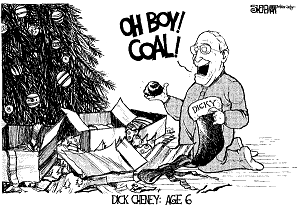
1 I mean, think about it, where else could all the coal be going? If I was good enough to get the presents Santa left me as a kid you'd have to be pretty rotten to get coal. It's gotta be going to politicians. And I've even found proof:
Apparently, jurors are too nice for prosecutors during the Christmas season. On the other hand, there's always the possibility that some jurors who might have held out will convict so they can get out of the courthouse and back to shopping, baking, cleaning up before the relatives visit, etc.
Subscribe to:
Posts (Atom)