Click here to see a video of my discussion of Luginbyhl v. Commonwealth, in which the Virginia Court of Appeals rules that a police officer's sworn statement that he did a DUI breath test in proper conditions, that the machine that didn't malfunction, that he didn't make any mistakes, that the reading he observed was "X", and that he was properly trained in the machine's operating procedure is not testimonial and therefore the sworn statement is allowed into evidence despite the federal Supreme Court's 6th Amendment ruling in the Crawford decision.
The discussion is also available as audio if you go over, click on Lex Radio and listen to it at Odeo.
Be forewarned, I have a face for radio and a voice for silent films so either choice is kind of Hobsonish in nature.

11 September 2005
New Zealand: Happy Officers

Don't they look like the happiest class of police recruits you've ever seen? Every other recruit class picture I've ever seen has been of a bunch of sullen cadets standing in front of some building. And look at the car. Not the stock white, gray, or brown car for them.
Someday when I become rich (like they promised me when I went to law school) and can travel around the world, I think I might like to visit this Bay of Plenty place.
New Zealand: Terrorist Police Recruit?
"Police have rubbished allegations a man who was almost recruited as an officer was linked to the terrorists responsible for the Bali bombings."
As an aside - Here in the States we need a term which is the equivalent to "rubbished." This is a cool phrase that's used throughout all the Commonwealth nations. Hereabouts, our papers merely report that our politicians "deny" things. I can't really think of what we could use here that carries the same meaning and impact. Our nearest related term would be "trashed", but that carries a different connotation (destroyed - i.e. "We trashed their rugby team.") The nearest I can think of in meaning is "pooh-poohed", but that just look silly as a headline on the Washington Post.
Suggestions?
New Zealand: Politics & Crime
Bashing a parole board for letting someone out who recidivates. (hmmm . . . is that the proper verb form?)
It's a press release from New Zealand First, which a little research indicates is a 10% party getting its power through the formation of coalitions with other more powerful parties. Given that, I'm not sure how badly the larger parties need it and don't know its ability to follow through.
It's a press release from New Zealand First, which a little research indicates is a 10% party getting its power through the formation of coalitions with other more powerful parties. Given that, I'm not sure how badly the larger parties need it and don't know its ability to follow through.
09 September 2005
A Prosecutor's Conscience
I'm sitting in the courtroom and the prosecutor is negotiating with the attorney next to me. I don't hear what the defense attorney asks for, but I hear the prosecutor say, "I'm sorry. I can't give you that deal without giving it to everyone else here and my conscience won't let me do that."
I looked over at the prosecutor and I must have grinned because he looks at me and says, "Yes, I do have a conscience!
I looked over at the prosecutor and I must have grinned because he looks at me and says, "Yes, I do have a conscience!
08 September 2005
The Political Season is Upon Us
Things are starting to gear up and accusations that "X" is soft on crime are starting to surface.
A Richmond judge sets a very dangerous precedent by allowing law enforcement officials to testify as experts on gang tattoos.
Guilt by association. Or, more accurately, impeachment by implied association - without even actual proof of association. As one guy asked me when I told him what the spiderweb is supposed to mean on the elbows of white clients, "How many of them are posers?"
I don't know. I can't answer that question from anything other than my subjective experiences and inferences. I suspect most haven't "earned" the tattoo. And I pretty much guarantee that the police "experts" cannot answer that question with any kind of objective, statistically based study either.
07 September 2005
Does Punishment Work?
You'll remember that in July 2004 I posted a couple times about punishment:
Do Heavy Guideline Sentences or Mandatory Minimums Work?
Continuing the Punishment Discussion
Someone recently left a comment on the latter of these asking: "I would like to make a question: in your opinion, is punishment deterrent to crime?"
At the risk of repeating myself, yes, I believe that punishment acts as a deterrent. I don't have any scientific proof of this but through observation and discussion with many of my clients I can tell you that the examples I would offer would be the firearm possession statutes. Once the fact that heavy punishment follows possession of a firearm as a felon or possession of a firearm and drugs at the same time sinks in these activities are avoided. As well, I believe - again without proof - that there is probably a fair portion of drug suppliers that won't touch crack because they realize the punishment difference between crack and powder.
Of course, there is a range of reasons why these punishments deter certain activities. One is that there are few crimes which are implicated and it sinks in that if the criminal actor is going to be risk averse he needs to avoid these specific activities. A second is that the punishments are out of proportion. They are so heavy that when a cost-benefit analysis is done most everyone realizes that it is just plain dumb to have a firearm around drugs or to deal in a specific form of a drug when profit can just as easily be made selling a different sort. A third is that the punishment is widely publicized and known; a massive punishment doesn't deter if there is no notice.
I don't think this can be applied on a larger scale (for the reasons discussed in the second post above); however, for a limited class of charges it can be very effective. On the other hand, it also leads to some very unbalanced and unjust sentencing based upon arbitrary factors (ie crack v. powder).
Map of Visitors

For those of you using Site Meter, I just wanted to point out a new feature I found. Under By World Map you can get an actual map from where your latest visitors have come. The one I put up here is mine for North America.
Cool!
Japan : Yakuza
Anytime you run a news search for crime in Japan you come up with lots of Yakuza stories. Here's the ever popular finger story (seen in every movie) along with a sociology and history of the organizations.
In some aspects the Yakuza seems more civilized than our organized crime (leaders retire) while in others it seems less (gangsters targeting crowds at baseball games).
Part of the problem with closing down the Yakuzas is their police connections:
In some aspects the Yakuza seems more civilized than our organized crime (leaders retire) while in others it seems less (gangsters targeting crowds at baseball games).
Part of the problem with closing down the Yakuzas is their police connections:
This is not to suggest that Japanese police completely look the other way when it comes to the mob. Over the years Japanese law enforcement officials, who have been admired the world over for their high standard of discipline, have staged numerous raids on various yakuza offices. These assaults have tended, however, to be more a show of police muscle than a genuine attempt to shut down gangster operations. Relations between Japanese police and the yakuza are complex; each side evidently has something akin to respect for the other. Like certain elements of the civilian population, some Japanese police officers admire the yakuza's adherence to a feudal-era code of chivalry. Likewise, Japanese mobsters for whatever reason from time to time will turn in a member of a gang to help the police "solve" a case. In one expert's words, there exists a "symbiosis" between police and mobsters that has served to legitimize the position of the yakuza in Japanese society.Apparently, Japanese businesses are so compromised that 50% of loans in Japan are write offs because they are unenforcable against Yakuza members.
Japanese Crime : China
Throw a Malatov cocktail at a Chinese Bank = 3 years, 6 months.
Mail razor blades to the Chinese consulate = 8 months probation (if you're sorry).
Heck, my clients are always sorry - maybe I should start practicing in Japan.
Mail razor blades to the Chinese consulate = 8 months probation (if you're sorry).
Heck, my clients are always sorry - maybe I should start practicing in Japan.
Crime Trends in Australia
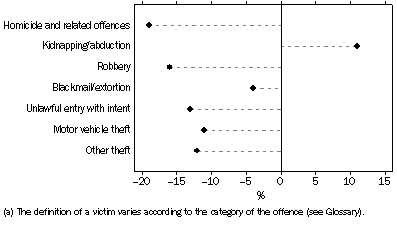
1. The good news is that crime seems to be on the decline.
2. The really bad news is that "hillbilly heroin" is making serious inroads into Australia.
Australia - U.S. : Death Doctor
Apparently a doctor went to Australia and was associated with 80 deaths, including at least 8 proceeding from operations the doctor was forbidden to perform in the States. The doctor somehow got back to the U.S.
One prosecution was dismissed, another has begun. However, there are worries that the case has become so politicized that the U.S. may refuse extradition (he must be in a blue circuit).
Articles here, here, here, & here.
One prosecution was dismissed, another has begun. However, there are worries that the case has become so politicized that the U.S. may refuse extradition (he must be in a blue circuit).
Articles here, here, here, & here.
Australia: Villification Legislation
Okay folks, time for a paradigm shift. They are no longer "hate crimes." They are "villification enhancements."
05 September 2005
The Next Justice

Orin has done a wonderful job of pointing out why, other than the obvious political reasons, Janice Rogers Brown should be made a Justice of the Federal Supreme Court: she believes in the 4th Amendment. Of course, she'd be awful lonely as the only Justice who does, but it'd be a step in the right direction.

Heck, if Orin'd said she was also textualist I might've had to hunt her down and propose.
So You Thought Virginia Would Have Conservative Courts . . .
How do you define a conservative court? I would define it as a court which relies on textual interpretation and original intent of constitutional matters. A court which is reluctant to expand the meaning of a statute beyond that which is plainly spelled out in a statute, even if the result would not be optimal or lead to a result everyone agrees is bad. It's the legislature's job to fix a statute as long as it doesn't trespass upon constitutional issues; even when the constitution is trespassed upon a conservative court will not amend the statute, it will merely strike down the section which is unconstitutional and leave the repair to the legislature. Above all, conservative courts sneer at legislative intent arguments, recognizing that statutes are often a compromise between several legislators who have left enough play in the wording so that everyone thinks the statute means what he wants it to mean, and there is never an adequate written explanation of what the majority of the legislators wanted the statute to mean, and that those few legislators who try to develop some sort of written record are probably promoting a viewpoint which they wouldn't have to if the statute supported their interpretation through the canons of interpretation, et cetera, &cetera, etc.
Virginia, that redest of red states, would surely have one of the most conservative courts out there - wouldn't it?
Consider this not atypical passage from Carter v. Commonwealth, 2002, 38 VaApp 116:
Hmmm . . . There seems to be a theme here . . .
[addendum] As well, a conservative court would believe in State rights and interpret things under the State's laws and constitution as much as possible, applying the federal constitution only when it has been imposed upon it by the federal supreme court. What do the courts appellate in Virginia have to say about that?
OMG! Somebody switched our appellate judges with - shudder - judges from the 9th Circuit! They're going to turn us into California - or worse, remake the whole Commmonwealth in the image of Northern Virginia. We're dooooomed!!!
Virginia, that redest of red states, would surely have one of the most conservative courts out there - wouldn't it?
Consider this not atypical passage from Carter v. Commonwealth, 2002, 38 VaApp 116:
Well established "principles of statutory construction require us to ascertain and give effect to the legislative intent." "The plain, obvious, and rational meaning of a statute is always preferred to any curious, narrow or strained construction; a statute should never be construed so that it leads to absurd results." Thus, "[i]t is a basic rule of statutory construction that a word in a statute is to be given its everyday, ordinary meaning unless the word is a [term] of art." Because the Code of Virginia is "one body of law," we may consult other statutes "using the same phraseology" to assist us in divining legislative intent. "Although penal laws are to be construed strictly [against the Commonwealth], they 'ought not to be construed so strictly as to defeat the obvious intent of the legislature.'"This one paragraph contains pretty much all the dodges used in Virginia law to avoid giving a statute the written meaning of the statute: legislative intent, absurd results, term of art, use of other statutes to divine legislative intent, obvious intent of the legislature.
Hmmm . . . There seems to be a theme here . . .
[addendum] As well, a conservative court would believe in State rights and interpret things under the State's laws and constitution as much as possible, applying the federal constitution only when it has been imposed upon it by the federal supreme court. What do the courts appellate in Virginia have to say about that?
Jackson v. Commonwealth, 41 Va.App. 211 (2003): Our courts have consistently held that the protections afforded under the Virginia Constitution are co-extensive with those in the United States Constitution.Thus, no recourse to the Commonwealth's constitution at all.
OMG! Somebody switched our appellate judges with - shudder - judges from the 9th Circuit! They're going to turn us into California - or worse, remake the whole Commmonwealth in the image of Northern Virginia. We're dooooomed!!!
03 September 2005
Comment Spam
Because I have been getting comment spam I have activated Blogger's word-repeat verification. Sorry for the added inconvenience.
02 September 2005
Sentence Diagrams and Statutes
So, while I sat in the office most of the afternoon with no clients dropping by, I spent the time trying to sentence diagram a statute. I am trying to figure out how to prove to the Court of Appeals that its interpretation of a statute is wrong. Mind you, I'm rusty at this and I haven't gotten the copy of Higher lessons in English: A work on English grammar and composition I ordered yet. Still, a few web pages got me most of the way along.
After a couple hours of doing this, I came to one conclusion All legislators must be taken out and shot. Tom has brought me around on the death penalty. However, the only reason I favor it is that the other option would be far more cruel. The only other appropriate punishment would be to make legislators sit down and draw sentence diagrams of their own convoluted, self - contradictory, obscure statutes with 7 or 8 conjunctions or subjunctions as well as 3 to 4 prepositional phrases each. It is a punishment far worse than death.
Oh yeah, does anyone know if subjunctives are handled the same way conjunctives are in a sentencing diagram? I think so but I haven't been able to find confirmation.
A Client
Y'know, I sit in my office every Friday from 2-5 p.m. so that any client can come by to see me. I tell them this. The back of my card tells clients to come see me during this time. My answering service tells people to come see me during this time.
Today a client actually dropped by to talk to me about his case. He is the first person to do so in over a month. Over a month.
Sometimes I look down the road and wonder if the attorney doing real estate law needs an associate . . .
Today a client actually dropped by to talk to me about his case. He is the first person to do so in over a month. Over a month.
Sometimes I look down the road and wonder if the attorney doing real estate law needs an associate . . .
An Interesting Set of Blogs
Here is a different approach to blogging. A DC lawfirm has set up three blogs about different aspects of federal and international law. There is daily blogging at each, but in a very different format than I've seen previously. Each post reads like a mini-brief (with footnotes, no less) and is very professional. None of the posts have an individual's name attached - only the firm's name.
My best guess? An associate is tasked to write something each day or a group of associates share a rotating duty to post. The posts are informative but very white bread. No outlandish opinions or personal stories appear. I think the blogs are meant to look impressive for clients who might come to the website, but not do anything which might upset a client by expressing strong opinions or personal quirks. They're also meant to keep the reader on the firm's website - they don't link anywhere else.
As always, I wonder about the economic efficiency of such sites but I don't run a big firm so maybe I'm wrong in thinking that the time an associate spends researching and writing a post with footnotes supporting every other line might not be the best use of billable time. Perhaps it's a long term reputation building strategy (much like publishing a news letter).
Anyway, here's the master page which links to all three blogs.
Lv Grits for Breakfast
Sua Sponte No More
One of the first blogs I read was Sua Sponte. It was always an interesting read and was one of the blogs which convinced me that I could actually get CrimLaw going.
Well, law school's over, a clerkship starts, and the blog ends.
Bon chance, mes ami.
Well, law school's over, a clerkship starts, and the blog ends.
Bon chance, mes ami.
01 September 2005
Changes in Virginia's Exile Law
I just noticed today that the General Assembly has changed the punishment portion of our felon in possession of a firearm law so that it is more lenient.
Va. Code sec. 18.2-308.2 used to call for 5 years punishment, none suspended, if in possesion after having been convicted of a violent felony, 2-5 years, 2 not to be suspended, if convicted of a non-violent felony, and had a catch-all "This is a class 6 felony" (0-5 years). I know this because in a case now on appeal I argued whether the mandatory time provisions applied when the underlying was not a conviction but a juvenile "adjudication" (which is by law a civil proceeding). However, the prosecutor and judge found a case which reasoned that because the statute states that someone can be convicted under 18.2-308.2 if he was convicted of a felony or adjudicated a delinquent for an act which would have been a felony then the fact that the mandatory punishment section of the statute only refers to those convicted means that the mandatory punishment portion of the statute applies to those adjudicated as well. The trial judge had to follow the precedent and now I'm trying to figure out how to politely tell appellate judges that their statutory construction skills were a little bit, ummmm, "out of kilter" when they decided that case.
Anyway, the law has now changed so that someone found with a firearm after previously being convicted of a violent felony will get 5 years. All others will get 2-5 years unless 10 years have passed since the conviction. In that case the punishment reverts to a simple class 6 felony (0-5). It's a subtle change in the law which actually makes a lot of sense. However, I'm surprised to see it because it flies in the face of "getting tough on crime" in an election year. Our legislators should be congratulated for this improvement in the statute.
Subscribe to:
Posts (Atom)