In North Carolina there are people actually pushing to lower the BAC level to .06 for a presumption of guilt in a DUI accusation. They are also shocked that a lot of people who are going to court with .08 BAC's aren't getting convicted.
And why might they not be getting convicted? Hmmm . . . Could it be because everybody recognizes that at .08 most people aren't drunk? I don't see a lot of .08-.10 DUI charges coming to court and most of the time those are guys who got arrested at a traffic check point or got stopped for some totally unrelated reason. There was no problem with their driving, they were just in the wrong place at the wrong time.
To be fair, there is the odd man who only drinks once a year at the firm's Christmas party and can't hold his booze. He gets tagged going home because he is weaving within his lane and is guilty. Of course, as this guy sits in the gallery sticking out like a sore thumb because he's the only Defendant wearing a suit that day and he is nervous (as opposed to the practiced nonchalance of those in court for their 8th or 9th time) everyone knows that this is most probably the only time this guy will ever see the inside of a courtroom and a little common sense often prevails, allowing him to be convicted of reckless driving instead of a DUI.
.06? And thus we create yet another law which people ignore. Sure. Why not another one? We already have the rights of passage for young adults as they drink underage and smoke marijuana illegally while the rest of us look the other way because not many actually believe in the laws. Then we're shocked, shocked, I say, when they move on to more serious drugs and/or crimes after we have taught them that laws are not legitimate.

14 August 2004
Who Says the NYTimes is Liberal?
The murder of a man pretrial leads to a mythos surrounding a Defendant.
With the exception of the last few paragraphs this is entirely the prosecution's view. I'd like to know the other side. Or, perhaps the NYTimes could have troubled itself to actually interview a witness?
Yeah, I know it wasn't a major article and probably didn't get a lot of resources. It's a shame, this looks like this could have been very interesting if it had received more thorough coverage.
Police Officer Guilty
Officer pleads guilty to throwing a walkie-talkie at a fleeing suspect and hiting him in the head, causing death. A State grand jury clears him, the family gets a $750,000 civil settlement, and now he's pled guilty to federal charges of violating civil liberties.
Can't remember the last time I heard of an officer getting charged by the federal prosecutor around here. Actually, I can't ever remember the federal prosecutor doing it. Maybe it's because people down here believe in federalism a little more. But then how do you explain Exile . . .
Can't remember the last time I heard of an officer getting charged by the federal prosecutor around here. Actually, I can't ever remember the federal prosecutor doing it. Maybe it's because people down here believe in federalism a little more. But then how do you explain Exile . . .
13 August 2004
What Book I Am

You're The Hitchhiker's Guide to the Galaxy!
by Douglas Adams
Considered by many to be one of the funniest people around, you are quite an entertainer. You've also traveled to the far reaches of what you deem possible, often confused and unsure of yourself. Life continues to jostle you around like a marble, but it's shown you so much of the world that you don't care. Wacky adventures continue to lie ahead. Your favorite number is 42.
Take the Book Quiz
at the Blue Pyramid.
But I still want to know what the question is . . .
And then there are the days which go like this:
Scene - client and I are in the lockup area talking about his case before his preliminary hearing for felony petit larceny. I have just explained (yet again) the fact that this day is only for a preliminary hearing.
Client: I told you to get me a deal and make this a misdemeanor.
Me: You have 8 prior larcenies, you were caught wearing the clothes store security saw you carry into the changing room and you made a full confession to a police officer after signing a Miranda form. The prosecutor laughed at me when I asked her for a deal.
Client: A guy in my pod has almost 100 charges and he's getting a deal. Why can't I get one?
Me: Where was that guy charged at, [jurisdiction X]?
Client: No, in this county. Why can't you get me a deal?
Me: Maybe something will happen in circuit court when we have a different prosecutor.
Client: If I had a paid lawyer, he'd have got me a deal.
(Based on many a conversation but reflecting none in particular)
Pointers for Writing a Newspaper When in Jail
Don't use too many exclamation marks.
Don't lie.
Don't blame the paper for putting you where you are. We didn't put the gun/knife/blunt instrument in your hand.
Do be succinct, but don't leave out pertinent facts - like, for instance, a previous significant other who died under suspicious circumstances or an outstanding warrant for murder in another state.
Do be straightforward. If you've appeared in print before, your secrets will out.
Don't try to pull strings. Believe it or not, a newspaper route carries no weight.
Don't name-drop gratuitously. If God or the governor were a real pal, you wouldn't be in prison. And last but not least:
Do be innocent.
Lv SW VA Law
12 August 2004
The De Facto Ban on Jury Trials in Virginia
Reading this article about the high percentage of guilty pleas and the absolute dearth of jury trials in Virginia Beach reminded me that I haven't had a jury trial in a while. How, you ask, can that be? Have I not proceeded to trial on a matter of guilt or innocence? Why yes, I have but lately none of my clients has been desperate or stupid enough to take a jury.
Let me explain. Jury trials in Virginia are not often a shield to defend the innocent, they are usually a sword to punish the guilty. This is because the jury sentences in Virginia. Juries cannot suspend any part of a sentence, cannot run sentences concurrently, and are by law denied the sentencing recommendations that judges get. Therefore, if a Defendant is charged with a class 4 felony (2-10 years), a class 3 felony (5-20 years), or a class 2 felony (20-Life) most often he is faced with the inescapable threat that if he exercises his right to a jury trial and is found guilty he will be sentenced to the mandatory prison time. Even if there is no mandatory sentence juries tend to sentence higher than judges. A judge gets a sentencing recommendation and usually follows it. Additionally, quite often a sentencing recommendation will be far lower than the mandatory sentence; in these cases the judge can, and usually will, follow the recommendations by suspending a portion of the mandatory time. But wait, there's more. In Virginia not only must the Defendant waive his right to a jury trial both the prosecutor and judge must waive their right to a jury trial. Thus, in serious cases it is not uncommon for a prosecutor to threaten to exercise her right to a jury trial and I've seen cases go to jury simply because the Defendant refused to plead guilty to everything the prosecution charged him with. However, the worst was probably the day I was sitting in court and heard a judge tell another attorney that if his client pled not guilty the judge was going to require a jury trial.
And your next question is how the system outlined above doesn't tread heavily upon a Virginian's right to a "trial, by an impartial jury of his vicinage", Va Const Art I sec 8, or an American's right to "an impartial jury of the State and district wherein the crime shall have been committed?" US Const Amend VI.
Well, while the punishment "shall be ascertained by the jury" it can be suspended by the judge. Therefore, the jury is merely setting an upper limit beyond which the judge cannot impose incarceration. The Defendant has a right to a sentencing hearing with a presentence report. The judge is then free to suspend any excessive prison time the jury imposes and render the same active prison sentence that he would have had there never been a jury trial. The Virginia courts appellate have found that this solves any constitutional problems.
It's a nice theory and probably correct in finding that the statutory scheme is de jure constitutional. The only problem is that those of us out in the trial courts live on the other side of the de jure / de facto line. In reality judges rarely change a sentence which has been handed down by a jury and when they do often do not lower it to where the sentence recommendation would have had it. Considering this, it is probably malpractice to recommend a jury trial in the vast majority of cases. I think that most jury trials occur when Defendants know they are going to spend a large amount of time in prison whether found guilty by a judge or jury, when Defendants will face the same penalty from either a judge or jury (Virginia Exile), when the trial takes place in an urban area where the population has equal parts serious distrust of anything the police do in the lower classes and very liberal tendencies in the upper classes, and those cases which occur every so often where the Defendant is either unable or refuses to understand the consequences of his actions. And even if you add all those together, only "1.3 percent of all criminal cases in circuit courts in 2003 went to a jury trial." That says a lot about the lack of confidence that Virginians and their lawyers have that a just result can be reached through a jury trial.
Of course, I'm a Defense attorney and an avowed advocate of the right to a jury trial. If I could ever truly recommend them to my clients I'd be happy trying one a week. With that in mind you should probably be somewhat dubious of my view of the way the system currently works. So here are passages from the Virginia Criminal Sentencing Commission: Annual Report 2003:
“Virginia is one of only five states that allow juries to determine sentence length in non capital offenses. Since the implementation of the [no-parole] system, Virginia juries have typically handed down sentences more severe than the recommendations in the sentencing guidelines. In fact, in FY2003, as in previous years, a jury sentence was far more likely to exceed the guidelines than fall within the guidelines range. By law, juries are not allowed by law to receive any information regarding the sentencing guidelines to assist them in their sentencing decisions.Note that the last sentence talks about the median rather than the average difference. I suspect that the average is much higher. Unfortunately, I cannot find anyplace where I can find distilled statistics to confirm that suspicion (nor raw stats either but I'm not sure how I'd do with them anyway).
. . . .
In FY2003, the Commission received 351 cases tried by juries. While the compliance rate for cases adjudicated by a judge or resolved by a guilty plea was at 80 percent during the fiscal year, sentences handed down by juries fell into compliance with the guidelines only 37 percent of the time. In fact, jury sentences fell above the guidelines recommendation in 42 percent of the cases. This pattern of jury sentencing vis-a-vis the guidelines has been consistent since . . . 1995.
Judges, although permitted by law to lower a jury sentence they feel is inappropriate, typically do not amend sanctions imposed by juries. Judges modified jury sentences in less than one-fourth of the FY2003 cases in which juries found the defendant guilty. Of the cases in which the judge modified the jury sentence, judges brought a high jury sentence into compliance with the guidelines recommendation 26 percent of the time. In 39 percent of the cases, judges modified the jury sentence but not enough to bring the final sentence into compliance.
In those jury cases in which the final sentence fell short of the guidelines, it did so by a median value of just over one year. In cases where the ultimate sentence resulted in a sanction more severe than the guidelines recommendation, the sentence exceeded the guidelines maximum recommendation by a median value of less than three years.
Wide World of Blogs
A Season of Mists looks like it's going to be a good addition to the blawgosphere.
ambivalent imbroglio points to the confidence it takes to be a PD while Arbitrary & Capricious points out how it's become more difficult to defend people as they've switched from mellow potheads to meth freaks.
The Prosecutor's Spot wonders if he did the right thing by showing leniency to a 13 year old boy and Crime & Federalism points to a prosecutor who has gone tooo far.
On the other hand, I respectfully dissent points out what life is like for those of us who eat what we kill.
Blonde Justice asks how people explain "beyond a reasonable doubt" to juries.
Public Defender Dude notes that if the Kobe case folds he will lose an example of an innocent man convicted.
True Believer points out that the ABA is going to recognize a specialization in DUI defense.
Via the Curmudgeonly Clerk: When Judges Strike Back! (coming soon as a Fox video)
Begging the Question offers a few questions that you probably should avoid in your Supreme Court argument.
Non Legal but VERY IMPORTANT: From SW VA Law - If you are walking in the woods in the next two weeks and a cube of fish meat falls from the sky and hits you in the head, you are not having a break with reality. However, you might want to watch out for the raccoons.
10 August 2004
United States v. Martin (4th Circuit)
Are State Trial Systems Unconstitutional?
Subject: Enhancement of sentencing when a Defendant has demanded her right to a trial de novo in superior court.
[facts] Defendant was convicted of a misdemeanor in a North Carolina district court and sentenced to 60 days in jail. She exercised her absolute right to a trial de novo in superior court. While waiting for her trial she was sentenced in federal court and the misdemeanor conviction was counted against her, adding 2 points to her criminal history. Subsequently, the charge was dismissed in superior court without prejudice.
[finding] The trial court was incorrect in applying 2 points to Defendant's criminal history. The trial court should have only applied 1 point. The error is harmless because it does not change the sentence.
[reasoning] North Carolina has a fairly typical lower court - higher court dynamic wherein misdemeanors are tried in lower courts. These courts are without a record and do not provide an option for a jury. To counter these infirmities anyone tried and convicted in the lower court has an absolute right to a trial in the upper court (even if she pled guilty).
The prosecution portrays this as an appeal and asserts that 2 criminal history points should be added (for a conviction with 60 days) because an appeal does not invalidate a conviction. However, the prosecution is wrong because the higher court engages in a trial de novo rather than a review of the findings of the lower court.
The Defendant portrays this as a decision void ab initio after the Defendant calls for the exercise of her option for a trial de novo. The court rejects this because a Defendant can withdraw her demand for a trial de novo and the case would return to the lower court for imposition of the original sentence. Therefore, it is merely voidable.
Relying on the reasoning supra, the court finds the decision is voidable rather than void. Therefore, the exercise of the right to a trial de novo is actually a stay of the lower court sentence. Under sec. 4A1.1(c) criminal history points are increased by 1 point for a stayed decision. This is what should have been done in this case.
[the dicta] The court recognizes that there are constitutional problems with its decision. This sort of State trial system actually consists of a single bifurcated trial. Because the trial in the inferior court does not have full constitutional protections there is substantial doubt as to the reliability of the inferior court decision
The fact that the lower court does not allow a jury trial and that, prior to a jury trial in the superior court, this "conviction" can be counted in a federal sentencing raises serious questions as to the constitutionality of the state court systems. The constitutional questions in the inferior court are wiped out by the absolute right to a trial de novo with a jury. The fact that there are no consequences from the inferior court's adjudication makes this system constitutional. The court's interpretation of the sentencing guidelines "would seemingly constitute a significant collateral consequence."
[comment] The court's finding that (1) the sentence is stayed and its explanation that (2) in this sort of state trial system there is actually a single, bifurcated trial are directly at odds with one another. The answer here would seem to be that since it is a single, bifurcated trial which is concluded in the superior court there was no disposition at the time of federal sentencing and therefore no points should have been awarded. The fact that the superior court dismissed the case, rendering the lower court decision a nullity, is strong evidence in favor of this interpretation. It wasn't an appeal; it wasn't a void decision; it wasn't a stay; it was a trial in progress wherein no conviction or sentence had been imposed. A great advantage of the interpretation I offer is that it avoids any constitutional question.
As for the court's constitutionality conjecture, the court's interpretation is absolutely backward. The court's interpretation does not call the State systems into question - it calls the constitutionality of the criminal history points in the guidelines, as this case interprets them, into question. If the court's interpretation is correct it runs contrary to long standing (pre-guidelines) precedent which declares this sort of State system constitutional. However, a more fitting interpretation of this added criminal history point is that it imposes a punishment on a person prior to her ability to exercise her constitutionally guaranteed right to a jury trial. There is no doubt that if the Defendant in one of these State systems could only avail herself of the bench trial in the lower court that the system would be unconstitutional. Therefore, the actual trial takes place in the superior court. The hearing in the lower court is, in effect, a preliminary hearing. The Defendant then decides whether he will acquiesce to the decision of the constitutionally deficient lower court or exercise his right to an actual trial. Seen in this light, this court's decision actually punishes the person being sentenced in federal court for a crime of which she has not been convicted.
find the case here
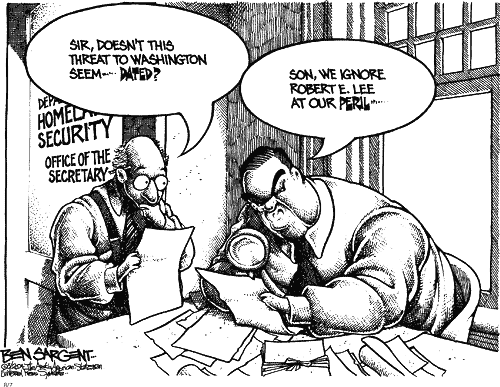
09 August 2004
A Week in the Life of Criminal Defense Attorney (sorta)
Actually these are selected days from the last two weeks. The rest of the days were either light days or had things occur of which I cannot write.
Wednesday: In the afternoon I go court for Client's preliminary hearing on his felony discharge of a firearm in a house. The only problem is that Client hasn't shown up. After waiting for a while I finally go up have the clerk call the case. The prosecutor and I point out that one of the court papers has a different date and it's possible the client got confused. The judge isn't having any of it. He remembers Client standing in front of him and telling Client the correct date. Still, he allows that he will withdraw the capias for arrest if Client shows up at court prior to 4:30.
So I run across the hall to call the various numbers I have for Client, hoping that one will work. Finally someone picks one up and the conversation went something like this:
Thursday: In the morning my first case is a possession of drugs in a jail. I talk to the prosecutor and he agrees to drop it to a misdemeanor 12 months with 6 months suspended (3 months to actually serve). Client jumps all over that. Then I drive off to another county where I have a felony trial. I arrive at 9:45, 15 minutes before circuit court starts in that county. Then I walk into the courtroom and it's in full swing. I look up at the prosecutor and he flashes me nine fingers; then he signals that everything is fine. Then I point to the back to let him know that I am going to the lockup area to see my client and I turn to leave. At that moment a voice comes from the bench: "Mr. Lammers, either sit down or leave the courtroom." I say "Yes sir" and scoot out the back door. Client is in the witness room and I go talk to him there. Then I go talk to the witnesses he had me subpoena from the juvenile detention center.
Client's case is a forlorn hope. The teacher from the juvenile facility is called and testifies that my client attacked him. Some of his testimony is a self-serving but it's clear that he and my client got in a fight. In my cross I screw up and ask one question too many and some pictures of the injuries get in which should not have (still kicking myself for that one). Then I call two of the kids from the detention center and my client. Their testimony varies as to exactly what occurred after the fight began but they are all clear in that they state the fight started when the teacher shoved the kid. So it's a swearing contest which the judge decides in the favor of the teacher. Yeah, I know, you're shocked.1
---------- ---------- ----------
1 The weird thing about these cases is that because my client was found guilty he will probably be held for less time then he would if he just remained in juvenile detention until he was 21.
---------- ---------- ----------
In the afternoon I go to another county's circuit court to ask that my client be released from a drug treatment program. Client has been kicked out of his residence and is living in his girlfriend's car so that he is close enough to attend the mandatory meetings. After hearing this from client and confirmation from his counselor at the drug program the judge decides to let him out so that he can move in with his mother in NYC.
Next stop is Federal Court. Client got probation but hasn't been making his meetings and turned up hot for marijuana (twice). The probation officer recommends work release, the prosecutor recommends work release, I ask for work release and the judge sends Client away to jail for 60 days specifically denying him work release.
Monday: In the morning I have a preliminary hearing scheduled for a client who used his brother's name in order to avoid a driving with a suspended license charge. The problem is that in so doing he signed his brother's name to a bunch of papers and swore to the magistrate that everything was true in those papers. He is charged with 6 counts of forging a public document (2-10 years), 1 count of perjury (0-10 years), and 1 count of driving suspended. There is no defense (client confessed) but the prosecutor agrees to drop all but two felonies if we waive the preliminary hearing and agree to plead guilty. Client jumps at the offer.
Then I go up to circuit court for sentencing for a client who has been found guilty of uttering and carrying drugs into a jail. She didn't show up for her sentencing hearing previously and just got picked up recently. She's been rejected for the drug treatment program I wanted to get her into because she never went to the interview. So I get up and do my best tap-dancing in an attempt to get the judge to allow her a continuance so that she can go get evaluated for the program. The judge decides to continue the case for a week but revokes my client's bond because he "knows she'll get interviewed quickly if she's in the jail."
In the afternoon I go the circuit court for a sentencing but Client has not come to court. The case gets continued for a month and a capias is issued for Client. Then I go to the court next door for a show cause. Client has 20 years suspended over his head on each of 4 charges (2 X B&E;2 X grand larceny). Ordered into a drug program he failed out and was previously show caused at which time the judge resuspended all the time and reordered him into the drug program. He failed out again and this is the show cause I'm representing him on. I'm up there giving it my best talking about his obligations and angling for the least amount of jail time possible when I look up at the judge and realize that not a thing I'm saying is impacting. He is not happy that he gave Client two opportunities (on B&E's, no less) and both were wasted. Still, when all is said and done, he only sends Client to prison for two years.
After finishing that I scoot downstairs to general district court for a client's trespassing charge. Client should be found not guilty because he was sleeping over at a friend's house when the police came to arrest his friends because they were evicted two days previous. Client didn't know and told the officers but he had a number of other warrants so they just added the trespass into the mix. When I get to the courtroom I find out that client's case has already been called and Client agreed to 90 days suspended. I'm a little perturbed that is case was handled without my presence so I go talk to the clerk about it. She is beside herself for having called my case without me and it turns out that happened is that when all the other charges had been handled on a different date that paperwork had been seperated and my name was on the other papers. So then I go back to see if Client wants me to reopen the case and I find a client who is jubilant that he is getting out of jail today and doesn't want anything to mess that up. So I don't do anything.
Tuesday: The only case I have today is a felony petit larceny (0-5 years). Nothing too out of the ordinary. The witnesses told police that Client went to the meat department with an empty cart and just started throwing steaks in it; they found this a little interesting (1) because most people look at $20 steaks before they decide to buy them, and (2) because most people buying steaks aren't obviously homeless. Then Client wheeled the cart off to a corner where no on could see him and when he came out of the corner the cart was empty. Being of a suspicious nature the store manager then confronted Client who pulled over $100 worth of various meats out from under his shirt. On top of that he confessed. I get the prosecutor to offer misdemeanor petit larceny, 12 months - none suspended. Client balks so I go back out and with a little more persuasion get the prosecutor to offer 12 months with 2 suspended. Client finally agrees to this.
Wednesday: In the afternoon I go court for Client's preliminary hearing on his felony discharge of a firearm in a house. The only problem is that Client hasn't shown up. After waiting for a while I finally go up have the clerk call the case. The prosecutor and I point out that one of the court papers has a different date and it's possible the client got confused. The judge isn't having any of it. He remembers Client standing in front of him and telling Client the correct date. Still, he allows that he will withdraw the capias for arrest if Client shows up at court prior to 4:30.
So I run across the hall to call the various numbers I have for Client, hoping that one will work. Finally someone picks one up and the conversation went something like this:
Me: Ma'am, is Mr. Jones there?And you know what? When I check the local paper online it has his obit. So I print it out and take it to the judge and he decides to withdraw the capias.
Female: Who is this?
Me: Ma'am this is his attorney and he's supposed to be in court today The judge has agreed not to have him arrested if he turns himself in by 4:30. But he's got to turn himself in by 4:30.
Female: That's going to be kinda hard since he's dead.
Thursday: In the morning my first case is a possession of drugs in a jail. I talk to the prosecutor and he agrees to drop it to a misdemeanor 12 months with 6 months suspended (3 months to actually serve). Client jumps all over that. Then I drive off to another county where I have a felony trial. I arrive at 9:45, 15 minutes before circuit court starts in that county. Then I walk into the courtroom and it's in full swing. I look up at the prosecutor and he flashes me nine fingers; then he signals that everything is fine. Then I point to the back to let him know that I am going to the lockup area to see my client and I turn to leave. At that moment a voice comes from the bench: "Mr. Lammers, either sit down or leave the courtroom." I say "Yes sir" and scoot out the back door. Client is in the witness room and I go talk to him there. Then I go talk to the witnesses he had me subpoena from the juvenile detention center.
Client's case is a forlorn hope. The teacher from the juvenile facility is called and testifies that my client attacked him. Some of his testimony is a self-serving but it's clear that he and my client got in a fight. In my cross I screw up and ask one question too many and some pictures of the injuries get in which should not have (still kicking myself for that one). Then I call two of the kids from the detention center and my client. Their testimony varies as to exactly what occurred after the fight began but they are all clear in that they state the fight started when the teacher shoved the kid. So it's a swearing contest which the judge decides in the favor of the teacher. Yeah, I know, you're shocked.1
---------- ---------- ----------
1 The weird thing about these cases is that because my client was found guilty he will probably be held for less time then he would if he just remained in juvenile detention until he was 21.
---------- ---------- ----------
In the afternoon I go to another county's circuit court to ask that my client be released from a drug treatment program. Client has been kicked out of his residence and is living in his girlfriend's car so that he is close enough to attend the mandatory meetings. After hearing this from client and confirmation from his counselor at the drug program the judge decides to let him out so that he can move in with his mother in NYC.
Next stop is Federal Court. Client got probation but hasn't been making his meetings and turned up hot for marijuana (twice). The probation officer recommends work release, the prosecutor recommends work release, I ask for work release and the judge sends Client away to jail for 60 days specifically denying him work release.
Monday: In the morning I have a preliminary hearing scheduled for a client who used his brother's name in order to avoid a driving with a suspended license charge. The problem is that in so doing he signed his brother's name to a bunch of papers and swore to the magistrate that everything was true in those papers. He is charged with 6 counts of forging a public document (2-10 years), 1 count of perjury (0-10 years), and 1 count of driving suspended. There is no defense (client confessed) but the prosecutor agrees to drop all but two felonies if we waive the preliminary hearing and agree to plead guilty. Client jumps at the offer.
Then I go up to circuit court for sentencing for a client who has been found guilty of uttering and carrying drugs into a jail. She didn't show up for her sentencing hearing previously and just got picked up recently. She's been rejected for the drug treatment program I wanted to get her into because she never went to the interview. So I get up and do my best tap-dancing in an attempt to get the judge to allow her a continuance so that she can go get evaluated for the program. The judge decides to continue the case for a week but revokes my client's bond because he "knows she'll get interviewed quickly if she's in the jail."
In the afternoon I go the circuit court for a sentencing but Client has not come to court. The case gets continued for a month and a capias is issued for Client. Then I go to the court next door for a show cause. Client has 20 years suspended over his head on each of 4 charges (2 X B&E;2 X grand larceny). Ordered into a drug program he failed out and was previously show caused at which time the judge resuspended all the time and reordered him into the drug program. He failed out again and this is the show cause I'm representing him on. I'm up there giving it my best talking about his obligations and angling for the least amount of jail time possible when I look up at the judge and realize that not a thing I'm saying is impacting. He is not happy that he gave Client two opportunities (on B&E's, no less) and both were wasted. Still, when all is said and done, he only sends Client to prison for two years.
After finishing that I scoot downstairs to general district court for a client's trespassing charge. Client should be found not guilty because he was sleeping over at a friend's house when the police came to arrest his friends because they were evicted two days previous. Client didn't know and told the officers but he had a number of other warrants so they just added the trespass into the mix. When I get to the courtroom I find out that client's case has already been called and Client agreed to 90 days suspended. I'm a little perturbed that is case was handled without my presence so I go talk to the clerk about it. She is beside herself for having called my case without me and it turns out that happened is that when all the other charges had been handled on a different date that paperwork had been seperated and my name was on the other papers. So then I go back to see if Client wants me to reopen the case and I find a client who is jubilant that he is getting out of jail today and doesn't want anything to mess that up. So I don't do anything.
Tuesday: The only case I have today is a felony petit larceny (0-5 years). Nothing too out of the ordinary. The witnesses told police that Client went to the meat department with an empty cart and just started throwing steaks in it; they found this a little interesting (1) because most people look at $20 steaks before they decide to buy them, and (2) because most people buying steaks aren't obviously homeless. Then Client wheeled the cart off to a corner where no on could see him and when he came out of the corner the cart was empty. Being of a suspicious nature the store manager then confronted Client who pulled over $100 worth of various meats out from under his shirt. On top of that he confessed. I get the prosecutor to offer misdemeanor petit larceny, 12 months - none suspended. Client balks so I go back out and with a little more persuasion get the prosecutor to offer 12 months with 2 suspended. Client finally agrees to this.
DUI Overreaction
True Believer goes over the all too frequent DUI overreactions based upon the very drunk but burdening the social drinker.
08 August 2004
OFF POINT: Politics
I try to avoid writing about politics here but when the perfect candidate for president comes along you just have to sit up and take notice.
Yep, my vote is now sewn up.
Yep, my vote is now sewn up.
The Great Texas Hibiscus Raid


The plant on the left is the Texas Star Hibiscus and the one on the right is marijuana. Apparently 10 members of the Harris County, Texas Organized Crime and Narcotics Task Force couldn't tell the difference. The hibiscus plants were in the front yard and based upon their presence a full scale raid of the house took place. But wait, if you think it's bizarre that members of a narcotics task force didn't know what marijuana looks like you need to know that it gets even stranger:
[T]he team of narcotics officers combed [the] house for about an hour, at one point discussing whether red and gold bamboo growing in [a] window might be marijuana. They also asked [the owner] what he did with the watermelons and cantaloupes growing in his back yard.So, I guess the owner was going to cut a cantaloupe in half, hollow out one side, poke a bamboo shoot into it, and smoke his hibiscus through the improvised pipe.
From this point on every time a Harris County officer tries to use the artifice of claiming that he acted "based on my training and experience" the defense attorneys should have a field day.
LvModulator
07 August 2004
CSI and the Jury
The Curmudgeonly Clerk asks whether shows like CSI have effected the way juries view evidence.
Well, I'll tell you how shows like CSI have helped me. They have led to the easy availability of books which explain forensic evidence and are easily understood. So now when I want to find out how things work I can usually find a book that explains it in English at my local Barnes & Noble instead of hunting around for some technical manual or college text book where there will be three foot long greek/latin words and pages upon pages of charts to decipher.
As to how it effects juries, I'm not sure it has in any of my cases. Of course, I make the purposeful blindness argument because often police seem to stop looking for evidence if it might place in doubt the guilt of the person they've decided is guilty. However, this argument has been made as long as anyone can remember and I think it's a hit or miss proposition. I find juries to be amazingly perceptive as to whether you are making a desperate argument or the police really have purposefully chosen not to take fingerprint evidence or check to see if the hair at the scene matches your client. Of course, being a big fan of juries I might be a little biased.1
--------- --------- ---------
1 My biggest gripe about the Virginia system of criminal law is the taking of a jury is basically banned in serious cases except in extreme desperation or when used by the prosecutor as a weapon.
PD's Neighbor Arrested
Ah, this reminds me of when I was living in a sketchy neighborhood while I tried to get my office off the ground (rent's cheap when people shoot at each other in your neighborhood and police don't even bother to come by). The night I decided to leave was when one of my fugitive clients showed up and woke me at 1:30 a.m.
Discovery in Virginia
BD forwards this article to me about the Chief Justice of Virginia's Supreme Court meeting with public defenders. It goes on to discuss what is being done to fix the problems in indigent defense. Of course, we all know what would solve the problems: Increase by at least 100% the caps on payments to court appointed attorneys and require both the Commonwealth and localities to match every penny they give to prosecutors with a penny given to the public defender (where there are PD offices). Of course, we all know this isn't going to happen either so I was just about to dismiss the article as another case of hand wringing and non-solutions when I cam across this statement:
There is a striking disparity in how different prosecutors' offices handle discovery. The best give me a copy of my client's record, a copy of police reports, and a copy of all statements. Most at least give me a copy of my client's record and copies of statements made by my client. Some won't really give me anything. I am refused a copy of my client's record but allowed to take notes from it in the prosecutor's office; usually I receive my client's statements, and the prosecutor picks and chooses what he's going to tell me about the rest of the evidence. While I've not experienced it, I hear horror stories about jurisdictions where no discovery is given unless the Defense attorney goes to court and forces the prosecution to disclose it under order from the judge.
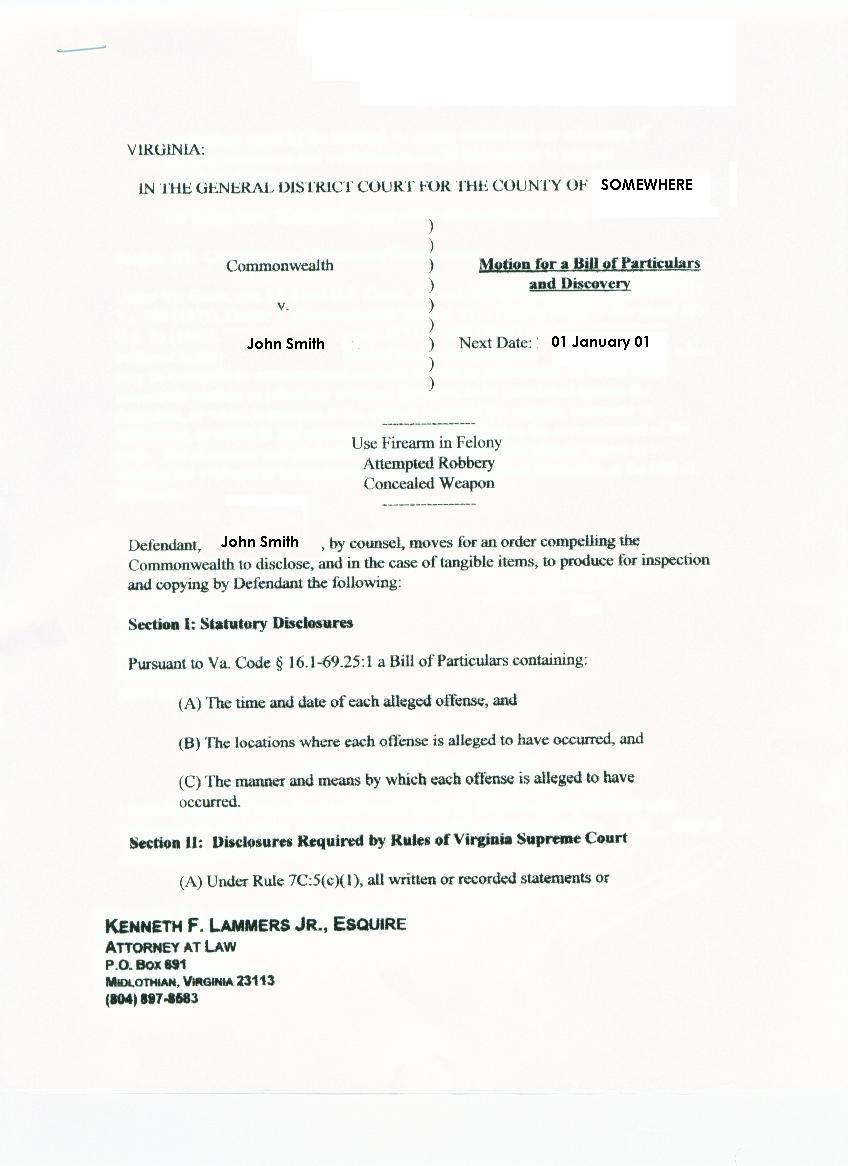
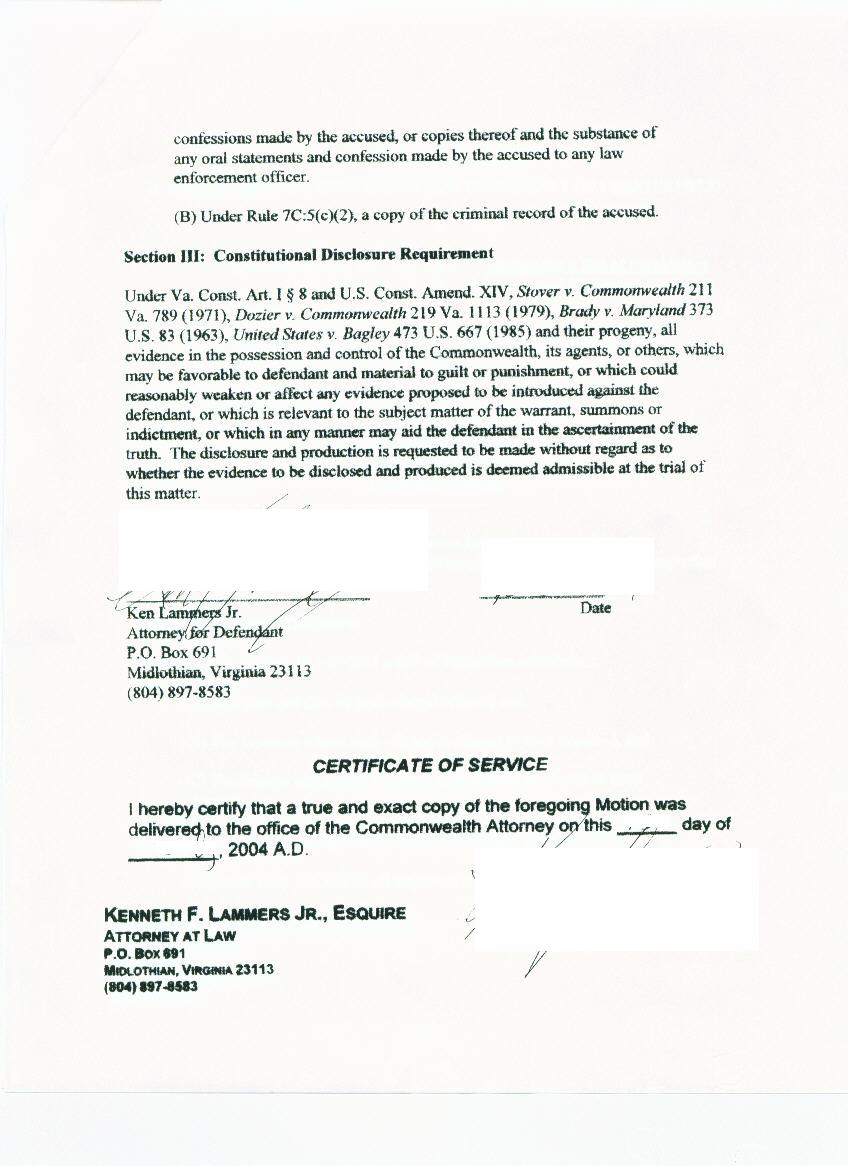
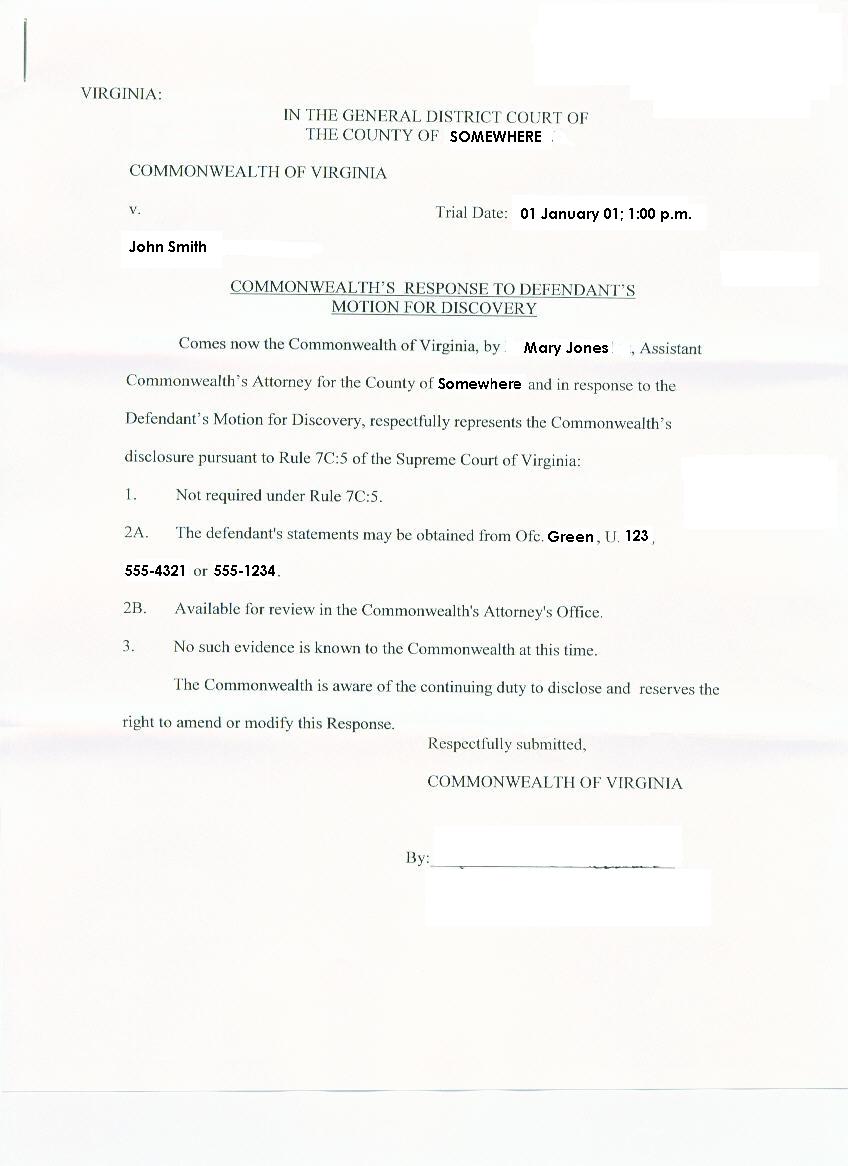
As an example, I have jpeg's below of a discovery motion (the top two) and a reply (the last one; click on them to see larger versions). Three caveats: First, it is Rule 7C:5 discovery from general district court (preliminary hearings and misdemeanors) and this rule does not deal with expert or alibi evidence (I guess it's assumed not to be at issue in district court). Second, the names have been changed to protect just about everyone. Third, they are from different cases (done out of an abundance of caution).
After you read them, you will realize why, no matter how many times the Virginia courts appellate say it isn't, the primary purpose of the preliminary hearing in Virginia is to get discovery. Most judges realize this and allow some lattitude in questioning as long as it doesn't turn into too much of a fishing expedition.
[addendum] When I click on these jpegs in Explorer it brings up small pictures. If you place the mouse pointer over the picture for a second a box will appear at the bottom right and you can click it to make the pictures large enough to read.


Virginia has some of the most stringent discovery rules in the country. Defense attorneys are not allowed to see complete police reports if the prosecutors decide to withhold them.Now, that's not really true. Under Virginia Rule 3A:11 if I file for full felony discovery I am required to turn over scientific tests/reports, provide the prosecution with my client's alibi, and give the prosecution any reports I have concerning my client's mental condition (assuming any of the three are relevant to the trial).
. . . .
“I don’t think it makes the system unfair,” said Loudoun Commonwealth’s Attorney Jim Plowman when asked Wednesday about Virginia’s discovery rules. “We have to give [the defense attorneys] everything and they give us nothing, so in that respect it is not unfair.”
There is a striking disparity in how different prosecutors' offices handle discovery. The best give me a copy of my client's record, a copy of police reports, and a copy of all statements. Most at least give me a copy of my client's record and copies of statements made by my client. Some won't really give me anything. I am refused a copy of my client's record but allowed to take notes from it in the prosecutor's office; usually I receive my client's statements, and the prosecutor picks and chooses what he's going to tell me about the rest of the evidence. While I've not experienced it, I hear horror stories about jurisdictions where no discovery is given unless the Defense attorney goes to court and forces the prosecution to disclose it under order from the judge.
As an example, I have jpeg's below of a discovery motion (the top two) and a reply (the last one; click on them to see larger versions). Three caveats: First, it is Rule 7C:5 discovery from general district court (preliminary hearings and misdemeanors) and this rule does not deal with expert or alibi evidence (I guess it's assumed not to be at issue in district court). Second, the names have been changed to protect just about everyone. Third, they are from different cases (done out of an abundance of caution).
After you read them, you will realize why, no matter how many times the Virginia courts appellate say it isn't, the primary purpose of the preliminary hearing in Virginia is to get discovery. Most judges realize this and allow some lattitude in questioning as long as it doesn't turn into too much of a fishing expedition.
[addendum] When I click on these jpegs in Explorer it brings up small pictures. If you place the mouse pointer over the picture for a second a box will appear at the bottom right and you can click it to make the pictures large enough to read.
06 August 2004
Vindication for Mr. Kringle
FARK suspects that someone by the name "Grinch" has stolen these Christmas lights. In our continuing defense of Mr. Kringle, we at the Lammers Law Office ask anyone with any knowledge of this event to contact our office.
Case update: At this time the trial has been delayed because of massive discovery involved. The Commonwealth is trying to tie Mr. Kringle in to millions of prior trespassings and we are tracking down as many as possible to prove that he had permission to enter the residences. We believe our "milk and cookie" defense will neutralize this aspect of the case.
As always, we look forward to the complete exoneration of our client.
To Do List on Arm: Kill Grandparents
She may be callous, cocky, cold, heartless, and manipulative but she's also dumb.
05 August 2004
4th Circuit - Alteration of a Plea Agreement by Judge & Prosecutor
United States v. Wood - Subject: (1) Oral modification of a plea agreement. (2) Whether the probation officer is the "government" under the "safety valve" provision.
(1) [facts and procedure] The plea agreement clearly states that the Defendant agrees he is accountable for 500g of crack unless the presentence investigation finds a lesser amount. It goes on to state that at sentencing Defendant's attorney will argue that he is responsible for less than 1.5kg of crack. Apparently, the court finds that there was less than 1.5kg and refuses to hear evidence or argument on the weight involved in the sentencing hearing.1
[finding] A plea agreement is not merely a contract between two parties; it “implicates the integrity of the criminal justice system.” The prosecution is held to a higher standard than the Defendant for imprecisions or ambiguities in the plea agreement and beyond that “[t]he Government’s heightened responsibility extends beyond the plea negotiation to all matters relating to the plea agreement.”
The prosecution can alter the agreement through his statements in a hearing involving the case (even after the court has accepted it). The prosecution can alter the agreement by not correcting the trial judge as the judge makes an error and mischaracterizes the plea agreement to the Defendant.
In this case “the district court repeatedly suggested that Wood would have the right to challenge the drug weight finding at sentencing.” The prosecution not only acquiesced, he made at least one statement which seemed to accept the judge's characterization.2 Therefore, the plea agreement was altered. The fact that a court cannot alter the terms of a plea agreement is of no moment because the court lays the responsibility squarely at the feet of the prosecution for not objecting as well as making a statement at variance with the written plea agreement.
The fact that the Defense attorney understood the clause in the plea agreement and explained it to his client does not matter. It is the Defendant's understanding which is at the core of the matter and when the judge, without correction, mischaracterizes the terms of the agreement the Defendant is entitled to rely upon the mischaracterization.
The fact that the prosecution's alteration and subsequent breach of the plea agreement was inadvertent is of little importance.
The remedy is specific performance. Mr. Wood gets a hearing as to weight.
(2) A probation officer is not the government under the 18 U.S.C. Sec. 3553 (f) “safety valve” provision. The Defendant must cooperate with the government in order to qualify.
[comment] Just when you think you've gotten an appellate court in its nice little stereotypical box it goes and does this. This strikes me as a dang good decision for those of us out there representing Defendants. If the judge makes any mistake in his characterization of the plea agreement and the prosecutor doesn't jump up and immediately correct him it changes the terms of the agreement.
Given the vagaries of the English language, the statements made which always may be interpreted to mean something different by someone else, and the ability of clients to hear what they want to hear (and rely upon that improper understanding), you give a decent appellate lawyer a transcript and he's going to be able to make hay in all sorts of cases.
As I read it the case is well decided. Still, I'm a little surprised at the Fightin' Fourth walking away from the four corners of a contract. What next? Will the esteemed judges decide that a stop for an air freshener hanging from the rearview mirror is a pretext stop because the drug dog was there 10 seconds after the stop? (don't bet the house, folks)
---------- ---------- ----------
1 The opinion is not clear on the amount the judge decided was attributable to Mr. Wood. There were estimates from the co-conspirators of 285.5g and a guesstimate by the probation officer of 1.25kg based on co-conspirator statements that Wood had a sandwich bag and 2-3 kleenex boxes of crack. Math was never my strong point but that adds up to over 1.5kg as I do the addition. I can only assume that the judge did not give credence to the guesstimate and only found the 285.5g.
2 In fairness, the prosecutor seems to have believed that the weight would be over 1.5kg and therefore an argument as to weight would be required. Nevertheless, his statement that “there will be a more full hearing at sentencing concerning the drug weight issue” does anticipate an argument as to weight – just not the one that's at issue in this appeal.
04 August 2004
And Now For Something Completely Different . . .
Apparently there is a new nominee for the 4th Circuit. While there might be some fussing, I predict a fairly quick Senate endorsement because I'm pretty sure he's got friends on all sides in D.C.
Lv Legal Right
Lv Legal Right
Virginia Court of Appeals
Farnsworth v. Commonwealth: Subject: If a felon has his right to possess a firearm restored in another State does he have the right to possess a firearm in Virginia?
The court adopts a plain reading of Virginia Code § 18.2-308.2. Under this section once convicted of a felony in "the United States or any territory thereof" (West Virginia) even should an "other appropriate authority" (West Virginia) restore a person's civil rights that person must either "petition the circuit court of the jurisdiction in which he resides for a permit to possess or carry a firearm" or receive a pardon from Virginia's governor. As neither of these events had occurred the person is guilty of possessing a firearm as a felon.
The court finds that the Defendant did not properly preserve his appellate argument that under U.S. Const. Art IV, sec 1 the Commonwealth of Virginia is bound by West Virginia's restoration by "full faith and credit" requirements.
[comment] It's a harsh outcome but I think it is an accurate read of the statute. I just keep wondering how many people in the Commonwealth have come here thinking that they have no problems and are in violation of a law that would mandate their imprisonment for 2 or 5 years.
Logan v. Commonwealth: Subject: Under Virginia Code § 18.2-474.1 would conviction of possession of a drug trigger jeopardy and therefore bar a conviction for delivery to a prisoner?
[facts and procedure] Defendant delivered marijuana to an inmate. Defendant pled guilty to midemeanor possession of marijuana in general district court and then tried to use that conviction as a bar to the felony delivery charge in circuit court.
[finding] Because the statute allows a conviction for conspiracy to deliver, possession of marijuana is not a lesser included offense.
[comment] As I read the drug section of this statute there are 3 separate crimes: (1) delivery, (2) attempt to deliver, and (3) conspiracy to deliver. Either (1) or (2) should be barred by jeopardy. (3) would not but the decision lacks a description of facts sufficient for me to come to a conclusion as to whether there was a group of people involved or if this was just a deliverer and a recipient (and thus not a conspiracy).
This comes across as a Defense attorney being procedurally clever (cudos), the prosecutor not catching it, and the courts moving to "do justice." I really want to know the facts here and find it a little curious that there isn't even a paragraph explaining them.
03 August 2004
The 9th Circuit in the 4th
I get out of court about 2:30 and I've not yet eaten. On my way back to the office I stop at a local bar and get a coke and some fish & oysters. After I tell somebody who recognized me as a lawyer that I don't do bankruptcy and recommend another lawyer, I finally sat down to eat.
While I'm eating I hear the semi-drunk guys behind me at the bar start to discuss the 9th Circuit. First, I find out that Scott Peterson is going to be found not guilty because the trial's in the 9th Circuit. Then I learn that the reason O.J. was found not guilty was because of the 9th Circuit. In fact "you can't get convicted of murder in the 9th Circuit unless they want you to." Then, before they returned to the more important discussion of the comparative length of NASCAR pit rows, I finally learned that you can't convict almost anybody out there because of the 9th Circuit.
Now, wait one sec. Lest ye think this is merely a plebeian attitude I point you to part of the Blakely argument Monday in the 4th Circuit:
Please.
While I'm eating I hear the semi-drunk guys behind me at the bar start to discuss the 9th Circuit. First, I find out that Scott Peterson is going to be found not guilty because the trial's in the 9th Circuit. Then I learn that the reason O.J. was found not guilty was because of the 9th Circuit. In fact "you can't get convicted of murder in the 9th Circuit unless they want you to." Then, before they returned to the more important discussion of the comparative length of NASCAR pit rows, I finally learned that you can't convict almost anybody out there because of the 9th Circuit.
Now, wait one sec. Lest ye think this is merely a plebeian attitude I point you to part of the Blakely argument Monday in the 4th Circuit:
When discussing possible remedies, McLoughlin suggested that the Fourth Circuit could follow the Ninth Circuit's decision in Ameline. A mild chuckle ran through the crowd at this notion.O.K. All that said, I have one request. Those of you who are out there writing practicums for those of us that don't have time to do it for ourselves (CLE's, legal magazines, law review articles, etc.) please, please, PUH-leez remember that if I quote a case from the 9th Circuit the reaction above will be played out in court. I know this is wrong. I know it is biased. I know it is dumb. I also know it is true. I need cites from other places - preferably southern or mid-western. Please. In addition to the numerous perfect cases from the west coast, give me a semi-useful cite from the 5th Circuit, or Alabama, or Ohio, or . . .
Please.
Blow By Blow of the 4th's Blakely Argument
Over at Begging the Question there is an account of how the argument went in the 4th Circuit.
Judicial Economy?
Professor Berman, of Sentencing Law & Policy fame, asks whether the 4th Circuit's recommendation that District Courts issue two opinions, one assuming the guidelines entirely valid and one assuming the guidelines entirely invalid, is actually going to aid judicial economy.
As everyone who's been reading this blog for a while probably realizes, I believe the guidelines remain constitutional with only the departures1 for unproven / unadmitted acts unconstitutional. Assuming that I am right, the action which the 4th Circuit recommends are all moot once the Supreme Court issues its opinion in this matter.2
But wait, there's more. What if the 4th is actually trying to shape the question as it is considered in the Supreme Court? By favoring two diametrically opposed viewpoints and ignoring the third the court is adding cards to the hands of those briefing to the Supreme Court. It allows them to paint the situation as a three pronged Hobson's choice: find the guidelines constitutional or they're out completely or, if you take the third choice, create massive chaos as every Defendant since the Blakely ruling files motions and comes back to court for sentencing. On a pragmatic level the first choice is far, far easier. Now, it's unlikely that any of this maneuvering will effect the votes of Scalia, Thomas, Stevens, Ginsberg, or, for that matter, O'Connor, the Chief Justice, or (most definitely) Breyer (who is too heavily vested in the guidelines to back down now).
I leave it to you to extrapolate on this further. I gotta go to court . . .
---------- ---------- ----------
1 [addendum] Professor Berman was kind enough to point out that "departure" may be imprecise. Let me clarify. By departure I mean any upward "adjustment" which would have been made prior to Blakely from the base sentence composed of the intersection of the client's record with his indicted charge. I apologize for any confusion. In my rush this morning I fell into courthouse slang.
2 I think that this is the most sensible reading of Blakely and am suspicious that too many courts have been entirely too eager to declare the guidelines entirely unconstitutional. In my view most of this rises from two points of origin: (1) a large number of judges who have chaffed under the guidelines and the fact that they render the judge almost meaningless in most federal criminal cases, & (2) a minority of judges who want to favor the prosecution, or at least feel there is a need to be "fair" to the prosecutor, and think that the severance of upward departures unfairly burdens the prosecutor and therefore must be gotten around by declaring the guidelines unconstitutional as a whole and then actually following them as "recommendations."
02 August 2004
The 4th Walks Away from the 6th
A reader has forwarded the information that the 4th Circuit has upheld the guidelines in their entirety, within hours of hearing argument.
I wait to see how the judges justify this conclusion (and wish I could say I am shocked). Apparently there are also dissents.
The appellate court has also "recommended" that trial courts issue dual sentences.
More information as I get it . . .
[addendum] Sentencing Law & Policy has the actual order here.
01 August 2004
dailypress.com
Welcome to everyone who has come here from the Daily Press article. I hope you find this page interesting.
(1) To clarify my "tempest in a teapot" comment: Basically, I meant that in most cases the federal prosecutors will now indict every charge they intend to prove rather than indicting one charge (usually conspiracy) and then putting in evidence of all the other charges and aggravating factors during the sentencing hearing. Prior to the Blakely decision what you were charged with didn't really matter, a Defendant was sentenced to the worst crime the government alleged post conviction - even if the jury never even heard about that crime at trial. Perhaps the best explanation is from a trial court in Mass:
In the short run the system will be disrupted as Defendants who were not indicted on all the charges the prosecution wants to punish them for or who were not indicted with specificity come to court and the judges have to decide how to deal with that. However, from the moment the prosecutors reacted to this decision its impact will be lessened greatly. Having met a few federal prosecutors, I am convinced that they reacted quickly and have already taken the necessary steps.
[addendum] Via SL&P an article from The Birmingham News which backs my assertion.
(2) My major posts on Blakely are:
The Massachusetts Ruling that Federal Sentencing Guidelines are Unconstitutional (actually pre-Blakely but it explains the guidelines situation well)
Blakely and Federal Sentencing Feeneyizing the Upward Departures
Virginia-izing the Federal Sentencing Guidelines
The Trickle Before the Torrent U.S. v. Croxford
The Trickle Before the Torrent II
Blakely Waiver
DOJ Blakely Memo
Guidelines out in Texas
Virginia and Blakely
Blakely Trends
Blakely and Trial Courts
Wilkins Recusal?
(1) To clarify my "tempest in a teapot" comment: Basically, I meant that in most cases the federal prosecutors will now indict every charge they intend to prove rather than indicting one charge (usually conspiracy) and then putting in evidence of all the other charges and aggravating factors during the sentencing hearing. Prior to the Blakely decision what you were charged with didn't really matter, a Defendant was sentenced to the worst crime the government alleged post conviction - even if the jury never even heard about that crime at trial. Perhaps the best explanation is from a trial court in Mass:
"[T]he Guidelines introduced a concept known as “real offense sentencing,” based on an offender’s “relevant conduct.” Pursuant to this approach -- and in keeping with the goal of curbing judicial discretion -- a judge must first determine the offender’s “relevant conduct” from materials formally placed before him primarily by the [prosecutor]; then the judge must impose a sentence based on the offender’s “real offense,” without regard to the actual offense of conviction."So now prosecutors will allege all the offenses they intend to prove and plead them with specificity. A few things will be lost: Defendants will no longer be punished for testifying at their own trial by longer sentences if they are found guilty (because you couldn't indict him of that pre-trial). Then again, the prosecutor could always bring a separate, later charge of perjury if he wants to punish the Defendant.
. . .
"[T]he concept of “real offense” sentencing as practiced under the Guidelines not only affects where -- within the permissible range -- an offender ought be sentenced, it frequently adjusts that range upward considerably. No state system –- not one –- has adopted this approach. The result has been the routine sentencing of offenders on the basis of crimes with which they have never been charged, the commission of which they deny, without any evidence ever having been proffered against them. Even more bizarre, federal criminal sentences may today be based on conduct of which an offender has been formally acquitted."
In the short run the system will be disrupted as Defendants who were not indicted on all the charges the prosecution wants to punish them for or who were not indicted with specificity come to court and the judges have to decide how to deal with that. However, from the moment the prosecutors reacted to this decision its impact will be lessened greatly. Having met a few federal prosecutors, I am convinced that they reacted quickly and have already taken the necessary steps.
[addendum] Via SL&P an article from The Birmingham News which backs my assertion.
(2) My major posts on Blakely are:
The Massachusetts Ruling that Federal Sentencing Guidelines are Unconstitutional (actually pre-Blakely but it explains the guidelines situation well)
Blakely and Federal Sentencing Feeneyizing the Upward Departures
Virginia-izing the Federal Sentencing Guidelines
The Trickle Before the Torrent U.S. v. Croxford
The Trickle Before the Torrent II
Blakely Waiver
DOJ Blakely Memo
Guidelines out in Texas
Virginia and Blakely
Blakely Trends
Blakely and Trial Courts
Wilkins Recusal?
Subscribe to:
Posts (Atom)