
07 August 2004
Discovery in Virginia
BD forwards this article to me about the Chief Justice of Virginia's Supreme Court meeting with public defenders. It goes on to discuss what is being done to fix the problems in indigent defense. Of course, we all know what would solve the problems: Increase by at least 100% the caps on payments to court appointed attorneys and require both the Commonwealth and localities to match every penny they give to prosecutors with a penny given to the public defender (where there are PD offices). Of course, we all know this isn't going to happen either so I was just about to dismiss the article as another case of hand wringing and non-solutions when I cam across this statement:
There is a striking disparity in how different prosecutors' offices handle discovery. The best give me a copy of my client's record, a copy of police reports, and a copy of all statements. Most at least give me a copy of my client's record and copies of statements made by my client. Some won't really give me anything. I am refused a copy of my client's record but allowed to take notes from it in the prosecutor's office; usually I receive my client's statements, and the prosecutor picks and chooses what he's going to tell me about the rest of the evidence. While I've not experienced it, I hear horror stories about jurisdictions where no discovery is given unless the Defense attorney goes to court and forces the prosecution to disclose it under order from the judge.
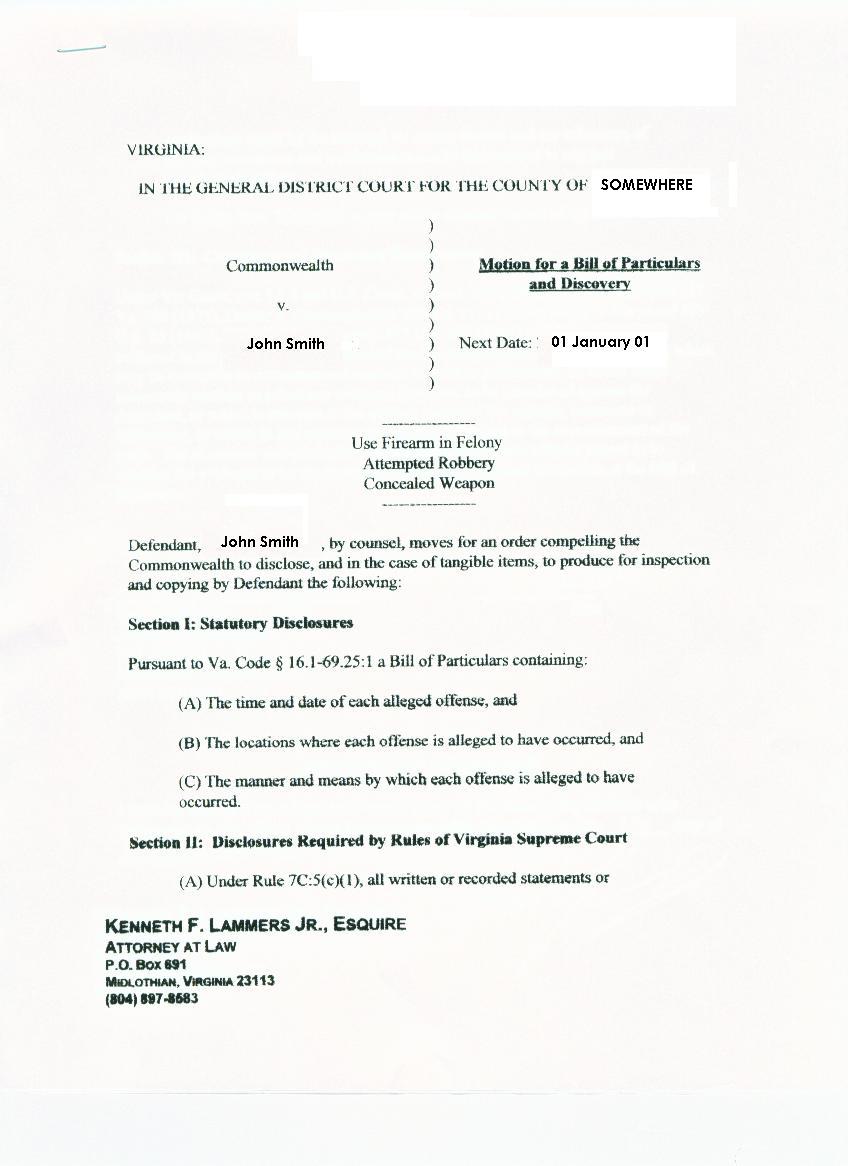
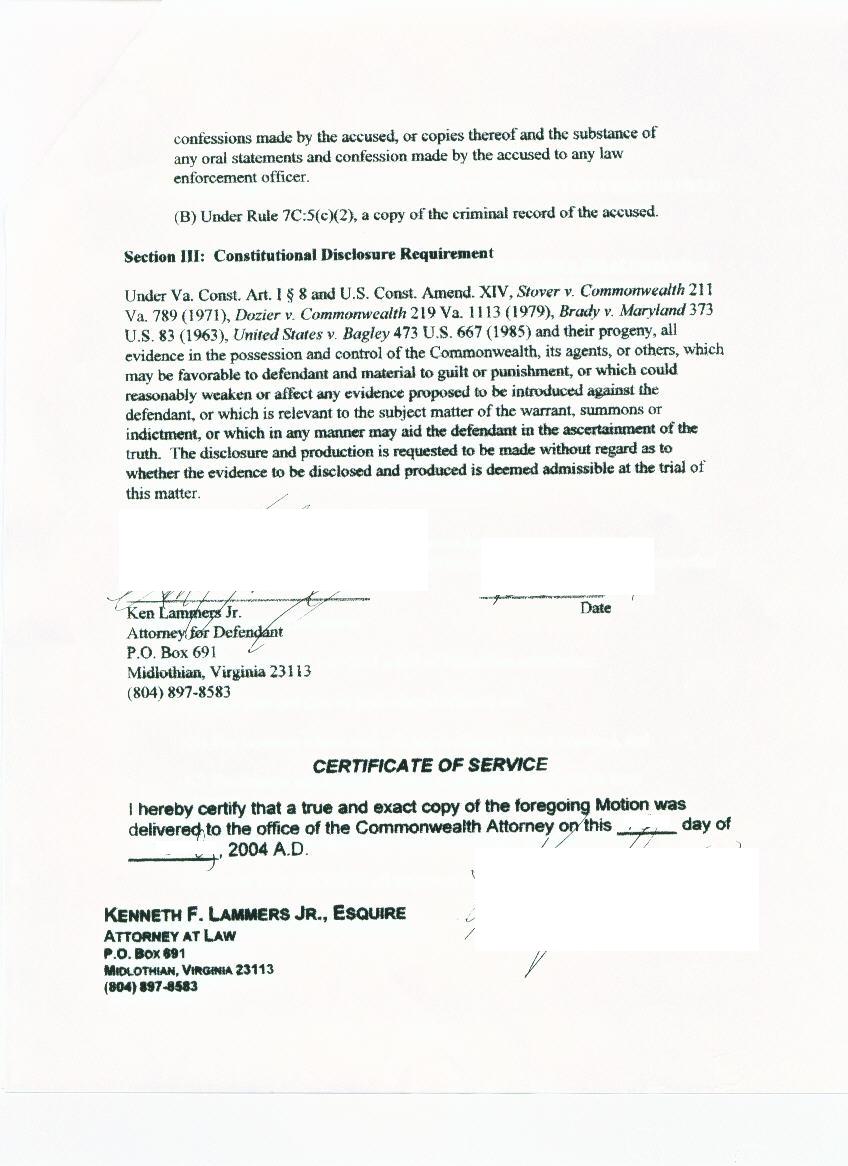
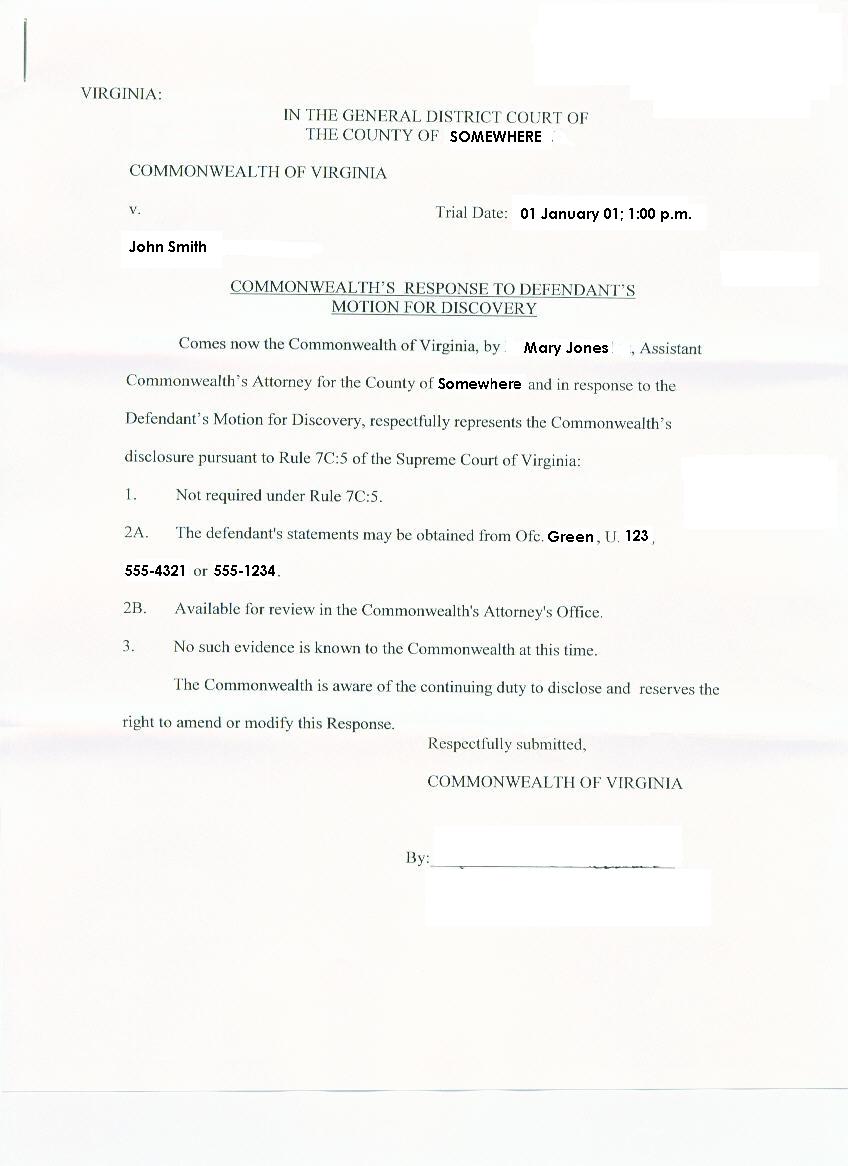
As an example, I have jpeg's below of a discovery motion (the top two) and a reply (the last one; click on them to see larger versions). Three caveats: First, it is Rule 7C:5 discovery from general district court (preliminary hearings and misdemeanors) and this rule does not deal with expert or alibi evidence (I guess it's assumed not to be at issue in district court). Second, the names have been changed to protect just about everyone. Third, they are from different cases (done out of an abundance of caution).
After you read them, you will realize why, no matter how many times the Virginia courts appellate say it isn't, the primary purpose of the preliminary hearing in Virginia is to get discovery. Most judges realize this and allow some lattitude in questioning as long as it doesn't turn into too much of a fishing expedition.
[addendum] When I click on these jpegs in Explorer it brings up small pictures. If you place the mouse pointer over the picture for a second a box will appear at the bottom right and you can click it to make the pictures large enough to read.


Virginia has some of the most stringent discovery rules in the country. Defense attorneys are not allowed to see complete police reports if the prosecutors decide to withhold them.Now, that's not really true. Under Virginia Rule 3A:11 if I file for full felony discovery I am required to turn over scientific tests/reports, provide the prosecution with my client's alibi, and give the prosecution any reports I have concerning my client's mental condition (assuming any of the three are relevant to the trial).
. . . .
“I don’t think it makes the system unfair,” said Loudoun Commonwealth’s Attorney Jim Plowman when asked Wednesday about Virginia’s discovery rules. “We have to give [the defense attorneys] everything and they give us nothing, so in that respect it is not unfair.”
There is a striking disparity in how different prosecutors' offices handle discovery. The best give me a copy of my client's record, a copy of police reports, and a copy of all statements. Most at least give me a copy of my client's record and copies of statements made by my client. Some won't really give me anything. I am refused a copy of my client's record but allowed to take notes from it in the prosecutor's office; usually I receive my client's statements, and the prosecutor picks and chooses what he's going to tell me about the rest of the evidence. While I've not experienced it, I hear horror stories about jurisdictions where no discovery is given unless the Defense attorney goes to court and forces the prosecution to disclose it under order from the judge.
As an example, I have jpeg's below of a discovery motion (the top two) and a reply (the last one; click on them to see larger versions). Three caveats: First, it is Rule 7C:5 discovery from general district court (preliminary hearings and misdemeanors) and this rule does not deal with expert or alibi evidence (I guess it's assumed not to be at issue in district court). Second, the names have been changed to protect just about everyone. Third, they are from different cases (done out of an abundance of caution).
After you read them, you will realize why, no matter how many times the Virginia courts appellate say it isn't, the primary purpose of the preliminary hearing in Virginia is to get discovery. Most judges realize this and allow some lattitude in questioning as long as it doesn't turn into too much of a fishing expedition.
[addendum] When I click on these jpegs in Explorer it brings up small pictures. If you place the mouse pointer over the picture for a second a box will appear at the bottom right and you can click it to make the pictures large enough to read.
06 August 2004
Vindication for Mr. Kringle
FARK suspects that someone by the name "Grinch" has stolen these Christmas lights. In our continuing defense of Mr. Kringle, we at the Lammers Law Office ask anyone with any knowledge of this event to contact our office.
Case update: At this time the trial has been delayed because of massive discovery involved. The Commonwealth is trying to tie Mr. Kringle in to millions of prior trespassings and we are tracking down as many as possible to prove that he had permission to enter the residences. We believe our "milk and cookie" defense will neutralize this aspect of the case.
As always, we look forward to the complete exoneration of our client.
Case update: At this time the trial has been delayed because of massive discovery involved. The Commonwealth is trying to tie Mr. Kringle in to millions of prior trespassings and we are tracking down as many as possible to prove that he had permission to enter the residences. We believe our "milk and cookie" defense will neutralize this aspect of the case.
As always, we look forward to the complete exoneration of our client.
To Do List on Arm: Kill Grandparents
She may be callous, cocky, cold, heartless, and manipulative but she's also dumb.
05 August 2004
4th Circuit - Alteration of a Plea Agreement by Judge & Prosecutor
United States v. Wood - Subject: (1) Oral modification of a plea agreement. (2) Whether the probation officer is the "government" under the "safety valve" provision.
(1) [facts and procedure] The plea agreement clearly states that the Defendant agrees he is accountable for 500g of crack unless the presentence investigation finds a lesser amount. It goes on to state that at sentencing Defendant's attorney will argue that he is responsible for less than 1.5kg of crack. Apparently, the court finds that there was less than 1.5kg and refuses to hear evidence or argument on the weight involved in the sentencing hearing.1
[finding] A plea agreement is not merely a contract between two parties; it “implicates the integrity of the criminal justice system.” The prosecution is held to a higher standard than the Defendant for imprecisions or ambiguities in the plea agreement and beyond that “[t]he Government’s heightened responsibility extends beyond the plea negotiation to all matters relating to the plea agreement.”
The prosecution can alter the agreement through his statements in a hearing involving the case (even after the court has accepted it). The prosecution can alter the agreement by not correcting the trial judge as the judge makes an error and mischaracterizes the plea agreement to the Defendant.
In this case “the district court repeatedly suggested that Wood would have the right to challenge the drug weight finding at sentencing.” The prosecution not only acquiesced, he made at least one statement which seemed to accept the judge's characterization.2 Therefore, the plea agreement was altered. The fact that a court cannot alter the terms of a plea agreement is of no moment because the court lays the responsibility squarely at the feet of the prosecution for not objecting as well as making a statement at variance with the written plea agreement.
The fact that the Defense attorney understood the clause in the plea agreement and explained it to his client does not matter. It is the Defendant's understanding which is at the core of the matter and when the judge, without correction, mischaracterizes the terms of the agreement the Defendant is entitled to rely upon the mischaracterization.
The fact that the prosecution's alteration and subsequent breach of the plea agreement was inadvertent is of little importance.
The remedy is specific performance. Mr. Wood gets a hearing as to weight.
(2) A probation officer is not the government under the 18 U.S.C. Sec. 3553 (f) “safety valve” provision. The Defendant must cooperate with the government in order to qualify.
[comment] Just when you think you've gotten an appellate court in its nice little stereotypical box it goes and does this. This strikes me as a dang good decision for those of us out there representing Defendants. If the judge makes any mistake in his characterization of the plea agreement and the prosecutor doesn't jump up and immediately correct him it changes the terms of the agreement.
Given the vagaries of the English language, the statements made which always may be interpreted to mean something different by someone else, and the ability of clients to hear what they want to hear (and rely upon that improper understanding), you give a decent appellate lawyer a transcript and he's going to be able to make hay in all sorts of cases.
As I read it the case is well decided. Still, I'm a little surprised at the Fightin' Fourth walking away from the four corners of a contract. What next? Will the esteemed judges decide that a stop for an air freshener hanging from the rearview mirror is a pretext stop because the drug dog was there 10 seconds after the stop? (don't bet the house, folks)
---------- ---------- ----------
1 The opinion is not clear on the amount the judge decided was attributable to Mr. Wood. There were estimates from the co-conspirators of 285.5g and a guesstimate by the probation officer of 1.25kg based on co-conspirator statements that Wood had a sandwich bag and 2-3 kleenex boxes of crack. Math was never my strong point but that adds up to over 1.5kg as I do the addition. I can only assume that the judge did not give credence to the guesstimate and only found the 285.5g.
2 In fairness, the prosecutor seems to have believed that the weight would be over 1.5kg and therefore an argument as to weight would be required. Nevertheless, his statement that “there will be a more full hearing at sentencing concerning the drug weight issue” does anticipate an argument as to weight – just not the one that's at issue in this appeal.
(1) [facts and procedure] The plea agreement clearly states that the Defendant agrees he is accountable for 500g of crack unless the presentence investigation finds a lesser amount. It goes on to state that at sentencing Defendant's attorney will argue that he is responsible for less than 1.5kg of crack. Apparently, the court finds that there was less than 1.5kg and refuses to hear evidence or argument on the weight involved in the sentencing hearing.1
[finding] A plea agreement is not merely a contract between two parties; it “implicates the integrity of the criminal justice system.” The prosecution is held to a higher standard than the Defendant for imprecisions or ambiguities in the plea agreement and beyond that “[t]he Government’s heightened responsibility extends beyond the plea negotiation to all matters relating to the plea agreement.”
The prosecution can alter the agreement through his statements in a hearing involving the case (even after the court has accepted it). The prosecution can alter the agreement by not correcting the trial judge as the judge makes an error and mischaracterizes the plea agreement to the Defendant.
In this case “the district court repeatedly suggested that Wood would have the right to challenge the drug weight finding at sentencing.” The prosecution not only acquiesced, he made at least one statement which seemed to accept the judge's characterization.2 Therefore, the plea agreement was altered. The fact that a court cannot alter the terms of a plea agreement is of no moment because the court lays the responsibility squarely at the feet of the prosecution for not objecting as well as making a statement at variance with the written plea agreement.
The fact that the Defense attorney understood the clause in the plea agreement and explained it to his client does not matter. It is the Defendant's understanding which is at the core of the matter and when the judge, without correction, mischaracterizes the terms of the agreement the Defendant is entitled to rely upon the mischaracterization.
The fact that the prosecution's alteration and subsequent breach of the plea agreement was inadvertent is of little importance.
The remedy is specific performance. Mr. Wood gets a hearing as to weight.
(2) A probation officer is not the government under the 18 U.S.C. Sec. 3553 (f) “safety valve” provision. The Defendant must cooperate with the government in order to qualify.
[comment] Just when you think you've gotten an appellate court in its nice little stereotypical box it goes and does this. This strikes me as a dang good decision for those of us out there representing Defendants. If the judge makes any mistake in his characterization of the plea agreement and the prosecutor doesn't jump up and immediately correct him it changes the terms of the agreement.
Given the vagaries of the English language, the statements made which always may be interpreted to mean something different by someone else, and the ability of clients to hear what they want to hear (and rely upon that improper understanding), you give a decent appellate lawyer a transcript and he's going to be able to make hay in all sorts of cases.
As I read it the case is well decided. Still, I'm a little surprised at the Fightin' Fourth walking away from the four corners of a contract. What next? Will the esteemed judges decide that a stop for an air freshener hanging from the rearview mirror is a pretext stop because the drug dog was there 10 seconds after the stop? (don't bet the house, folks)
---------- ---------- ----------
1 The opinion is not clear on the amount the judge decided was attributable to Mr. Wood. There were estimates from the co-conspirators of 285.5g and a guesstimate by the probation officer of 1.25kg based on co-conspirator statements that Wood had a sandwich bag and 2-3 kleenex boxes of crack. Math was never my strong point but that adds up to over 1.5kg as I do the addition. I can only assume that the judge did not give credence to the guesstimate and only found the 285.5g.
2 In fairness, the prosecutor seems to have believed that the weight would be over 1.5kg and therefore an argument as to weight would be required. Nevertheless, his statement that “there will be a more full hearing at sentencing concerning the drug weight issue” does anticipate an argument as to weight – just not the one that's at issue in this appeal.
04 August 2004
And Now For Something Completely Different . . .
Apparently there is a new nominee for the 4th Circuit. While there might be some fussing, I predict a fairly quick Senate endorsement because I'm pretty sure he's got friends on all sides in D.C.
Lv Legal Right
Lv Legal Right
Virginia Court of Appeals
Farnsworth v. Commonwealth: Subject: If a felon has his right to possess a firearm restored in another State does he have the right to possess a firearm in Virginia?
The court adopts a plain reading of Virginia Code § 18.2-308.2. Under this section once convicted of a felony in "the United States or any territory thereof" (West Virginia) even should an "other appropriate authority" (West Virginia) restore a person's civil rights that person must either "petition the circuit court of the jurisdiction in which he resides for a permit to possess or carry a firearm" or receive a pardon from Virginia's governor. As neither of these events had occurred the person is guilty of possessing a firearm as a felon.
The court finds that the Defendant did not properly preserve his appellate argument that under U.S. Const. Art IV, sec 1 the Commonwealth of Virginia is bound by West Virginia's restoration by "full faith and credit" requirements.
[comment] It's a harsh outcome but I think it is an accurate read of the statute. I just keep wondering how many people in the Commonwealth have come here thinking that they have no problems and are in violation of a law that would mandate their imprisonment for 2 or 5 years.
Logan v. Commonwealth: Subject: Under Virginia Code § 18.2-474.1 would conviction of possession of a drug trigger jeopardy and therefore bar a conviction for delivery to a prisoner?
[facts and procedure] Defendant delivered marijuana to an inmate. Defendant pled guilty to midemeanor possession of marijuana in general district court and then tried to use that conviction as a bar to the felony delivery charge in circuit court.
[finding] Because the statute allows a conviction for conspiracy to deliver, possession of marijuana is not a lesser included offense.
[comment] As I read the drug section of this statute there are 3 separate crimes: (1) delivery, (2) attempt to deliver, and (3) conspiracy to deliver. Either (1) or (2) should be barred by jeopardy. (3) would not but the decision lacks a description of facts sufficient for me to come to a conclusion as to whether there was a group of people involved or if this was just a deliverer and a recipient (and thus not a conspiracy).
This comes across as a Defense attorney being procedurally clever (cudos), the prosecutor not catching it, and the courts moving to "do justice." I really want to know the facts here and find it a little curious that there isn't even a paragraph explaining them.
The court adopts a plain reading of Virginia Code § 18.2-308.2. Under this section once convicted of a felony in "the United States or any territory thereof" (West Virginia) even should an "other appropriate authority" (West Virginia) restore a person's civil rights that person must either "petition the circuit court of the jurisdiction in which he resides for a permit to possess or carry a firearm" or receive a pardon from Virginia's governor. As neither of these events had occurred the person is guilty of possessing a firearm as a felon.
The court finds that the Defendant did not properly preserve his appellate argument that under U.S. Const. Art IV, sec 1 the Commonwealth of Virginia is bound by West Virginia's restoration by "full faith and credit" requirements.
[comment] It's a harsh outcome but I think it is an accurate read of the statute. I just keep wondering how many people in the Commonwealth have come here thinking that they have no problems and are in violation of a law that would mandate their imprisonment for 2 or 5 years.
Logan v. Commonwealth: Subject: Under Virginia Code § 18.2-474.1 would conviction of possession of a drug trigger jeopardy and therefore bar a conviction for delivery to a prisoner?
[facts and procedure] Defendant delivered marijuana to an inmate. Defendant pled guilty to midemeanor possession of marijuana in general district court and then tried to use that conviction as a bar to the felony delivery charge in circuit court.
[finding] Because the statute allows a conviction for conspiracy to deliver, possession of marijuana is not a lesser included offense.
[comment] As I read the drug section of this statute there are 3 separate crimes: (1) delivery, (2) attempt to deliver, and (3) conspiracy to deliver. Either (1) or (2) should be barred by jeopardy. (3) would not but the decision lacks a description of facts sufficient for me to come to a conclusion as to whether there was a group of people involved or if this was just a deliverer and a recipient (and thus not a conspiracy).
This comes across as a Defense attorney being procedurally clever (cudos), the prosecutor not catching it, and the courts moving to "do justice." I really want to know the facts here and find it a little curious that there isn't even a paragraph explaining them.
03 August 2004
The 9th Circuit in the 4th
I get out of court about 2:30 and I've not yet eaten. On my way back to the office I stop at a local bar and get a coke and some fish & oysters. After I tell somebody who recognized me as a lawyer that I don't do bankruptcy and recommend another lawyer, I finally sat down to eat.
While I'm eating I hear the semi-drunk guys behind me at the bar start to discuss the 9th Circuit. First, I find out that Scott Peterson is going to be found not guilty because the trial's in the 9th Circuit. Then I learn that the reason O.J. was found not guilty was because of the 9th Circuit. In fact "you can't get convicted of murder in the 9th Circuit unless they want you to." Then, before they returned to the more important discussion of the comparative length of NASCAR pit rows, I finally learned that you can't convict almost anybody out there because of the 9th Circuit.
Now, wait one sec. Lest ye think this is merely a plebeian attitude I point you to part of the Blakely argument Monday in the 4th Circuit:
Please.
While I'm eating I hear the semi-drunk guys behind me at the bar start to discuss the 9th Circuit. First, I find out that Scott Peterson is going to be found not guilty because the trial's in the 9th Circuit. Then I learn that the reason O.J. was found not guilty was because of the 9th Circuit. In fact "you can't get convicted of murder in the 9th Circuit unless they want you to." Then, before they returned to the more important discussion of the comparative length of NASCAR pit rows, I finally learned that you can't convict almost anybody out there because of the 9th Circuit.
Now, wait one sec. Lest ye think this is merely a plebeian attitude I point you to part of the Blakely argument Monday in the 4th Circuit:
When discussing possible remedies, McLoughlin suggested that the Fourth Circuit could follow the Ninth Circuit's decision in Ameline. A mild chuckle ran through the crowd at this notion.O.K. All that said, I have one request. Those of you who are out there writing practicums for those of us that don't have time to do it for ourselves (CLE's, legal magazines, law review articles, etc.) please, please, PUH-leez remember that if I quote a case from the 9th Circuit the reaction above will be played out in court. I know this is wrong. I know it is biased. I know it is dumb. I also know it is true. I need cites from other places - preferably southern or mid-western. Please. In addition to the numerous perfect cases from the west coast, give me a semi-useful cite from the 5th Circuit, or Alabama, or Ohio, or . . .
Please.
Blow By Blow of the 4th's Blakely Argument
Over at Begging the Question there is an account of how the argument went in the 4th Circuit.
Judicial Economy?
Professor Berman, of Sentencing Law & Policy fame, asks whether the 4th Circuit's recommendation that District Courts issue two opinions, one assuming the guidelines entirely valid and one assuming the guidelines entirely invalid, is actually going to aid judicial economy.
As everyone who's been reading this blog for a while probably realizes, I believe the guidelines remain constitutional with only the departures1 for unproven / unadmitted acts unconstitutional. Assuming that I am right, the action which the 4th Circuit recommends are all moot once the Supreme Court issues its opinion in this matter.2
But wait, there's more. What if the 4th is actually trying to shape the question as it is considered in the Supreme Court? By favoring two diametrically opposed viewpoints and ignoring the third the court is adding cards to the hands of those briefing to the Supreme Court. It allows them to paint the situation as a three pronged Hobson's choice: find the guidelines constitutional or they're out completely or, if you take the third choice, create massive chaos as every Defendant since the Blakely ruling files motions and comes back to court for sentencing. On a pragmatic level the first choice is far, far easier. Now, it's unlikely that any of this maneuvering will effect the votes of Scalia, Thomas, Stevens, Ginsberg, or, for that matter, O'Connor, the Chief Justice, or (most definitely) Breyer (who is too heavily vested in the guidelines to back down now).
I leave it to you to extrapolate on this further. I gotta go to court . . .
---------- ---------- ----------
1 [addendum] Professor Berman was kind enough to point out that "departure" may be imprecise. Let me clarify. By departure I mean any upward "adjustment" which would have been made prior to Blakely from the base sentence composed of the intersection of the client's record with his indicted charge. I apologize for any confusion. In my rush this morning I fell into courthouse slang.
2 I think that this is the most sensible reading of Blakely and am suspicious that too many courts have been entirely too eager to declare the guidelines entirely unconstitutional. In my view most of this rises from two points of origin: (1) a large number of judges who have chaffed under the guidelines and the fact that they render the judge almost meaningless in most federal criminal cases, & (2) a minority of judges who want to favor the prosecution, or at least feel there is a need to be "fair" to the prosecutor, and think that the severance of upward departures unfairly burdens the prosecutor and therefore must be gotten around by declaring the guidelines unconstitutional as a whole and then actually following them as "recommendations."
As everyone who's been reading this blog for a while probably realizes, I believe the guidelines remain constitutional with only the departures1 for unproven / unadmitted acts unconstitutional. Assuming that I am right, the action which the 4th Circuit recommends are all moot once the Supreme Court issues its opinion in this matter.2
But wait, there's more. What if the 4th is actually trying to shape the question as it is considered in the Supreme Court? By favoring two diametrically opposed viewpoints and ignoring the third the court is adding cards to the hands of those briefing to the Supreme Court. It allows them to paint the situation as a three pronged Hobson's choice: find the guidelines constitutional or they're out completely or, if you take the third choice, create massive chaos as every Defendant since the Blakely ruling files motions and comes back to court for sentencing. On a pragmatic level the first choice is far, far easier. Now, it's unlikely that any of this maneuvering will effect the votes of Scalia, Thomas, Stevens, Ginsberg, or, for that matter, O'Connor, the Chief Justice, or (most definitely) Breyer (who is too heavily vested in the guidelines to back down now).
I leave it to you to extrapolate on this further. I gotta go to court . . .
---------- ---------- ----------
1 [addendum] Professor Berman was kind enough to point out that "departure" may be imprecise. Let me clarify. By departure I mean any upward "adjustment" which would have been made prior to Blakely from the base sentence composed of the intersection of the client's record with his indicted charge. I apologize for any confusion. In my rush this morning I fell into courthouse slang.
2 I think that this is the most sensible reading of Blakely and am suspicious that too many courts have been entirely too eager to declare the guidelines entirely unconstitutional. In my view most of this rises from two points of origin: (1) a large number of judges who have chaffed under the guidelines and the fact that they render the judge almost meaningless in most federal criminal cases, & (2) a minority of judges who want to favor the prosecution, or at least feel there is a need to be "fair" to the prosecutor, and think that the severance of upward departures unfairly burdens the prosecutor and therefore must be gotten around by declaring the guidelines unconstitutional as a whole and then actually following them as "recommendations."
02 August 2004
The 4th Walks Away from the 6th
A reader has forwarded the information that the 4th Circuit has upheld the guidelines in their entirety, within hours of hearing argument.
I wait to see how the judges justify this conclusion (and wish I could say I am shocked). Apparently there are also dissents.
The appellate court has also "recommended" that trial courts issue dual sentences.
More information as I get it . . .
[addendum] Sentencing Law & Policy has the actual order here.
I wait to see how the judges justify this conclusion (and wish I could say I am shocked). Apparently there are also dissents.
The appellate court has also "recommended" that trial courts issue dual sentences.
More information as I get it . . .
[addendum] Sentencing Law & Policy has the actual order here.
01 August 2004
dailypress.com
Welcome to everyone who has come here from the Daily Press article. I hope you find this page interesting.
(1) To clarify my "tempest in a teapot" comment: Basically, I meant that in most cases the federal prosecutors will now indict every charge they intend to prove rather than indicting one charge (usually conspiracy) and then putting in evidence of all the other charges and aggravating factors during the sentencing hearing. Prior to the Blakely decision what you were charged with didn't really matter, a Defendant was sentenced to the worst crime the government alleged post conviction - even if the jury never even heard about that crime at trial. Perhaps the best explanation is from a trial court in Mass:
In the short run the system will be disrupted as Defendants who were not indicted on all the charges the prosecution wants to punish them for or who were not indicted with specificity come to court and the judges have to decide how to deal with that. However, from the moment the prosecutors reacted to this decision its impact will be lessened greatly. Having met a few federal prosecutors, I am convinced that they reacted quickly and have already taken the necessary steps.
[addendum] Via SL&P an article from The Birmingham News which backs my assertion.
(2) My major posts on Blakely are:
The Massachusetts Ruling that Federal Sentencing Guidelines are Unconstitutional (actually pre-Blakely but it explains the guidelines situation well)
Blakely and Federal Sentencing Feeneyizing the Upward Departures
Virginia-izing the Federal Sentencing Guidelines
The Trickle Before the Torrent U.S. v. Croxford
The Trickle Before the Torrent II
Blakely Waiver
DOJ Blakely Memo
Guidelines out in Texas
Virginia and Blakely
Blakely Trends
Blakely and Trial Courts
Wilkins Recusal?
(1) To clarify my "tempest in a teapot" comment: Basically, I meant that in most cases the federal prosecutors will now indict every charge they intend to prove rather than indicting one charge (usually conspiracy) and then putting in evidence of all the other charges and aggravating factors during the sentencing hearing. Prior to the Blakely decision what you were charged with didn't really matter, a Defendant was sentenced to the worst crime the government alleged post conviction - even if the jury never even heard about that crime at trial. Perhaps the best explanation is from a trial court in Mass:
"[T]he Guidelines introduced a concept known as “real offense sentencing,” based on an offender’s “relevant conduct.” Pursuant to this approach -- and in keeping with the goal of curbing judicial discretion -- a judge must first determine the offender’s “relevant conduct” from materials formally placed before him primarily by the [prosecutor]; then the judge must impose a sentence based on the offender’s “real offense,” without regard to the actual offense of conviction."So now prosecutors will allege all the offenses they intend to prove and plead them with specificity. A few things will be lost: Defendants will no longer be punished for testifying at their own trial by longer sentences if they are found guilty (because you couldn't indict him of that pre-trial). Then again, the prosecutor could always bring a separate, later charge of perjury if he wants to punish the Defendant.
. . .
"[T]he concept of “real offense” sentencing as practiced under the Guidelines not only affects where -- within the permissible range -- an offender ought be sentenced, it frequently adjusts that range upward considerably. No state system –- not one –- has adopted this approach. The result has been the routine sentencing of offenders on the basis of crimes with which they have never been charged, the commission of which they deny, without any evidence ever having been proffered against them. Even more bizarre, federal criminal sentences may today be based on conduct of which an offender has been formally acquitted."
In the short run the system will be disrupted as Defendants who were not indicted on all the charges the prosecution wants to punish them for or who were not indicted with specificity come to court and the judges have to decide how to deal with that. However, from the moment the prosecutors reacted to this decision its impact will be lessened greatly. Having met a few federal prosecutors, I am convinced that they reacted quickly and have already taken the necessary steps.
[addendum] Via SL&P an article from The Birmingham News which backs my assertion.
(2) My major posts on Blakely are:
The Massachusetts Ruling that Federal Sentencing Guidelines are Unconstitutional (actually pre-Blakely but it explains the guidelines situation well)
Blakely and Federal Sentencing Feeneyizing the Upward Departures
Virginia-izing the Federal Sentencing Guidelines
The Trickle Before the Torrent U.S. v. Croxford
The Trickle Before the Torrent II
Blakely Waiver
DOJ Blakely Memo
Guidelines out in Texas
Virginia and Blakely
Blakely Trends
Blakely and Trial Courts
Wilkins Recusal?
31 July 2004
Bits and Pieces
A collection of little things which have happened recently:
I've been growing a beard over the last month or so and it was looking pretty scraggly for a while. About two weeks ago I go in the back door of the local courthouse (used by lawyers, police, and employees) and walk thru the Sheriff's area on my way to the elevator leading to the courts. There's a work detail from the jail moving a bunch of furniture from the rooms into the hall (who knows why). After I pass two of the prisoners one turns to the other and ask, "Who's that?" The second, without even hesitating, replies, "He's a narc."
I finally watched the Kings of Comedy DVD I bought a while back. If you watch the deleted scenes D.L. Hughley talks what it's like to visit someone in jail.
Last week I left my office door open as I went across the hall to visit the WC. When I came back the psychiatrist who has the office a the bottom of the stairs had just walked in. She looks up at my medals and asks if I was really in military intelligence. Then she looks at my W&L Law diploma between the portraits of Washington and Lee. Next she looks at the statue I have sitting in top of my file cabinet, gets a strange look on her face, and asks about the guy standing on a gargoyle. I explain that it's St. Michael defeating the Devil and she sort of dismisses it. She looks at the wall behind my desk and asks "What are those?" I explain that they are war hammers and that they are kind of a play on my name. She takes a final look around the office: "This office is just so . . . Male."
I'm talking to a fellow Defense attorney. He's of Italian descent and I ask him if he is a member of some Italian-American group I saw on C-Span. He tells me he gets their e-mails but won't join because he cannot go to meetings. When I ask him why not he answers: "Because if you are Italian and you go to meetings with other Italians you end up on a bunch of film over at the FBI."
I rented a car for a few days while my Saab was being brought up to spec so that it is legal to drive in Virginia. When I return the car a couple of employees are kind enough to give me a ride back to my office. Half way there one of them says "Hey, you're the guy who's representing the girl who stole our car in March." And, sure enough, I am. They're not upset; they think it's funny. This is happening to me more often. The judges know where my office is so if someone has a charge in Midlothian they will assign the case to me. Of course, the people who start turning out to be complaining witnesses are the clerks at the gas station I use, the employees at the rental agency, the girl who cuts my hair, etc. So far no one's been too upset about it which is of no little importance when the lady standing behind you with scissors realizes who you are.
I'm sitting in court last Friday talking to the prosecutor while we wait for the clerk to call all the kids accused of striking the guards with intent to injure. As a joke, he looks up the Virginian anti-terrorist statute to see if it could apply to these kids. It could. The basic test is whether the act was done to influence a government official. Fighting with a guard because they won't let you have salad could be seen as trying to get them to allow you to eat more. You'd have to read the statute broadly (and have a friendly judge) but it's definitely a charge a prosecutor could make with a straight face.
I've been growing a beard over the last month or so and it was looking pretty scraggly for a while. About two weeks ago I go in the back door of the local courthouse (used by lawyers, police, and employees) and walk thru the Sheriff's area on my way to the elevator leading to the courts. There's a work detail from the jail moving a bunch of furniture from the rooms into the hall (who knows why). After I pass two of the prisoners one turns to the other and ask, "Who's that?" The second, without even hesitating, replies, "He's a narc."
I finally watched the Kings of Comedy DVD I bought a while back. If you watch the deleted scenes D.L. Hughley talks what it's like to visit someone in jail.
Last week I left my office door open as I went across the hall to visit the WC. When I came back the psychiatrist who has the office a the bottom of the stairs had just walked in. She looks up at my medals and asks if I was really in military intelligence. Then she looks at my W&L Law diploma between the portraits of Washington and Lee. Next she looks at the statue I have sitting in top of my file cabinet, gets a strange look on her face, and asks about the guy standing on a gargoyle. I explain that it's St. Michael defeating the Devil and she sort of dismisses it. She looks at the wall behind my desk and asks "What are those?" I explain that they are war hammers and that they are kind of a play on my name. She takes a final look around the office: "This office is just so . . . Male."
I'm talking to a fellow Defense attorney. He's of Italian descent and I ask him if he is a member of some Italian-American group I saw on C-Span. He tells me he gets their e-mails but won't join because he cannot go to meetings. When I ask him why not he answers: "Because if you are Italian and you go to meetings with other Italians you end up on a bunch of film over at the FBI."
I rented a car for a few days while my Saab was being brought up to spec so that it is legal to drive in Virginia. When I return the car a couple of employees are kind enough to give me a ride back to my office. Half way there one of them says "Hey, you're the guy who's representing the girl who stole our car in March." And, sure enough, I am. They're not upset; they think it's funny. This is happening to me more often. The judges know where my office is so if someone has a charge in Midlothian they will assign the case to me. Of course, the people who start turning out to be complaining witnesses are the clerks at the gas station I use, the employees at the rental agency, the girl who cuts my hair, etc. So far no one's been too upset about it which is of no little importance when the lady standing behind you with scissors realizes who you are.
I'm sitting in court last Friday talking to the prosecutor while we wait for the clerk to call all the kids accused of striking the guards with intent to injure. As a joke, he looks up the Virginian anti-terrorist statute to see if it could apply to these kids. It could. The basic test is whether the act was done to influence a government official. Fighting with a guard because they won't let you have salad could be seen as trying to get them to allow you to eat more. You'd have to read the statute broadly (and have a friendly judge) but it's definitely a charge a prosecutor could make with a straight face.
30 July 2004
900 Felony Charges
Arbitrary and Capricious links to a story from Seattle where a contract public defender took it upon himself to handle 413 felony cases in 2003 and had a gross intake of $255,000 from indigent defense in 2002.
I'm not sure if the 413 refers to the number of people defended or the actual number of felony charges (many defendants have multiple charges). Still, let's put that in perspective:
Virginia pays $507 per felony ($112 for the prelim and $395 for the trial). For serious felonies (possible 20+ years) Virginia pays $1,208 ($112 for the prelim and $1096 for the trial). Most courts I work in have terms of court which are two months long and each term I have - at the outside - 10 people whose felony charges are handled in circuit court and maybe 15 more for whom I'm able to take care of the case in the district court;1 if I wrap something up in district court the felony only pays $395 because it was reduced to a misdemeanor and there was no prelim. Let's assume an average of two charges per Defendant. That means each term I'm defending 25 people with 50 charges. Over a year that's 150 people with 300 charges. Assuming that 20% of those which went to circuit court were serious felonies (which are never settled in district court) I think I'd gross about $74,000 in a year. I'd have to do over three times the amount of business in order to get near what this guy took in: 450 people with 900 felony charges.
I could do that. I'd just have to give up little things like sleep, sanity, etc.
---------- ---------- ----------
1 Actually, these numbers probably represent about twice the norm.
I'm not sure if the 413 refers to the number of people defended or the actual number of felony charges (many defendants have multiple charges). Still, let's put that in perspective:
Virginia pays $507 per felony ($112 for the prelim and $395 for the trial). For serious felonies (possible 20+ years) Virginia pays $1,208 ($112 for the prelim and $1096 for the trial). Most courts I work in have terms of court which are two months long and each term I have - at the outside - 10 people whose felony charges are handled in circuit court and maybe 15 more for whom I'm able to take care of the case in the district court;1 if I wrap something up in district court the felony only pays $395 because it was reduced to a misdemeanor and there was no prelim. Let's assume an average of two charges per Defendant. That means each term I'm defending 25 people with 50 charges. Over a year that's 150 people with 300 charges. Assuming that 20% of those which went to circuit court were serious felonies (which are never settled in district court) I think I'd gross about $74,000 in a year. I'd have to do over three times the amount of business in order to get near what this guy took in: 450 people with 900 felony charges.
I could do that. I'd just have to give up little things like sleep, sanity, etc.
---------- ---------- ----------
1 Actually, these numbers probably represent about twice the norm.
Anyone Going to the Blakely Argument Monday?
If anyone goes to the Blakely argument Monday in the 4th Circuit, I invite correspondence.
I would really like someone to let us all know what went on during the argument and will understand if the correspondent asks not to be named in the blog.
I would really like someone to let us all know what went on during the argument and will understand if the correspondent asks not to be named in the blog.
29 July 2004
Unfair Humor
Sometimes my feeble attempts at humor do not amuse and corrections are called for. JH, who knows the judge in the McNair case mentioned here, writes to tell me that my comment was unfair:
Your statement (July 28, 2004) that "In Tennessee weaving within a lane is not sufficient to stop a car on suspicion of DUI. At least not if your name is McNair", however, represents an unwarranted cheap shot at a conscientious trial judge. Judge Cheryl Blackburn's impulses are those of the former career prosecutor that she is, but her integrity is beyond reproach.
The implication that Mr. McNair received special treatment is simply false. In Tennessee, weaving within a single lane of traffic is insufficient to support a stop if your name is Guy Binette, see, 33 S.W.2d 215 (Tenn. 2000), nor even if your name is Gonzala Moran Garcia and more than 40 lbs. of methamphetamine is seized from your vehicle. See, 123 S.W.3d 335 (Tenn. 2003).
Wilkins Recusal?
Chief Judge Wilkins was the first head of the US Sentencing Commission (see page 7 of this pdf) and thus forever linked to it. Does anyone know if he has recused himself from the 02 August 2004 4th Circuit en banc argument concerning the application of Blakely?
[addendum] I sent this question out to Blakely Blog and Sentencing Law & Policy and was referred to United States v. Glick, 946 F.2d 335 (4th Cir., 1991) and Buford v. United States, 121 S.Ct. 1276, 532 U.S. 59, 532 U.S. 59, 149 L.Ed.2d 197 (2001). In Glick Chief Judge Wilkins affirms his ability to pass judgement on the proper application of the guidelines even though he was then sitting on the Sentencing Commission. Buford is an example of Justice Breyer passing judgement on the proper application of the guidelines despite being an original member of the Commission.
However, I find this language in Glick intriguing:
So I guess my question now broadens. Should both Wilkins and (later) Breyer recuse themselves under the standard Breyer set out and Wilkins adopted?
[addendum] I sent this question out to Blakely Blog and Sentencing Law & Policy and was referred to United States v. Glick, 946 F.2d 335 (4th Cir., 1991) and Buford v. United States, 121 S.Ct. 1276, 532 U.S. 59, 532 U.S. 59, 149 L.Ed.2d 197 (2001). In Glick Chief Judge Wilkins affirms his ability to pass judgement on the proper application of the guidelines even though he was then sitting on the Sentencing Commission. Buford is an example of Justice Breyer passing judgement on the proper application of the guidelines despite being an original member of the Commission.
However, I find this language in Glick intriguing:
In an earlier case involving the appeal of a sentence, Chief Judge Stephen G. Breyer, United States Court of Appeals for the First Circuit, and former member of the Sentencing Commission, sua sponte raised the question whether he should disqualify himself from hearing that appeal. United States v. Wright,873 F.2d 437, 445 (1st Cir. 1989) (Breyer, J., writing separately). Judge Breyer, who was extensively involved in the drafting and promulgation of the guidelines and policy statements that applied to the sentence in question, concluded that it would be proper for him to continue to participate in appeals in " typical Guidelines cases, unless they involve a serious legal challenge to the Guidelines themselves." Id. at 447. I agree.I really cannot think of a more serious legal challenge to the guidelines themselves than the issues raised by Blakely (short of rearguing Mistretta). Should the Supreme Court decide that upward departures are not severable and that sentencing juries are not allowed the Court may have to strike down the guidelines in their entirety.
Emphasis added.
So I guess my question now broadens. Should both Wilkins and (later) Breyer recuse themselves under the standard Breyer set out and Wilkins adopted?
28 July 2004
Judges v. Good Arguments
A reader asks:
"Doesn't it wear on you to make good arguments and have them rejected by judges who don't want to rock the boat?"
Well, to begin with I must say that with the possible exception of DUI law I cannot say that I've seen judges afraid "to rock the boat."1 Most judges are trying to do justice. I find that if I make solid, rational arguments before them (which I make citing case law with the cases in a file in front of me) that after a while they start to listen. They often do not agree but they listen because they realize there is a rational basis for your argument. Heck, after a while even some of the prosecutors will listen to you if you've been making good solid arguments.
Of course, there will always be Judge Smith in the city of Whatsitsname who's been sitting on the bench for well-nigh unto 30 years and doesn't want to hear you tell him that his understanding of the law is wrong (even when it most definitely is). I'd like to tell you that the appellate courts are there to fix this but I'd be lying. The appellate courts will reign in the worst of the worst but if the matter is close the deference given to the trial judge will beat you every time. A competent trial judge who does not want to be reversed knows better than to give the Defendant much of anything to work with. He won't explain why he's overruling your motion or making a particular finding; he doesn't have to. Then the appellate courts can pick thru the record and find the facts and theory most favorable to his finding and construct a defense of it. This is why those judges who explain their decision making process on the record are the ones who deserve our greatest respect because they are willing to stand by their decisions and not game the system.
Anyway, to get back on point, there's not much you can do about Judge Smith. You fight the good fight, develop a shell around your heart which keeps most things from bothering you too much, and bitch and whine like Hell to another Defense attorney after the trial about the absolutely insane decision that hang-em-high Smith came to today. Then the next day you have a trial in front of a different judge in a different court and you realize how good it is to practice in most courts where a judge will at least listen to your arguments.2
In the end I guess it all breaks down to self respect. If I have a serious issue but know that Judge Smith is going to ignore everything I say and rule the way he has on the last 25 cases of the same charge, I could slack. But then I'd be scum. And I don't like the idea of being scum. So I try my best to always provide the best argument I can. I know that most of the time it isn't going to work but that doesn't relieve me of the responsibility.3
---------- ---------- ----------
1 I have definitely gotten the feeling that some small minority of those on the bench worry about making DUI decisions which mitigate Virginia's draconian DUI laws because they will eventually have to go in front of the Legislature and explain those decisions if they want to keep their jobs. It is a flaw of having a judiciary which is a creature of the Legislature.
2 At this point I have to say a word for those out there who are PD's and get assigned rotations so that they are stuck in front of Judge Smith every day for 6 months. Or worse, they work in a county where Smith is the only judge. These people are yeomen and deserve our respect and/or pity.
3 Before anybody thinks I am trying to sound noble here let me say that nothing could be further from the truth. I just like to be able to wake up in the morning with the least guilt possible in my soul.
"Doesn't it wear on you to make good arguments and have them rejected by judges who don't want to rock the boat?"
Well, to begin with I must say that with the possible exception of DUI law I cannot say that I've seen judges afraid "to rock the boat."1 Most judges are trying to do justice. I find that if I make solid, rational arguments before them (which I make citing case law with the cases in a file in front of me) that after a while they start to listen. They often do not agree but they listen because they realize there is a rational basis for your argument. Heck, after a while even some of the prosecutors will listen to you if you've been making good solid arguments.
Of course, there will always be Judge Smith in the city of Whatsitsname who's been sitting on the bench for well-nigh unto 30 years and doesn't want to hear you tell him that his understanding of the law is wrong (even when it most definitely is). I'd like to tell you that the appellate courts are there to fix this but I'd be lying. The appellate courts will reign in the worst of the worst but if the matter is close the deference given to the trial judge will beat you every time. A competent trial judge who does not want to be reversed knows better than to give the Defendant much of anything to work with. He won't explain why he's overruling your motion or making a particular finding; he doesn't have to. Then the appellate courts can pick thru the record and find the facts and theory most favorable to his finding and construct a defense of it. This is why those judges who explain their decision making process on the record are the ones who deserve our greatest respect because they are willing to stand by their decisions and not game the system.
Anyway, to get back on point, there's not much you can do about Judge Smith. You fight the good fight, develop a shell around your heart which keeps most things from bothering you too much, and bitch and whine like Hell to another Defense attorney after the trial about the absolutely insane decision that hang-em-high Smith came to today. Then the next day you have a trial in front of a different judge in a different court and you realize how good it is to practice in most courts where a judge will at least listen to your arguments.2
In the end I guess it all breaks down to self respect. If I have a serious issue but know that Judge Smith is going to ignore everything I say and rule the way he has on the last 25 cases of the same charge, I could slack. But then I'd be scum. And I don't like the idea of being scum. So I try my best to always provide the best argument I can. I know that most of the time it isn't going to work but that doesn't relieve me of the responsibility.3
---------- ---------- ----------
1 I have definitely gotten the feeling that some small minority of those on the bench worry about making DUI decisions which mitigate Virginia's draconian DUI laws because they will eventually have to go in front of the Legislature and explain those decisions if they want to keep their jobs. It is a flaw of having a judiciary which is a creature of the Legislature.
2 At this point I have to say a word for those out there who are PD's and get assigned rotations so that they are stuck in front of Judge Smith every day for 6 months. Or worse, they work in a county where Smith is the only judge. These people are yeomen and deserve our respect and/or pity.
3 Before anybody thinks I am trying to sound noble here let me say that nothing could be further from the truth. I just like to be able to wake up in the morning with the least guilt possible in my soul.
W&L and the ABA
A W&L Law alumnus will become president of the ABA.
Not being a big fan of the ABA, I'm not sure how I feel about that. Still, I guess it is good for the school's prestige. Maybe it will be ranked back under 20 next year (I graduate and things go to Hell; maybe they should have offered me a teaching position).
Not being a big fan of the ABA, I'm not sure how I feel about that. Still, I guess it is good for the school's prestige. Maybe it will be ranked back under 20 next year (I graduate and things go to Hell; maybe they should have offered me a teaching position).
No DUI or Gun Charge for McNair
In Tennessee weaving within a lane is not sufficient to stop a car on suspicion of DUI. At least not if your name is McNair.
Don't make this mistake in Virginia folks. Weaving within the lane is plenty enough to pull you over here. And God help you if you commit the ultimate evil of having an air freshener hanging from your rear view mirror - you can be stopped any time the police decide to shake you down.
Don't make this mistake in Virginia folks. Weaving within the lane is plenty enough to pull you over here. And God help you if you commit the ultimate evil of having an air freshener hanging from your rear view mirror - you can be stopped any time the police decide to shake you down.
Man's Indomitable Nature
If you can get out of your handcuffs, crawl thru a 12" X 16" window, and steal a police car you are living proof that man can accomplish anything.
27 July 2004
A Week in the Life of a Criminal Defense Attorney
The post for this got so big I broke it down into day by day entries.
Each entry is under the Latin name for that day. So now you can never say you learned nothing from reading this blog. As to whether you learned anything useful? I make no claims and disavow any warranties explicit or implicit.
Enjoy.
Each entry is under the Latin name for that day. So now you can never say you learned nothing from reading this blog. As to whether you learned anything useful? I make no claims and disavow any warranties explicit or implicit.
Enjoy.
Dies Lunae et Dies Martis
Monday: In the morning I go off to court for a malicious wounding case. My client has not been in contact with me for a couple months which is always a little disconcerting when the charge carries a penalty of 5-20 years. When my client pleads not guilty the lack of communication causes some problems because the judge asks him a series of questions and one is whether he has any witnesses he wants in court. He does but never was able to get to my office to give me information to subpoena them and the judge just isn’t having any of that.
So we go forward with the trial. The prosecutor’s first witness is the victim. There is no doubt that my client got mad at something the victim said, pushed him and the victim’s hand went into a bonfire they were next to. Pictures show minor burns; although they look worse than they really were they show up nice and red in the picture. Over numerous objections on my part the prosecutor then introduces evidence of the other kid who jumped on the victim and started beating him with a beer bottle. I’m a little surprised it’s being put into evidence but I deal with it. By the end of the prosecution’s case I think the other kid’s actions have been discounted.
I argue three points. First, I argue that my client isn’t guilty because he didn’t “wound” the defendant. A wound in Virginia has a specific definition; caselaw has long held it to be the parting of the skin. I point out that the indictment contains the boilerplate malicious wounding language and the judge asks me about the “or otherwise injure language” found in the indictment. I point out that malicious injury is a different charge and has to be indicted in a particular manner (the manner of the injury must be included with specificity if there is no breaking of the skin). It’s kind of a ticky-tack objection and I’m just waiting for the prosecutor to move to amend the indictment to correct the deficiencies but he doesn’t. Not that the argument carried much weight with the judge. Still, since there was no amendment and the judge didn’t dismiss I have a built in ground for reversal (assuming that the Virginia Courts Appellate will follow their own precedent). Not that it would do my client much good, I think the correct remedy would be to return the case to the trial court for proceedings under a proper indictment.
Second, I argue that there was no proof of malice. Long, long, loooonnggg established caselaw in Virginia states that a blow with the hand is not enough to establish malice (I stopped tracing it backward in the mid-1800's). As well, there is more modern caselaw which states that malice is not established when someone is hit and the harm is caused by what they fell upon. The judge agrees with that argument and changes my client’s charge from malicious wounding to unlawful wounding (class 6 felony; up to 5 years in prison).
At this point, I make my final argument. I argue that in order to convict someone of unlawful wounding the statute requires conflicting findings. First, the judge must find that the wound was not done with malice. In other words, the judge must find that the wound was caused by recklessness. Nevertheless, the statute also requires that in order to convict someone of unlawful wounding the judge must find that the person had the intent to wound, injure, or kill that person. I ask that the statute be struck as a violation of the 14th Amendment due process rights of my client and that the charge be reduced to a battery. The judge grins at me and overrules the motion without even asking the prosecutor to argue the point.
After that the case is continued until the sentencing hearing.
In the afternoon I go off to a different courthouse. One of my clients has every charge the officer could think of to pile on him because he was stupid and, when he got caught shoplifting ran and scared the daylights out of the officer by pulling Halt! out during the confrontation. “I almost shot him the moment he pulled something out of his pocket. He’s lucky I used to sell that stuff so that I recognized it. Otherwise he’d be dead right now.” During the preliminary hearing I try to get the “release of noxious gas” charge dropped because Halt! is a liquid, not a gas. No luck, the judge certifies everything.
The next client is charged with felony driving as a habitual offender (mandatory year) and possession of marijuana. He’s got bigger problems in another jurisdiction so the prosecutor drops the marijuana charge (didn’t have the lab report) and reduces the felony h/o to a misdemeanor.. Client has to serve 6 months but that’s fine by him and his family as long as it keeps a felony off his record.
Tuesday: Not much going on today. So I fight the paperwork battle.
So we go forward with the trial. The prosecutor’s first witness is the victim. There is no doubt that my client got mad at something the victim said, pushed him and the victim’s hand went into a bonfire they were next to. Pictures show minor burns; although they look worse than they really were they show up nice and red in the picture. Over numerous objections on my part the prosecutor then introduces evidence of the other kid who jumped on the victim and started beating him with a beer bottle. I’m a little surprised it’s being put into evidence but I deal with it. By the end of the prosecution’s case I think the other kid’s actions have been discounted.
I argue three points. First, I argue that my client isn’t guilty because he didn’t “wound” the defendant. A wound in Virginia has a specific definition; caselaw has long held it to be the parting of the skin. I point out that the indictment contains the boilerplate malicious wounding language and the judge asks me about the “or otherwise injure language” found in the indictment. I point out that malicious injury is a different charge and has to be indicted in a particular manner (the manner of the injury must be included with specificity if there is no breaking of the skin). It’s kind of a ticky-tack objection and I’m just waiting for the prosecutor to move to amend the indictment to correct the deficiencies but he doesn’t. Not that the argument carried much weight with the judge. Still, since there was no amendment and the judge didn’t dismiss I have a built in ground for reversal (assuming that the Virginia Courts Appellate will follow their own precedent). Not that it would do my client much good, I think the correct remedy would be to return the case to the trial court for proceedings under a proper indictment.
Second, I argue that there was no proof of malice. Long, long, loooonnggg established caselaw in Virginia states that a blow with the hand is not enough to establish malice (I stopped tracing it backward in the mid-1800's). As well, there is more modern caselaw which states that malice is not established when someone is hit and the harm is caused by what they fell upon. The judge agrees with that argument and changes my client’s charge from malicious wounding to unlawful wounding (class 6 felony; up to 5 years in prison).
At this point, I make my final argument. I argue that in order to convict someone of unlawful wounding the statute requires conflicting findings. First, the judge must find that the wound was not done with malice. In other words, the judge must find that the wound was caused by recklessness. Nevertheless, the statute also requires that in order to convict someone of unlawful wounding the judge must find that the person had the intent to wound, injure, or kill that person. I ask that the statute be struck as a violation of the 14th Amendment due process rights of my client and that the charge be reduced to a battery. The judge grins at me and overrules the motion without even asking the prosecutor to argue the point.
After that the case is continued until the sentencing hearing.
In the afternoon I go off to a different courthouse. One of my clients has every charge the officer could think of to pile on him because he was stupid and, when he got caught shoplifting ran and scared the daylights out of the officer by pulling Halt! out during the confrontation. “I almost shot him the moment he pulled something out of his pocket. He’s lucky I used to sell that stuff so that I recognized it. Otherwise he’d be dead right now.” During the preliminary hearing I try to get the “release of noxious gas” charge dropped because Halt! is a liquid, not a gas. No luck, the judge certifies everything.
The next client is charged with felony driving as a habitual offender (mandatory year) and possession of marijuana. He’s got bigger problems in another jurisdiction so the prosecutor drops the marijuana charge (didn’t have the lab report) and reduces the felony h/o to a misdemeanor.. Client has to serve 6 months but that’s fine by him and his family as long as it keeps a felony off his record.
Tuesday: Not much going on today. So I fight the paperwork battle.
Dies Mercurii
Wednesday: I spend the morning in traffic court. My first client is charged with driving on a suspended license and contempt of court (for not coming on his first court date). He has gotten his license and when I show that to the judge that charge gets changed to driving without a license (so that his license won’t be suspended by the conviction). The contempt charge is dismissed when Client tells the court he got his court dates mixed up.
The second client has three contempt charges (for not coming to court), one misdemeanor failure to appear (for not coming to court), and two show causes (one for not coming to court and one for not doing community service). All of this comes out of a minor in possession of alcohol charge from 3 years ago for which Client had not done his community service. If he’d come to court when he was first show caused there is almost no doubt that he’d have faced no jail time. The judge who initially sentenced him sentenced him to community service without even putting any suspended time or a suspended fine over his head. So, by dodging court for three years he has exposed himself to the possibility of a year and 30 days in jail. I get the failure to appear dismissed by the judge when I point out that my client had no notice of court for that particular date. Then the judge and I go back and forth for a little while trying to figure out the timeline for all the court dates missed. Finally the judge just decides that everything is from so far in the past that he is going to dismiss all the charges. Then the judge looks at the underlying charge and decides to dismiss it as well. The prosecutor just stands there looking kind of dumbstruck.
So I walk out of the courtroom looking like some sort of superhero because the judge took it upon himself to throw all that stuff out (even I’m not audacious enough to ask a judge to throw out that many easily proven charges). Client is ecstatic and as soon as I shake his hand and send him on his way another guy walks up and hires me on the spot. He’s only got a driving suspended charge and I handle that pretty quickly getting him some suspended jail time and a fine.
At 11 a.m. I have a bond hearing for one of my clients. Client has no place to live, no job, is a drug addict, was picked up for a second felony the day before his prelim on his first felony, has new charges in Richmond as well, and has no money to post any kind of bond. All this comes out in the hearing. Shockingly, the judge did not set a bond for Client.
In the afternoon a client has a sentencing hearing for felony leaving the scene of an accident. I’m a little nervous about this one because client went over the median, bounced off a couple cars, took off in his car, and a little further down the road was found parked drinking alcohol after the accident. Still, nobody was hurt and Client has already spent over six months in jail. The judge sentences him to 3 years with 2 ½ suspended and requires him to complete the Salvation Army rehab program.
The second client has three contempt charges (for not coming to court), one misdemeanor failure to appear (for not coming to court), and two show causes (one for not coming to court and one for not doing community service). All of this comes out of a minor in possession of alcohol charge from 3 years ago for which Client had not done his community service. If he’d come to court when he was first show caused there is almost no doubt that he’d have faced no jail time. The judge who initially sentenced him sentenced him to community service without even putting any suspended time or a suspended fine over his head. So, by dodging court for three years he has exposed himself to the possibility of a year and 30 days in jail. I get the failure to appear dismissed by the judge when I point out that my client had no notice of court for that particular date. Then the judge and I go back and forth for a little while trying to figure out the timeline for all the court dates missed. Finally the judge just decides that everything is from so far in the past that he is going to dismiss all the charges. Then the judge looks at the underlying charge and decides to dismiss it as well. The prosecutor just stands there looking kind of dumbstruck.
So I walk out of the courtroom looking like some sort of superhero because the judge took it upon himself to throw all that stuff out (even I’m not audacious enough to ask a judge to throw out that many easily proven charges). Client is ecstatic and as soon as I shake his hand and send him on his way another guy walks up and hires me on the spot. He’s only got a driving suspended charge and I handle that pretty quickly getting him some suspended jail time and a fine.
At 11 a.m. I have a bond hearing for one of my clients. Client has no place to live, no job, is a drug addict, was picked up for a second felony the day before his prelim on his first felony, has new charges in Richmond as well, and has no money to post any kind of bond. All this comes out in the hearing. Shockingly, the judge did not set a bond for Client.
In the afternoon a client has a sentencing hearing for felony leaving the scene of an accident. I’m a little nervous about this one because client went over the median, bounced off a couple cars, took off in his car, and a little further down the road was found parked drinking alcohol after the accident. Still, nobody was hurt and Client has already spent over six months in jail. The judge sentences him to 3 years with 2 ½ suspended and requires him to complete the Salvation Army rehab program.
Deis Iovis
Thursday: In the morning I am the victim of being too successful. My client is at his preliminary hearing date charged with 2 counts of forging a public document (2-10 years each), 2 counts of possession of oxycontin (up to 10 years each), and one felony failure to appear (up to 5 years). I talk to the prosecutor and all the charges are going to be dropped but the failure to appear; that charge will become a misdemeanor and carry 12 months with 6 months suspended (3 months actually to serve). Client balks. It’s not that he doesn’t expect to be imprisoned; it’s just that he wasn’t expecting it today. He just can’t go today. After a long while his girlfriend and brother talk some sense into him but he still wants to put off reporting until Monday. When I am able to arrange that he finally decides to plead and take his sentence.
At 11:00 I have two bond hearings. In the first I get a $5,000 bond for my robbery suspect. It’s low for a robbery bond but that’s because he’s overcharged. It all comes out of a fight he got into with a towtruck driver who was trying to repo his sister’s car. I’m sure I’ll write more on that on a later date. The second gets confusing so it’s held over to the 1 p.m. docket.
At 1 pm I come back and take on the bond case again. The prosecutor and I have worked out all the charges except a trespass and we take care of them. Then I move the court to set a bond on that charge because the evidence seems to point to my client’s actual innocence; Client was staying at a friend’s house overnight when the landlord and police showed up the next morning and everyone was arrested because Friend was evicted and supposed to be off the property (it appears that Client knew nothing of this). The prosecutor points out that three of the charges we had just taken care of were contempt for not having come to court and the judge sets a $1,000 bond. As I am writing this down I realize that something is going on between my client and the prosecutor. I look up and see a quizzical, bring-it-on asshole look on the prosecutor’s face. I turn to my client and he is looking forward in a totally neutral fashion. I’m still not sure what happened. I guess I’m going to have to start wearing stilts now so my clients can’t look over me and make faces at the prosecutor.
Late in the afternoon I go to Beaumont Juvenile Correctional Center to visit a couple clients. This place is where Virginia dumps the worst of the worst juvenile offenders and you can tell. I’ve been in many a jail and prison and none of them feel as much like they are two seconds from getting entirely out of control as this place does almost every time I am there. Anyway, when I get there the guard at the front searches me and then has me sit down until headcount clears. I sit for 45 minutes, watching the entire dayshift go off duty. Finally, another guard walks up and asks what I’m waiting for (the first guard having left; presumably his shift ended). I tell her that I’m waiting for headcount to clear so I can visit my clients. She gasps and informs me that they were just starting headcount. So then I wait another 30 minutes for it to clear; as soon as it does she hustles me into a room to meet my clients. My clients being extraordinary trouble makers in a group of troublemakers are brought to me in cuffs. They remain handcuffed and we have to sit where the guards can watch everything through a window. Not that the guards were watching all that attentively. After a hour or so I finish the interviews and head back home.
At 11:00 I have two bond hearings. In the first I get a $5,000 bond for my robbery suspect. It’s low for a robbery bond but that’s because he’s overcharged. It all comes out of a fight he got into with a towtruck driver who was trying to repo his sister’s car. I’m sure I’ll write more on that on a later date. The second gets confusing so it’s held over to the 1 p.m. docket.
At 1 pm I come back and take on the bond case again. The prosecutor and I have worked out all the charges except a trespass and we take care of them. Then I move the court to set a bond on that charge because the evidence seems to point to my client’s actual innocence; Client was staying at a friend’s house overnight when the landlord and police showed up the next morning and everyone was arrested because Friend was evicted and supposed to be off the property (it appears that Client knew nothing of this). The prosecutor points out that three of the charges we had just taken care of were contempt for not having come to court and the judge sets a $1,000 bond. As I am writing this down I realize that something is going on between my client and the prosecutor. I look up and see a quizzical, bring-it-on asshole look on the prosecutor’s face. I turn to my client and he is looking forward in a totally neutral fashion. I’m still not sure what happened. I guess I’m going to have to start wearing stilts now so my clients can’t look over me and make faces at the prosecutor.
Late in the afternoon I go to Beaumont Juvenile Correctional Center to visit a couple clients. This place is where Virginia dumps the worst of the worst juvenile offenders and you can tell. I’ve been in many a jail and prison and none of them feel as much like they are two seconds from getting entirely out of control as this place does almost every time I am there. Anyway, when I get there the guard at the front searches me and then has me sit down until headcount clears. I sit for 45 minutes, watching the entire dayshift go off duty. Finally, another guard walks up and asks what I’m waiting for (the first guard having left; presumably his shift ended). I tell her that I’m waiting for headcount to clear so I can visit my clients. She gasps and informs me that they were just starting headcount. So then I wait another 30 minutes for it to clear; as soon as it does she hustles me into a room to meet my clients. My clients being extraordinary trouble makers in a group of troublemakers are brought to me in cuffs. They remain handcuffed and we have to sit where the guards can watch everything through a window. Not that the guards were watching all that attentively. After a hour or so I finish the interviews and head back home.
Dies Veneris
Friday: At 8:30 I arrive at the local courthouse. I’ve got to deal with my two general district court cases fairly quickly because at 9:30 I’m due in circuit court and I’ve a case in another county at 11:00. Of course, the officer in one of my cases is in juvenile court and won’t even be over to general district until 9:00. The prosecutor won’t do anything with the case until she talks with him. So I try to get my first case called. However, the docket is running slow and at 9:25 I get up to tell the clerk not to call my case until I finish my time in circuit court and come back downstairs. That very moment a case is completed and knowing I am on a tight time schedule she tries to do the right thing by calling my case. At this time I should ask for the case to be passed over but I figure that the case really shouldn’t take 5 minutes. After all, it’s just going to be the prosecutor dropping the drug charge and my client waiving her prelim on a felony failure to appear (nothing to have a prelim on; I know the facts because I was there the day she failed to appear, waiting for her). Of course, things go wrong right from the beginning. As soon as I tell the judge what we’re doing he informs me that there are two other charges: a driving on suspended license charge and a capias for absconding from pre-trial services. After a quick moment of discussion my client pleads guilty to the driving suspended and I point out to the judge that the capias1 wasn’t for contempt and therefore carries no penalty and need not be pled. We then spend the next ten minutes looking through statutes because the judge believes that all capiases carry the possibility of an additional jail sentence. Eventually the statutes do not support his contention; I still don’t think he believes me but he let it pass. Then I make a mostly pro forma motion to set a bond for my client. Under Virginia statutes there is a presumption that my client is not to get bond and most judges would have just cited that to me and been done with it. But no, this judge actually considers the equities and goes back and forth for a couple minutes before he decides that Client should get a $15K secure bond because her original charge had been dropped. He’s considering factors I wish a lot of other judges would but he’s killing me with all the time he’s taking. Finally it’s all done and I bolt out the back of the courtroom to the nearest stairwell in order to get to circuit court.
---------- ---------- ----------
1 Capias is just a court order to bring someone into custody. However, there are a number of people out there who think that each and every capias carries a contempt charge with it. They don’t.
---------- ---------- ----------
I finally get up to the circuit court 15 minutes late. The deputy at the back jokingly scolds me for not getting to court on time but the judge is magnanimous when I apologize: “Mr. Lammers, these things happen to everyone once in a while.” So then I sit thru pre-trials and pickup a couple show causes which both look like train wrecks (most show causes do). One guy is being show caused because he has been charged with felonies in 4 other jurisdictions.
After finishing pre-trials in circuit court I come back downstairs for my final district court case. Client is a kid who got so drunk he fell asleep in the middle of a road. Police find him and have to work really hard to wake him. When they finally do the kid gets belligerent, refuses to believe that these people standing in the county’s distinctive green uniforms are police, and “obstructs justice.” In the process of obstructing justice his head gets a nice big gas over his left eye and the eye itself is swollen as if a blow had landed. He even went to the hospital that night. Nevertheless, there is going to be no trial; Client is, on his own accord, pleading guilty. Once the officer arrived we came to a pretty quick resolution: Client pays a fine and gets 30 days suspended time. So we do that and after a few comforting words to Client’s parents I jump in my car and drive [in a safe and sane manner, obeying all the laws and speed limits] to get to the courthouse the next county over.
I get there five minutes late but it really doesn’t matter. Court is running far later than I am. It turns out I’ve got one more case on the docket than I thought I did but I prepped it up a while back so I’m ready for it. In the end all my client does is waive his preliminary hearing for eluding a police officer and felony driving when Virginia told you not to charges. I tried to talk the prosecutor into dropping one of the charges but when the deputy told him about Client driving 85 mph on dirt roads and 120+ on paved the prosecutor decides he’s not going to cut my guy a break. So Client’s charges get certified to the grand jury.
Finally, at the end of the docket, the case I came for is called. Out of a group of 20+ kids at Beaumont who were involved in a riot 5 are facing charges of assaulting a juvenile corrections employee with the intent to injure (up to 10 years prison) and I am representing one of them. The only problem is that one of the lawyers isn’t there. So the prosecutor asks the judge to go forward on 4 and schedule the remaining one for another date along with a show cause for the attorney. At this point the kid without a lawyer speaks up and says that he wants to represent himself. The judge asks the prosecutor his position on it and he says it’s the kid’s right to do so. Now that varies from my understanding of the law2 but he’s not my client so it’s not my place to speak up. The judge asks the kid a couple vague questions like “Do you understand what you are charged with?” - “Yes.” Then she sits there for a couple minutes mulling it over. Meanwhile, the prosecutor asks me what I think and I ask if the kid’s ever even read the statute. Then the prosecutor starts talking with another attorney about the case and she tells him a couple concerns she has. At this point the judge starts fussing at the Defense attorneys for raising objections without standing so we shut up. Finally, she decides that the kid can represent himself. So then the preliminary hearing begins.
---------- ---------- ----------
2 My understanding is that once someone has an attorney - especially a court appointed attorney which he had to ask for - he has waived his right to represent himself and it is within the sound discretion of the court to decide if he has the ability and resources necessary to represent himself.
----------- ---------- ----------
The prelim isn’t all that complicated.. The kids were all at mess and the guards got upset because they were taking too much salad. A confrontation ensued and the kids were told they were going to be punished. At this point one kid gets up, walks around, and finally throws a table over. When that happens everybody goes nuts and each guard ends up in a fight with numerous kids. Most of the evidence doesn’t involve my kid directly so I don’t ask any questions until the last guard who testifies that my client hit him in the nose. Just as the guard starts to testify the prosecutor looks up at my tape recorder (which is over there so it can actually pick up the testimony) and tells me it is not working. Throughout the hearing I see him reaching up and tapping the recorder to get it working again. At the end of the hearing I pick it back up and somehow the voice activation switch had been hit so it would only record when there was noise. I haven’t listened to the recording yet but I expect it will go something like this:
---------- ---------- ----------
3 Unfortunately, as I know he reads this blog, I am unable to tell you good people what the flaws are either.
---------- ---------- ----------
After all that ends I spend the early afternoon trying to get some subpoenas expedited. They’re late because of a misunderstanding between me and a client as to what his plea is going to be. The clerk isn’t exactly thrilled with me but agrees to get them out to the sheriff today. Now I can only pray that they are served in time.
In the late afternoon I have two appointments and by some miracle they both show up. I think this fulfills my quota of clients who actually show up for their appointments for at least a month.
Thus ends another week.
---------- ---------- ----------
1 Capias is just a court order to bring someone into custody. However, there are a number of people out there who think that each and every capias carries a contempt charge with it. They don’t.
---------- ---------- ----------
I finally get up to the circuit court 15 minutes late. The deputy at the back jokingly scolds me for not getting to court on time but the judge is magnanimous when I apologize: “Mr. Lammers, these things happen to everyone once in a while.” So then I sit thru pre-trials and pickup a couple show causes which both look like train wrecks (most show causes do). One guy is being show caused because he has been charged with felonies in 4 other jurisdictions.
After finishing pre-trials in circuit court I come back downstairs for my final district court case. Client is a kid who got so drunk he fell asleep in the middle of a road. Police find him and have to work really hard to wake him. When they finally do the kid gets belligerent, refuses to believe that these people standing in the county’s distinctive green uniforms are police, and “obstructs justice.” In the process of obstructing justice his head gets a nice big gas over his left eye and the eye itself is swollen as if a blow had landed. He even went to the hospital that night. Nevertheless, there is going to be no trial; Client is, on his own accord, pleading guilty. Once the officer arrived we came to a pretty quick resolution: Client pays a fine and gets 30 days suspended time. So we do that and after a few comforting words to Client’s parents I jump in my car and drive [in a safe and sane manner, obeying all the laws and speed limits] to get to the courthouse the next county over.
I get there five minutes late but it really doesn’t matter. Court is running far later than I am. It turns out I’ve got one more case on the docket than I thought I did but I prepped it up a while back so I’m ready for it. In the end all my client does is waive his preliminary hearing for eluding a police officer and felony driving when Virginia told you not to charges. I tried to talk the prosecutor into dropping one of the charges but when the deputy told him about Client driving 85 mph on dirt roads and 120+ on paved the prosecutor decides he’s not going to cut my guy a break. So Client’s charges get certified to the grand jury.
Finally, at the end of the docket, the case I came for is called. Out of a group of 20+ kids at Beaumont who were involved in a riot 5 are facing charges of assaulting a juvenile corrections employee with the intent to injure (up to 10 years prison) and I am representing one of them. The only problem is that one of the lawyers isn’t there. So the prosecutor asks the judge to go forward on 4 and schedule the remaining one for another date along with a show cause for the attorney. At this point the kid without a lawyer speaks up and says that he wants to represent himself. The judge asks the prosecutor his position on it and he says it’s the kid’s right to do so. Now that varies from my understanding of the law2 but he’s not my client so it’s not my place to speak up. The judge asks the kid a couple vague questions like “Do you understand what you are charged with?” - “Yes.” Then she sits there for a couple minutes mulling it over. Meanwhile, the prosecutor asks me what I think and I ask if the kid’s ever even read the statute. Then the prosecutor starts talking with another attorney about the case and she tells him a couple concerns she has. At this point the judge starts fussing at the Defense attorneys for raising objections without standing so we shut up. Finally, she decides that the kid can represent himself. So then the preliminary hearing begins.
---------- ---------- ----------
2 My understanding is that once someone has an attorney - especially a court appointed attorney which he had to ask for - he has waived his right to represent himself and it is within the sound discretion of the court to decide if he has the ability and resources necessary to represent himself.
----------- ---------- ----------
The prelim isn’t all that complicated.. The kids were all at mess and the guards got upset because they were taking too much salad. A confrontation ensued and the kids were told they were going to be punished. At this point one kid gets up, walks around, and finally throws a table over. When that happens everybody goes nuts and each guard ends up in a fight with numerous kids. Most of the evidence doesn’t involve my kid directly so I don’t ask any questions until the last guard who testifies that my client hit him in the nose. Just as the guard starts to testify the prosecutor looks up at my tape recorder (which is over there so it can actually pick up the testimony) and tells me it is not working. Throughout the hearing I see him reaching up and tapping the recorder to get it working again. At the end of the hearing I pick it back up and somehow the voice activation switch had been hit so it would only record when there was noise. I haven’t listened to the recording yet but I expect it will go something like this:
and that’s what I did. THUMP THUMP . . .At the end of the hearing the first couple lawyers made pretty strong arguments for the dismissal of their clients’ case. The prosecutor makes a it very clear to the judge that no matter what she does he’s going to take these cases to the grand jury. While there are serious problems in the prosecution of my client’s case it does pass the probable cause standard so I submit the case rather than telling the prosecutor the flaws.3 In the end, two of the cases should have been dismissed (three if the kid representing himself had known to object to hearsay). Nevertheless, the judge certifies them all
and that was why. THUMP THUMP . . .
---------- ---------- ----------
3 Unfortunately, as I know he reads this blog, I am unable to tell you good people what the flaws are either.
---------- ---------- ----------
After all that ends I spend the early afternoon trying to get some subpoenas expedited. They’re late because of a misunderstanding between me and a client as to what his plea is going to be. The clerk isn’t exactly thrilled with me but agrees to get them out to the sheriff today. Now I can only pray that they are served in time.
In the late afternoon I have two appointments and by some miracle they both show up. I think this fulfills my quota of clients who actually show up for their appointments for at least a month.
Thus ends another week.
26 July 2004
Yet Another Criminal Law Blog
Arbitrary and Capricious. Looks like it's got potential.
BTW: You'll notice that my Criminal Law list is starting to get a number of Defense oriented blogs. This is not because I'm avoiding prosecution blogs. I've just not seen many. If you have one out there be sure to let me know.
BTW: You'll notice that my Criminal Law list is starting to get a number of Defense oriented blogs. This is not because I'm avoiding prosecution blogs. I've just not seen many. If you have one out there be sure to let me know.
Dang! Dang! Dang!
I finally figured out how I can get free to go to the 4th Circuit's argument over Blakely on 02 August.
Then I check my voicemail and today a judge has assigned me another case that morning, without asking if I would be available. UUUuurrrrggg!!!
Somebody up there just doesn't want me to watch that argument.
Then I check my voicemail and today a judge has assigned me another case that morning, without asking if I would be available. UUUuurrrrggg!!!
Somebody up there just doesn't want me to watch that argument.
Subscribe to:
Posts (Atom)