A quick take on "Wanted" and Kennedy, Giles, & Heller.
And here it is in larger format at CLTV.

26 June 2008
Hey, I Went to Law School With That Guy

I've got no idea what exactly a Justice of the Peace is in Nevada; I'm just impressed that somebody from my class is already trying to become a judge.
addendum:
Well, this certainly was helpful:
NRS 4.170 Duties of justices of the peace. The justices shall be conservators of the peace in their respective townships, and shall discharge such duties as may be prescribed by law.Heck, if we had townships in Virginia that could describe my job.
addendum 2:
Ahah! Via Esmereralda County, here's a good definition:
Justice of the Peace/Justice Court The Justice of the Peace is required to preside over a variety of hearings, including preliminary examinations in felony and gross misdemeanor cases, trials for misdemeanor criminal matters, as well as, traffic violations, formal civil suits, small claims actions, temporary restraining order hearings, and landlord/tenant hearings. In addition, the judge performs marriage ceremonies, and is subject to call out at all hours of the day and night to issue search and arrest warrants.In other words it's what we in Virginia call a General District Court Judge.
Shaquille, Deputy No More
Once upon a time a sheriff made Shaq a deputy. Now, the sheriff wants his badges back. Why?
Because of this (nsfw).
Because of this (nsfw).
23 June 2008
19 June 2008
Yes, Virginia, Judges Do Have the Inherent Ability to take a Case Under Advisement
There's a practice in Virginia courts wherein a case is taken under "advisement" for a period of time - usually 6 or 12 months. There is no disposition prior to the end of that time and the charge is dismissed (or lowered) if the defendant has complied with certain conditions. It's a common practice in courts all over the Commonwealth.
However, there has been a rather small, but very vocal, minority of lawyers and judges out there who have argued for years that this just can't be done. They claim that because the General Assembly has written statutes specifically authorizing advisement in certain cases it is not allowed in other cases (e.g. statutory advisement for domestic assault).
The problem with their argument is that the rule they wish to apply cannot be sustained in a common law plus statutory modification jurisdiction such as Virginia. One simply cannot claim that the common law is abrogated because the General Assembly has passed a statute which specifically encompasses certain activities. If this were true the fact that, per 18.2-195.2:
Keeping this in mind, as well as the general statutory interpretation rule that as best possible statutes are to be read as being in harmony with the common law and only abrogating those parts they specifically change, there is a better way to interpret the statutes which the General Assembly has written about advisement in certain offenses. The General Assembly has not abrogated advisement in general, it has merely laid out the limits of what can and shall be done in relation to certain specific offenses.
And it seems the Supreme Court of Virginia is at least in partial agreement with me. Earlier this month it ruled that taking a case under advisement is an inherent power of the judiciary (Moreau v. Fuller). However, the Court blinked when it came to deciding certain parts of the case. It ignored parts of the trial court's record by designating only the order entered as the true record because "courts speak through their orders." So the parts wherein the trial judge noted the conditions and that the case would be dismissed after a period of time and completion of the conditions were not addressed by the Supreme Court because they were not part of a signed order, even though they were in the file.
The consequence of this decision is that the issue of whether advisement with conditions is valid should never reach the appellate courts. There is no signed order in cases taken under advisement because the case will not be completed until the period of time has elapsed and the judge evaluates the case to see if the defendant has done what he was ordered to do. So, technically advisement remains somewhat in limbo, but in reality the Supreme Court has endorsed the practice.
However, there has been a rather small, but very vocal, minority of lawyers and judges out there who have argued for years that this just can't be done. They claim that because the General Assembly has written statutes specifically authorizing advisement in certain cases it is not allowed in other cases (e.g. statutory advisement for domestic assault).
The problem with their argument is that the rule they wish to apply cannot be sustained in a common law plus statutory modification jurisdiction such as Virginia. One simply cannot claim that the common law is abrogated because the General Assembly has passed a statute which specifically encompasses certain activities. If this were true the fact that, per 18.2-195.2:
B. A person who knows that a false statement has been made in writing concerning the financial condition or ability to pay of himself or of any person for whom he is acting or any firm or corporation in which he is interested or for which he is acting and who with intent to defraud, procures a credit card, upon the faith of such false statement, for his own benefit, or for the benefit of the person, firm or corporation in which he is interested or for which he is acting, and obtains by use of the credit card, money, property, services or any thing of value, is guilty of grand larceny if the value of whatever is obtained is $200 or more or petit larceny if the value is less than $200.(and similar statutes) would exclude all other putative common law larcenies because the General Assembly has passed a law specifying that this is a larceny. There is no specific authorization by the General Assembly for the judicially developed elements which Virginia applies to other larceny cases. Of course, the same argument can probably be applied to all sorts of common law definitions used in Virginia law which have not been codified by the General Assembly, but larceny is the one which springs to mind most readily because the General Assembly has passed a number of statutes "deeming" acts to be larceny or simply stating an act is a larceny like 18.2-195.2.
Keeping this in mind, as well as the general statutory interpretation rule that as best possible statutes are to be read as being in harmony with the common law and only abrogating those parts they specifically change, there is a better way to interpret the statutes which the General Assembly has written about advisement in certain offenses. The General Assembly has not abrogated advisement in general, it has merely laid out the limits of what can and shall be done in relation to certain specific offenses.
And it seems the Supreme Court of Virginia is at least in partial agreement with me. Earlier this month it ruled that taking a case under advisement is an inherent power of the judiciary (Moreau v. Fuller). However, the Court blinked when it came to deciding certain parts of the case. It ignored parts of the trial court's record by designating only the order entered as the true record because "courts speak through their orders." So the parts wherein the trial judge noted the conditions and that the case would be dismissed after a period of time and completion of the conditions were not addressed by the Supreme Court because they were not part of a signed order, even though they were in the file.
The consequence of this decision is that the issue of whether advisement with conditions is valid should never reach the appellate courts. There is no signed order in cases taken under advisement because the case will not be completed until the period of time has elapsed and the judge evaluates the case to see if the defendant has done what he was ordered to do. So, technically advisement remains somewhat in limbo, but in reality the Supreme Court has endorsed the practice.
17 June 2008
Why Won't the Prosecutor Believe You and Drop the Prosecution of Your Client?
Ipse's frustrated. She told the prosecutor that his case isn't worth a hill of beans, but he just didn't seem too impressed.
Why? Why won't the evil prosecutor just do the right thing and drop the charge? Why?
Well, I can't speak for the prosecutor in this case, but let me offer a possibility.
Let's assume the prosecutor speaks with different defense attorneys about 20 cases a week. 10 defendants are so obviously guilty that even Gerry Spence couldn't win their trial. 10 fall somewhere in the gray zone. Of these 10, experience tells the prosecutor that 7 of the defense attorneys are doing the best with some minor facts in their favor; there are some interesting circumstances, but if pushed to a jury there's not much doubt how the trial will turn out. 1 defense attorney is working with facts and law which which will make the case closer, but still present a 75% chance of conviction at trial. 1 defense attorney has a case which is 50-50. 1 defense attorney has a case which the defense has an 80% probability of winning. And let's say that in this typical week 5 of the lawyers in the gray zone are pushing the prosecutor to drop their particular client's charge, either as a good faith assertion of non-guilt or as an opening negotiation ploy.
So, how's the prosecutor going to react when a defense attorney walks up to him in the courtroom and starts telling him how bad his case is? Well, he's not going to say, "Hmmmm, yes, I see your point. I'll drop the case as soon as I can get the paperwork done." He's probably going to say something along the lines of, "Gee, an offender who has an excuse. Never seen that before." Hopefully this will be joking banter. Never fear, you've put him on notice and he should give the officers/witnesses involved a call to see what the situation is. If you've got the 50-50 defendant or the 80% defendant sometime before the trial he's going to come to you with either a sweetheart of a deal or tell you he's going to drop the case. If he thinks you are one of the others you'll go to trial. Then it becomes a matter of who sized up the case better and if you're right you'll win walking away. Having done so, the next time you talk to that particular prosecutor he'll tend to listen a little more attentively because you've proven you were able to accurately assess a case and - perhaps more importantly - that you weren't just running a bluff.
Why? Why won't the evil prosecutor just do the right thing and drop the charge? Why?
Well, I can't speak for the prosecutor in this case, but let me offer a possibility.
Let's assume the prosecutor speaks with different defense attorneys about 20 cases a week. 10 defendants are so obviously guilty that even Gerry Spence couldn't win their trial. 10 fall somewhere in the gray zone. Of these 10, experience tells the prosecutor that 7 of the defense attorneys are doing the best with some minor facts in their favor; there are some interesting circumstances, but if pushed to a jury there's not much doubt how the trial will turn out. 1 defense attorney is working with facts and law which which will make the case closer, but still present a 75% chance of conviction at trial. 1 defense attorney has a case which is 50-50. 1 defense attorney has a case which the defense has an 80% probability of winning. And let's say that in this typical week 5 of the lawyers in the gray zone are pushing the prosecutor to drop their particular client's charge, either as a good faith assertion of non-guilt or as an opening negotiation ploy.
So, how's the prosecutor going to react when a defense attorney walks up to him in the courtroom and starts telling him how bad his case is? Well, he's not going to say, "Hmmmm, yes, I see your point. I'll drop the case as soon as I can get the paperwork done." He's probably going to say something along the lines of, "Gee, an offender who has an excuse. Never seen that before." Hopefully this will be joking banter. Never fear, you've put him on notice and he should give the officers/witnesses involved a call to see what the situation is. If you've got the 50-50 defendant or the 80% defendant sometime before the trial he's going to come to you with either a sweetheart of a deal or tell you he's going to drop the case. If he thinks you are one of the others you'll go to trial. Then it becomes a matter of who sized up the case better and if you're right you'll win walking away. Having done so, the next time you talk to that particular prosecutor he'll tend to listen a little more attentively because you've proven you were able to accurately assess a case and - perhaps more importantly - that you weren't just running a bluff.
16 June 2008
Drug Schedules: Should We Base Our Punishments Upon Them?
Back in the early 70's the federal government developed a set of "schedules" for drugs. A number of States adopted these schedules as well and governments began using them as a way to determine how possession/distribution of different drugs should be punished.
The schedules are generally broken down by three factors: medical use, potential abuse, and addictive qualities. Schedule I is where the drugs with no medical use, high abuse potential, and highly addictive qualities are categorized. Schedule II is where drugs of medical use, high abuse potential, and highly addictive qualities are categorized. Schedule III is where drugs of medical use, lower abuse potential, and moderate physical / strong psychological dependence. And the schedules continue downward. Examples of the top three would be LSD (I), cocaine(II), and ketamine (III).
It is an imperfect system, but one that always seemed - at least to me - to work. You could argue whether something belonged in I or II, but generally you knew something belonged in one of the two and, at least under Virginia law, the punishment is the same for possessing/dealing I or II. Then, I moved out to the mountains.
Everyone assumes the problem out here is methamphetamine. As far as I can tell, the only effect methamphetamine has had out here is that sudafed doesn't work anymore. There may be places, in the Appalachian Mountains where it is a major problem, just not immediately around here. The problem here is pills.
And this is where I wonder if the schedules and their application couldn't use a little tuning. Between schedules I/II and schedules III there is a dropoff in punishment under Virginian law. Dealing a schedule I/II drug carries up to 40 years (1st offense), up to life (2d offense), or 5 years to life (3d+ offense). Dealing a schedule III drug carries up to 10 years.
The problem is that - with pills - dealing, abuse, and death from OD's seem to happen with schedule III's as often as schedule I/II. Users/dealers seem to use, and sometimes mix, pills from across the schedules. It seems that people are abusing dihydrocodeinone (III) - or lately buprenorphine (III) - as often as oxycodone or methadone. We even see people using alprazolam (sched. IV) recreationally.
So, what's the solution? I'm not sure. And before anyone says "legalization", thanks but no thanks. We don't need the market flooded with more drugs for more people to OD on. Possibly, the General Assembly could be availed upon to pass a specific "pill abuse" statute. Something with punishment along the lines of up to 10 years, first distribution offense; 2 - 20 years, second distribution offense; and 5 - 40 years third distribution offense. It's nowhere near a perfect solution, but I'm not in the business of perfect solutions. I'm in the business of trying to protect the citizenry - both the night clerk at the Quikie-Mart who's getting robbed by people hopped up on dihydrocodeinone and the addict who is going to ruin his liver by snorting all that acetaminophen (if he lives that long) - and I've only got certain tools. Hopefully, the knowledge of attached punishment will nudge society away from this particular abuse. Hopefully, other steps would be taken to make this kind of abuse societally unacceptable. I know it's a long shot, but we've already failed if we choose not to try.
The schedules are generally broken down by three factors: medical use, potential abuse, and addictive qualities. Schedule I is where the drugs with no medical use, high abuse potential, and highly addictive qualities are categorized. Schedule II is where drugs of medical use, high abuse potential, and highly addictive qualities are categorized. Schedule III is where drugs of medical use, lower abuse potential, and moderate physical / strong psychological dependence. And the schedules continue downward. Examples of the top three would be LSD (I), cocaine(II), and ketamine (III).
It is an imperfect system, but one that always seemed - at least to me - to work. You could argue whether something belonged in I or II, but generally you knew something belonged in one of the two and, at least under Virginia law, the punishment is the same for possessing/dealing I or II. Then, I moved out to the mountains.
Everyone assumes the problem out here is methamphetamine. As far as I can tell, the only effect methamphetamine has had out here is that sudafed doesn't work anymore. There may be places, in the Appalachian Mountains where it is a major problem, just not immediately around here. The problem here is pills.
And this is where I wonder if the schedules and their application couldn't use a little tuning. Between schedules I/II and schedules III there is a dropoff in punishment under Virginian law. Dealing a schedule I/II drug carries up to 40 years (1st offense), up to life (2d offense), or 5 years to life (3d+ offense). Dealing a schedule III drug carries up to 10 years.
The problem is that - with pills - dealing, abuse, and death from OD's seem to happen with schedule III's as often as schedule I/II. Users/dealers seem to use, and sometimes mix, pills from across the schedules. It seems that people are abusing dihydrocodeinone (III) - or lately buprenorphine (III) - as often as oxycodone or methadone. We even see people using alprazolam (sched. IV) recreationally.
So, what's the solution? I'm not sure. And before anyone says "legalization", thanks but no thanks. We don't need the market flooded with more drugs for more people to OD on. Possibly, the General Assembly could be availed upon to pass a specific "pill abuse" statute. Something with punishment along the lines of up to 10 years, first distribution offense; 2 - 20 years, second distribution offense; and 5 - 40 years third distribution offense. It's nowhere near a perfect solution, but I'm not in the business of perfect solutions. I'm in the business of trying to protect the citizenry - both the night clerk at the Quikie-Mart who's getting robbed by people hopped up on dihydrocodeinone and the addict who is going to ruin his liver by snorting all that acetaminophen (if he lives that long) - and I've only got certain tools. Hopefully, the knowledge of attached punishment will nudge society away from this particular abuse. Hopefully, other steps would be taken to make this kind of abuse societally unacceptable. I know it's a long shot, but we've already failed if we choose not to try.
15 June 2008
12 June 2008
There Are Still Yippies in the World?
And apparently they travel with a lot of money (that smells like pot).
11 June 2008
Ref Outs the NBA
Tim Donaghy, a former NBA ref who has pled guilty and is facing federal sentencing, had the NBA file a million dollar restitution claim against him. Facing this somewhat doubtful, but possibly very damaging claim, how did Donaghy react? His lawyer filed a letter to the judge "explaining" how Donaghy is cooperating and pointing out manipulations which the NBA and its refs have engaged in to make the "right" teams win (or, at least have a better chance to win).
The only question left is who has greater credibility, the WWE or the NBA? At least the WWE doesn't pretend to be a real sport.
The only question left is who has greater credibility, the WWE or the NBA? At least the WWE doesn't pretend to be a real sport.
10 June 2008
Virginia Governor Commutes
3 Death Sentence Convict
Percy Lavar Walton
Kaine, who opposes capital punishment, has let five executions proceed. This was the first time he commuted a death sentence.
I'm sure Tom will have something to say about this.
I'm sure Tom will have something to say about this.
CLTV 29: Explaining Twitter, Trillain, & MySpace to Lawyer Types
A bit of tech for a change. Hopefully some of it will sink in on some of ya'll out there who keep insisting on using these things called "books" and actually talking to people face to face (how very 5 minutes ago ).
Here's the link to CLTV itself.
Here's the link to CLTV itself.
05 June 2008
NO! Totally Inappropriate
At about 5:22 a.m., someone tried to solicit the purchase of illegal methadone on this site. At about 6 a.m. (when I woke up), I deleted the solicitation.
Not cool. Not appropriate. Not here.
Keep that garbage off my site.
Not cool. Not appropriate. Not here.
Keep that garbage off my site.
04 June 2008
Theft in Its Various Forms
 1. A year at Yale.
2. A gawdawful ugly statue (seen right). The appropriate punishment? Make the thief keep it.
3. Medical records.
4. ID theft (1, 2, 3, 4)
5. Human organs.
6. Metal (1, 2, 3)
7. Money from McDonalds (when you don't turn in the money earned for several days someone will become suspicious).
8. Gas cans.
9. Actual gasoline.
10. Vintage racing bikes.
11. Televisions.
12. Cigarettes and cigars.
13. Farm equipment.
14. A bull: "A Westmoreland taxi operator was arrested after a cow's carcass was found in his taxi Tuesday morning."
03 June 2008
If You're Going to Insult Important People in Singapore
Don't post your location and dare the authorities to come get you.
Harvard Law Review Plagiarism
Could be. It could also be that the same guy wrote the brief in the moot court competition and the note.
02 June 2008
CLTV 28: Indigents, Guidelines, WVa, & Hancock
Interesting. My camera shoots much better in B&W. Stick around to the end for the Hancock trailer.
Here's the link at CLTV.
Here's the link at CLTV.
01 June 2008
30 May 2008
29 May 2008
The Victim Speaks,
Or Can She?
If the victim told the police that John Smith was going to kill her, can her statement be used in John Smith's murder trial?
Phil Telfeyan: And Ken *Yawns*
A kid, who has apparently spent his entire academic life at Harvard, wrote a polemical law review article in which he discovers *gasp* that there are poor people in the world and fusses at the elite for not doing more. Ho-Hum. So, what? It's not like this hasn't been done a thousand times before. I bet we've all been to CLE's where some out-of-touch, ivory tower or biglaw speaker has harangued us at lunch about our social responsibilities (and promptly been ignored).
Then, why the fuss? 1) He got his non-legal opinion piece published in the Harvard Law Review, and 2) The kid wasn't ready for prime time.
People came out of the woodwork to attack the article as entirely inappropriate for the Harvard Law Review. I mean, [snooty nasal accent] OMG Lovey, we just can't have this sort of thing at Hahvahd [/snooty nasal accent]. I've got to agree with Scott on this: "Who cares what appears in HLR, since it's of no consequence to real life lawyering anyway."
Look, law reviews have long ago become irrelevant. The only place you see them is at a law library, and even there they are just space wasters. I've never quoted a law review article to a court or even in an appellate brief. Even in the rare occaission that one might publish an article useful to a practitioner the practitioner would never know about it. After all, when the last three years have been filled with articles with titles like "Existential Judiciary Decisions, Leaps Not Naturally Lawful in the Jurisprudence of the 8th Amendment" even your most avid practitioner is going to stop taking the time to look through the law reviews; there are many out of touch law professors and no matter how often they point at those of us who actually practice as being the problem, nobody who is actually practicing law is going to start reading law review articles any time soon. Should the note have been published in the Harvard Law Review? No. Does it make one bit of difference to anyone? No.
Unfortunately for young Mr. Telfeyan, it looks like I'm in the minority on this. Therein lies the problem. He just gets ripped to shreds. Comments on the Volokh Conspiracy went nuts. They rip the article because it starts out and begins to base its argument on a statue at Harvard which he very badly misinterpreted (isn't this more a commentary on the person who reviewed the kid's article and didn't bother to check what the statue was about?). Then they go after the kid. He is portrayed as strange because he collects hats. He is portrayed as the stereotypical faux progressive who did some protest in High School to save Pajama Day and carries the socially aware trappings with him, while traveling the elite route of Harvard all the way through Law School (used to hear these called "limousine liberals" but I think the term has fallen out of use). He is portrayed as not putting his money where his mouth is since he is taking a position clerking for conservative Judge Janice Rogers Brown on the DC Circuit rather than pursuing the lower paying socially conscious positions he urges others to take. Then the young man makes the mistake of responding and feeding the fire by pointing out that he was the national moot court champ, not something which impresses most post law schoolers; he also said he'd start a blog - but it's locked down so only people he wants in are in.
Okay, everybody just take a second and catch their collective breaths. He's a young man raised in Northern California and edumacated at Harvard. This means he is probably much smarter than most of us, but has not had one bit of reality intrude on the social concepts he has had drilled into his head since birth. Are some of his actions hypocritical in the face of his article? Probably, but for all I know after he finishes his clerkship he will move down here in the mountains and take a job at legal aid, or as a court appointment lawyer, or even a prosecutor (send a resume, I'll give it to my boss) - eschewing the big paycheck waiting on the other side of being a clerk. And, if you want to lambast someone, find out who okayed the note for publication and go get her/him. The note shouldn't have been published in a law review, but it's not Phil Telfeyan at fault for submitting it - someone in the process should have pushed him toward something actually legal instead of an editorial and apparently no one did.
Then, why the fuss? 1) He got his non-legal opinion piece published in the Harvard Law Review, and 2) The kid wasn't ready for prime time.
People came out of the woodwork to attack the article as entirely inappropriate for the Harvard Law Review. I mean, [snooty nasal accent] OMG Lovey, we just can't have this sort of thing at Hahvahd [/snooty nasal accent]. I've got to agree with Scott on this: "Who cares what appears in HLR, since it's of no consequence to real life lawyering anyway."
Look, law reviews have long ago become irrelevant. The only place you see them is at a law library, and even there they are just space wasters. I've never quoted a law review article to a court or even in an appellate brief. Even in the rare occaission that one might publish an article useful to a practitioner the practitioner would never know about it. After all, when the last three years have been filled with articles with titles like "Existential Judiciary Decisions, Leaps Not Naturally Lawful in the Jurisprudence of the 8th Amendment" even your most avid practitioner is going to stop taking the time to look through the law reviews; there are many out of touch law professors and no matter how often they point at those of us who actually practice as being the problem, nobody who is actually practicing law is going to start reading law review articles any time soon. Should the note have been published in the Harvard Law Review? No. Does it make one bit of difference to anyone? No.
Unfortunately for young Mr. Telfeyan, it looks like I'm in the minority on this. Therein lies the problem. He just gets ripped to shreds. Comments on the Volokh Conspiracy went nuts. They rip the article because it starts out and begins to base its argument on a statue at Harvard which he very badly misinterpreted (isn't this more a commentary on the person who reviewed the kid's article and didn't bother to check what the statue was about?). Then they go after the kid. He is portrayed as strange because he collects hats. He is portrayed as the stereotypical faux progressive who did some protest in High School to save Pajama Day and carries the socially aware trappings with him, while traveling the elite route of Harvard all the way through Law School (used to hear these called "limousine liberals" but I think the term has fallen out of use). He is portrayed as not putting his money where his mouth is since he is taking a position clerking for conservative Judge Janice Rogers Brown on the DC Circuit rather than pursuing the lower paying socially conscious positions he urges others to take. Then the young man makes the mistake of responding and feeding the fire by pointing out that he was the national moot court champ, not something which impresses most post law schoolers; he also said he'd start a blog - but it's locked down so only people he wants in are in.
Okay, everybody just take a second and catch their collective breaths. He's a young man raised in Northern California and edumacated at Harvard. This means he is probably much smarter than most of us, but has not had one bit of reality intrude on the social concepts he has had drilled into his head since birth. Are some of his actions hypocritical in the face of his article? Probably, but for all I know after he finishes his clerkship he will move down here in the mountains and take a job at legal aid, or as a court appointment lawyer, or even a prosecutor (send a resume, I'll give it to my boss) - eschewing the big paycheck waiting on the other side of being a clerk. And, if you want to lambast someone, find out who okayed the note for publication and go get her/him. The note shouldn't have been published in a law review, but it's not Phil Telfeyan at fault for submitting it - someone in the process should have pushed him toward something actually legal instead of an editorial and apparently no one did.
28 May 2008
Different Courthouses, Different Things
Every county courthouse has things which set it apart. Yesterday, I was at a courthouse a couple hours down the road and thought I'd share some of the unique features.
Most of the courthouses I've seen in Virginia have the ubiquitous Confederate soldier somewhere on the grounds. Not this one; here they have a coal miner.
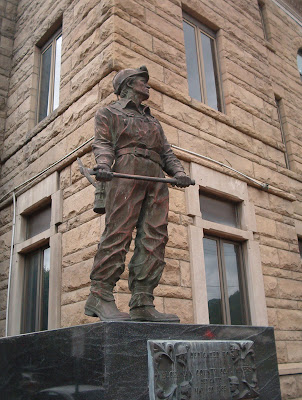
That's pretty cool and more appropriate to this area of Virginia.
Of course there were monuments to the county's war dead, including Vietnam, Korea, WWII, WWI, and the War of Northern Aggression. Inside there were the required pictures of important people from times gone by (most courts have these). However, there were also mounted animals.

 The deer has a placard introducing him as "Moe" and explaining that he was taken from a poacher. No explanation for the predator.
The coolest thing in the courthouse was something I couldn't take a picture of. In the Circuit Court there is a stained glass window of Lady Justice behind and above the judge. However, I just didn't have the nerve to pull my camera out and snap a photo while court was in session.
Most of the courthouses I've seen in Virginia have the ubiquitous Confederate soldier somewhere on the grounds. Not this one; here they have a coal miner.

That's pretty cool and more appropriate to this area of Virginia.
Of course there were monuments to the county's war dead, including Vietnam, Korea, WWII, WWI, and the War of Northern Aggression. Inside there were the required pictures of important people from times gone by (most courts have these). However, there were also mounted animals.

 The deer has a placard introducing him as "Moe" and explaining that he was taken from a poacher. No explanation for the predator.
The coolest thing in the courthouse was something I couldn't take a picture of. In the Circuit Court there is a stained glass window of Lady Justice behind and above the judge. However, I just didn't have the nerve to pull my camera out and snap a photo while court was in session.
27 May 2008
Was the Officer Wrong?
From Fight 'Em 'Til We Can't:
Next I watched this from the Billings Gazette. Nope, the initial attack was completed and the attacker was moving forward when the officer shot at him/his car. This video, which is much better quality, goes forward and shows the attacker getting tazered twice as well.
This, ladies and gentlemen, was a justified use of a firearm. I don't know why people cannot get it through their collective heads that a car can be every bit as effective a weapon as a firearm. Yeah, the offender claims he put it in reverse accidentally. However, we've all done that and you stomp on the brakes and stop the car after a few feet; you don't accelerate to contact. The offender just threw a couple thousand pounds of metal at the officer - that's an aggressive, life-threatening act. The officer has no idea if the offender is going to jump out with a firearm or pull forward and then ram him again. He is justified in reacting in a manner meant to preserve his own life.
BTW: As most of you know, I am dubious about the use of tazers. Not this time. The officer was alone and had a man on the ground who had already put the officer's life at risk - he'd demonstrated his dangerousness. The man started to get up. He's lucky the officer had switched to the tazer, because he still represented a clear and present danger to an officer who could have seen any action as a possible further attack.
It was an appropriate response. And the officer even scaled down his reaction as the event progressed. I'd say he handled the situation as well as anyone could be expected to.
The Billings media is all abuzz about a nearby small town cop who arrested someone for misdemeanor DUI and negligent endangerment after the cop shot at the guy through the windshield of his own patrol car. Yeah.So, I figure I'm off to watch a rookie officer make some major error in judgement. By sheer chance, I watched the complete version found on KTVQ's site on the upper right. The officer is following someone and lights him up. The car being stopped pulls into an alley. The officer stops his vehicle back some from the stopped car (I'd guess 20 feet). As soon as the officer stops his vehicle the car in front of him accelerates back into him, smashing into the police vehicle. Then it starts to take off again and, after going 100 feet or so, stops and pulls into a parking spot. The officer jumps out of his car and yells something about shots fired and things progress from there. However, I can't tell when the shots were fired. Maybe the reason there's been such a problem is that the shots were fired before the car moved?
Next I watched this from the Billings Gazette. Nope, the initial attack was completed and the attacker was moving forward when the officer shot at him/his car. This video, which is much better quality, goes forward and shows the attacker getting tazered twice as well.
This, ladies and gentlemen, was a justified use of a firearm. I don't know why people cannot get it through their collective heads that a car can be every bit as effective a weapon as a firearm. Yeah, the offender claims he put it in reverse accidentally. However, we've all done that and you stomp on the brakes and stop the car after a few feet; you don't accelerate to contact. The offender just threw a couple thousand pounds of metal at the officer - that's an aggressive, life-threatening act. The officer has no idea if the offender is going to jump out with a firearm or pull forward and then ram him again. He is justified in reacting in a manner meant to preserve his own life.
BTW: As most of you know, I am dubious about the use of tazers. Not this time. The officer was alone and had a man on the ground who had already put the officer's life at risk - he'd demonstrated his dangerousness. The man started to get up. He's lucky the officer had switched to the tazer, because he still represented a clear and present danger to an officer who could have seen any action as a possible further attack.
It was an appropriate response. And the officer even scaled down his reaction as the event progressed. I'd say he handled the situation as well as anyone could be expected to.
Subscribe to:
Posts (Atom)